


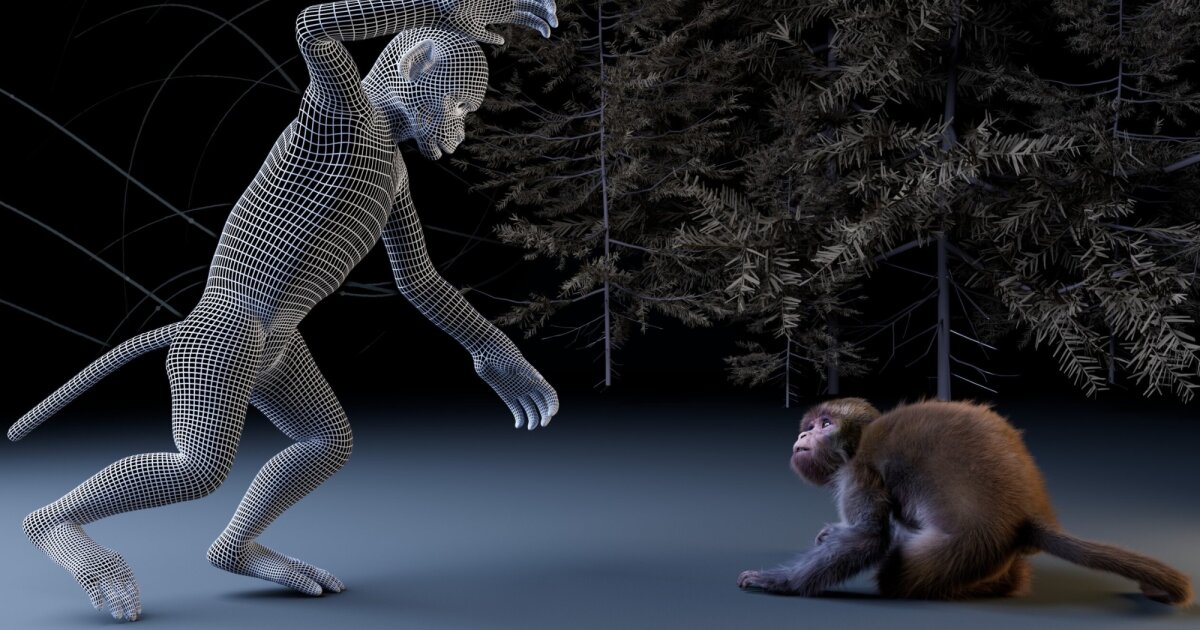
On the road to constructing flawless simulations of human faces, there’s a zone where things get … weird. Too realistic to be a caricature or cartoon, too fake to be the real deal, these middle-ground representations trigger responses of discomfort in many who encounter them.
It seems we may not be the only ones to experience what has come to be called an “uncanny valley” – rhesus macaques (Macaca mulatta) also treat semi-realistic avatars of themselves with no small amount of suspicion.
A small team of researchers from the University Clinic Tübingen in Germany and KU Leuven in Belgium set out to test whether modern digital technology was up to the task of making a dynamic 3D monkey model that was accurate enough to fool a real one. The results have now been published in the journal PLOS Biology.
Studying communication between primates typically relies on chance observations of individuals within groups as they interact naturally. Manipulating a key “actor” could provide researchers with a tool to better tease apart cause and effect, though short of training a simian to follow a script of facial expressions and movements, options have been limited.
At least, they were. Computer-generated imagery (CGI) is now capable of creating human faces and bodies that are virtually indistinguishable from a video of a real person.
Making a realistic animal using CGI has a few obstacles, from collecting sufficient tracking data to computing the movement of hair to be accurate. So University Clinic Tübingen neuroscientists Lucas M. Martini and Martin A. Giese led a team in developing their own realistic macaque avatar – MacAction – based on their own tracking data applied to a commercially available model.
Putting MacAction to the test with real macaques, the researchers displayed their CGI actor in front of an audience of eight macaques in a natural environment, along with videos of a real macaque.
The viewers fixated on one video as much as they did the other, suggesting sim-monkey was a success.
So what does one do with a fake monkey that passes for a real one? Martini and Giese decided to see how far they could take their simulation before things got a little uncanny.
A little more than half a century ago, a Japanese roboticist named Masahiro Mori coined the term Uncanny Valley to describe faces and models that were close enough to realistic to trigger recognition, without being convincing.
We’ve all seen them. Robots with rubbery grimaces. Morphing monsters with hollow eyes. Something in our primal brain no longer finds them cute or symbolic, driving us to put distance between us and the weirdness.
For their experiment, the team slowly adjusted their MacAction model from realistic to bare bones.
Martini, et al., PLOS Biology, 2026
“Starting from the unmodified highly realistic avatar, we first removed the fur, then color and texture, and for the most unrealistic version, we presented a white wireframe texture, removing shadows and depth cues of the surface structure,” the researchers write in their peer-reviewed study, published in PLOS Biology.
Putting these trimmed-down models through the same testing process, the team found evidence supporting their hypothesis that the macaques also experienced discomfort around the intermediate MacAction model.
Given how similar human and macaque responses are to simulations that fall short of realistic, we can be confident in assuming our own social perceptual processes apply to other primates. Which is just uncanny.
This research was published in PLOS Biology.
Fact-checked by Bronwyn Thompson

