


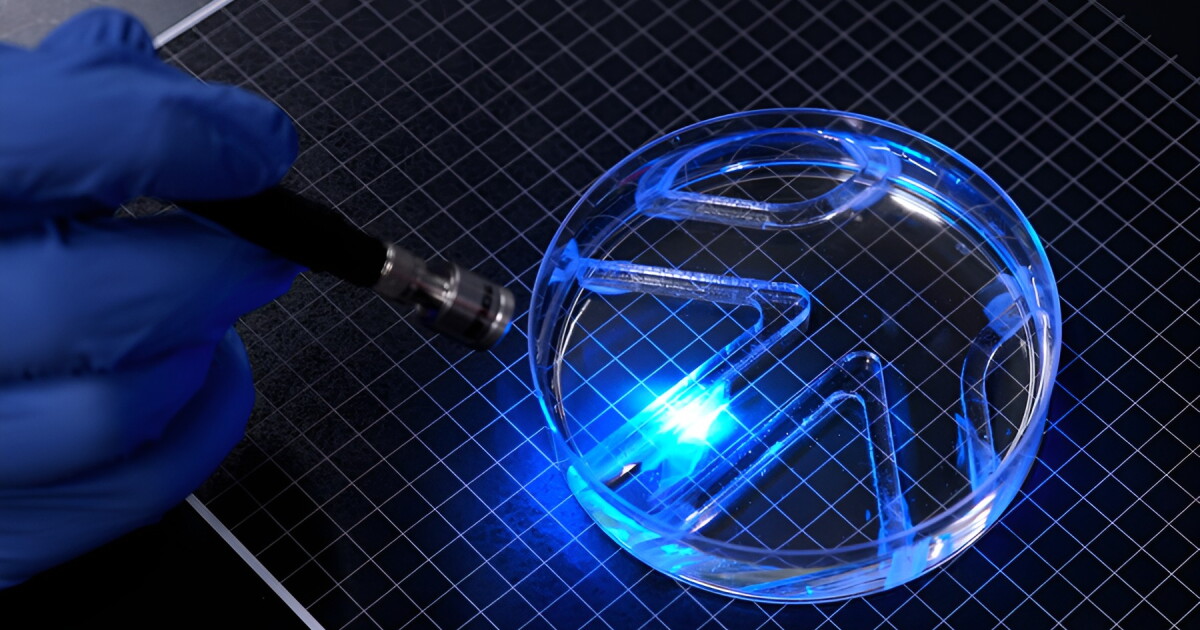
An MIT robot powered by a single layer of living muscle cells swam through a watery maze, following a light held in a researcher’s hand. It is slow, tiny and nowhere near ready for the open ocean, but its thin design could point toward softer, cheaper swimming machines.
The robot is about the size of a stick of chewing gum, with muscle cells attached to a flexible gel. The cells are genetically engineered to contract when light hits them. So if you shine a beam on one of its two fins, it beats. Alternate the light between them, and the robot turns as well as moves forward without the need for onboard electronics, so all the steering happens from outside the dish.
The fins measure 15 mm (0.59 in) long, 7 mm (0.28 in) wide and 0.5 mm (0.02 in) thick. “It takes a lot of force to move through water versus air,” says study author Ritu Raman, associate professor of mechanical engineering at MIT. “The robot’s quite strong, given its size.”
In the team’s earlier design, the very soft fibrin gel tended to wrinkle as the muscle cells pulled against it. The researchers switched to a stiffer gelatin-based gel and stamped square-bottomed grooves into its surface. Those grooves encouraged the cells to line up and fuse into fibers that could pull together more effectively.
Melanie Gonick, MIT
The team also gave the muscle a workout, stimulating it with light for 15 minutes a day at two pulses per second. Compared with an unstimulated control group, that routine increased fin displacement fourfold. The muscle also kept working without being anchored for more than 30 days.
At its fastest, the robot traveled about four body lengths per minute. In the reported test, it moved and turned through a simple maze in a large Petri dish while a researcher guided it with a handheld light. That is a neat demonstration of control, though the robot still depends on someone outside the dish to steer it.
Light-controlled, muscle-powered swimming robots aren’t a new thing. Earlier biohybrid swimmers, machines that combine living tissue with engineered parts, have used living cells to move and change direction. That includes a robotic ray driven by light-sensitive rat heart cells in 2016 and a fish robot with human heart cells that swam on its own in 2022.
This year, Chinese researchers unveiled a robotic manta ray powered by muscle taken from a frog and steered with light. Another 2026 design, OstraBot, is driven by trained skeletal muscle and reached 15.6 body lengths per minute, about four times the MIT robot’s speed. MIT’s contribution is the thin, single-layer construction. Its researchers say the design could need fewer cells than the thicker muscle blocks used in other biohybrid robots. That thinner, less bulky design could be cheaper to build and could move more efficiently.
The next challenge is to make that construction do more. The team notes that this version uses one cell line, muscle fibers aligned in one direction and simple shapes. More complex layouts might eventually produce stronger swimming or other movements.
“Currently, biohybrid robots from our group and others’ are built from bulky, 3D chunks of lab-grown skeletal muscle that require millions of cells to fabricate,” says Raman. “We believe that biohybrid robots powered by living muscle could one day perform delicate jobs like exploring environments too fragile or unpredictable for conventional hardware, because living tissue is soft, responsive to its surroundings, and can heal itself.”
Source: MIT

