


For years, American roads have been dominated by the sport utility vehicle. From mid-size crossovers to gargantuan three-row haulers, the high-riding faux rugged minibus has become the default setting for families.
Yet across the Atlantic, a retro resistance movement is gathering strength. The latest offensive comes from Rüsselsheim, Germany, where the Stellantis-owned Opel brand has pulled the sheet off a intriguing glimpse into a possible future.
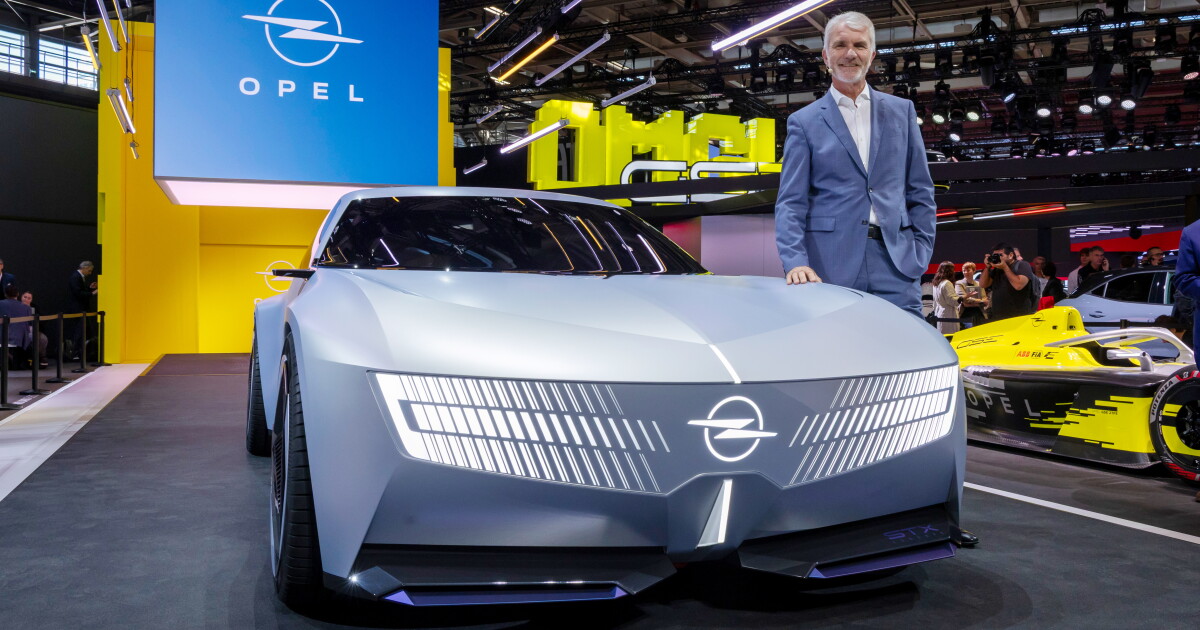
Revealed for the first time at this month’s Paris Motor Show, the Opel Sports Tourer eXperimental, or STX Concept, is a lesson in why the traditional station wagon is not just surviving into the electric age – it might actually be a superior tool for the job.
Opel/Stellantis
The grand unveiling by Opel Chief Executive Florian Huettl, introduced the concept not as a design fantasy but as a deliberate evolution from previous efforts like the Opel GT X Experimental, which borrowed more from the compact SUV craze. With the STX, however, Opel is looking back to the old school European station wagon, or ‘estate car’ as the locals say, with a heritage dating back to the 1953 Olympia Rekord Caravan. It was the first German factory-built station wagon and came at a time when the company was owned by America’s General Motors.
Even 64 years later Opel was still refining the long-roof formula for global audiences with versions like the sleek Opel Insignia Sports Tourer. The STX honors both ends of that lineage, rejecting the taller styling cues of modern crossovers.
The STX is evidently part of Opel’s new ‘Bold and Pure’ design philosophy. Whatever that means, the front fascia is given an evolved version of the old signature Opel Vizor, but now reimagined as a sweeping high-tech glass panel. Slanted vertical light animations frame an illuminated lightning bolt emblem.

Opel/Stellantis
The bodywork is ultra-modern too, as if it were carved from a single piece of metal. The cabin has an unusual truncated tail and a jagged C-pillar treatment where metal alternates with illuminated glass strips.
The STX is trying to demonstrate that in the EV era, aerodynamic efficiency is vital. Taller SUVs require bigger heavy battery packs to drive through the air but a low-slung wagon glides with less resistance. To maximize this advantage, Opel equips the STX with intelligent active aerodynamics. At highway speeds, active side bumpers adjust and two rear diffuser fins extend automatically. These drastically reduce low-pressure turbulence behind the massive 22-inch alloy wheels and keeping the wagon glued to the tarmac.
No technical details were provided but industry outsiders looked at the planned new Astra EV on the same Stellantis stand and speculated some impressive performance stats. The dual-motor, all-wheel-drive powertrain could be capable of rocketing the long-roof station wagon from 0-60 mph (96.5 km/h) in between 2 and 3 seconds with a top speed over 124 mph (200 km/h) and a range of around 400 miles (645 km). In a bulky crossover those stats would require a gargantuan battery, but the STX’s lithe profile should let it get away with far less electric grunt. This long-roof layout could become a genuine performance weapon.

Opel/Stellantis
GM walked away from Opel in 2017 and American buyers rarely get a taste of modern Opel products, but the STX has significance for the broader global market. As part of the sprawling Stellantis empire, the technology and design language will filter through to more global products.
We’ve reported how premium German rivals are already testing the waters with heavy-hitters like the Audi A6 Avant e-tron, Opel’s vision aims to bring that elite aesthetic down to a normal family car, albeit one that can offer massive interior cargo volume, sensational acceleration and a low center of gravity without sacrificing range. The STX shows that the wagon might not be something from the past – it could be the smartest shape for the electric future.
Source: Stellantis

