


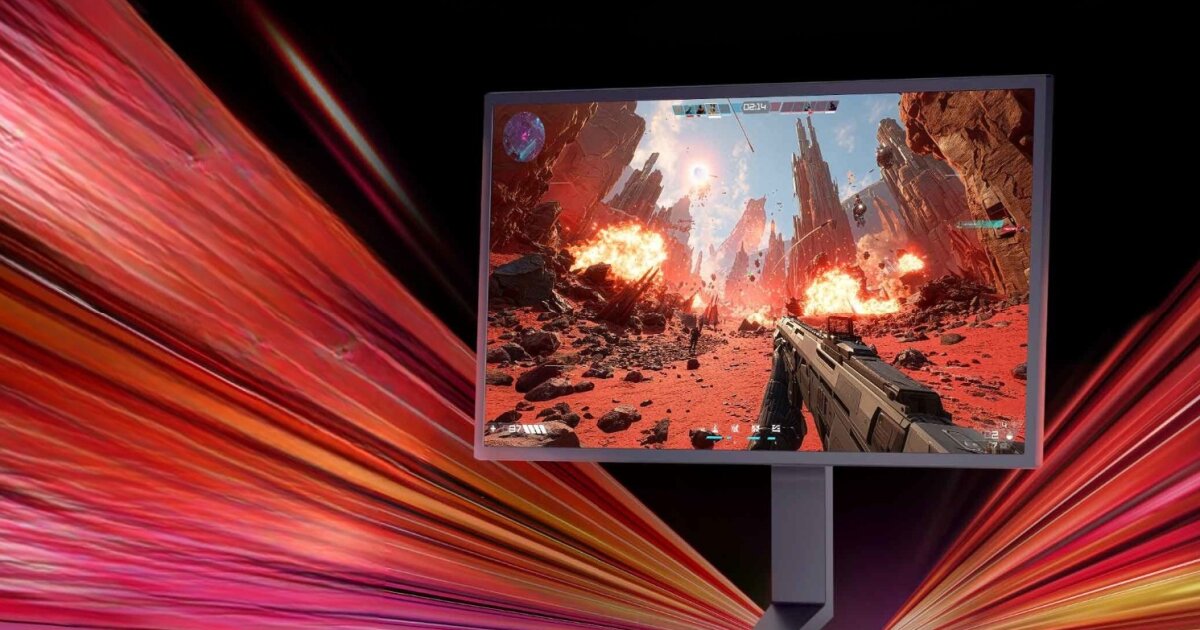
Gaming monitor refresh rates have been steadily climbing over the years: from 144 Hz to 240 Hz, 360 Hz, and beyond, with each jump promising a slight visual feedback edge for competitive players.
The UltraGear 25G590B pushes this ascent into new territory, with the company calling it the world’s first native 1,000-Hz Full HD gaming monitor. And from what we can tell, this claim seems to be true: the Acer Predator XB273U F6 did break the 1000-Hz barrier earlier this year, but only for a downsized 1,280 x 720 resolution.
Unlike broader showcases, such as its recent 5K UltraGear GM9, this model is built with a much more specific purpose in mind. Its 24.5-inch 1080p panel, its lightning-fast native refresh rate, and FPS-focused design make it less about high-quality cinematic immersion, and more about speed, consistency, and reducing every little bit of response time for e-sports play.
In theory, a screen that can refresh up to 1,000 times per second reduces visual delay and makes fast motion easier to read. In FPS games, this can help players track fast movements, spot enemies and identify their positions sooner, and maintain better aim during rapid lateral shifts.
For most casual gamers, this sounds a bit over the top – and in many cases, it probably is. To the untrained eye, the difference between 240 Hz and 1,000 Hz is barely noticeable. The people who stand to gain the most from this record-setting refresh rate are high-level competitors with PCs that can push extremely high frame rates, for whom shaving down the smallest fractions of latency can make a real difference.
LG
LG is also emphasizing that 1,000 Hz is available at the monitor’s default Full HD resolution: a distinction that sets it apart from other ultra-high refresh gaming monitors. At 1080p, it’s easier to achieve extreme frame rates, and keeps things readable; this resolution remains the standard in e-sports today.
The inclusion of Motion Blur Reduction Pro is intended to sharpen fast-moving objects and reduce blur during rapid movements. Overall, every decision the company has made for this panel prioritizes consistency, motion clarity, and visual confirmation over pixel density.
The 25G590B’s 24.5-inch display size is very much a deliberate choice. It’s also a format widely used in e-sports because you can see the entire screen in your natural field of view, without needing to excessively move your eyes – or worse, turn your head. The compact stand means that there’s more room for mouse movement, and the height, swivel, and tilt adjustability help fine-tune positioning. The panel also comes with calibration markers, making it easier to replicate your preferred setup wherever you are.
LG is adding a few AI-assisted extras, too, including AI Scene Optimization for genre-based picture adjustment, and AI Sound for spatial audio and clearer in-game comms with compatible headsets. Certainly useful additions, but at the same time, secondary to the monitor’s core mission.
The UltraGear 25G590B is expected to launch in select markets in the second half of 2026, with additional regions following soon afterward. It sits firmly in specialist territory, somewhere between e-sports hardware and enthusiast gaming gear. For most players, this piece of kit is likely overkill. But for competitors trying to gain any edge they can, this could be exactly the kind of excess that makes sense.
“This is a defining moment for gaming monitors,” said Lee Choong-hwoan, head of the Display Business at the LG Media Entertainment Solution Company. “By delivering the world’s first native 1000-Hz FHD gaming monitor, LG has established a new performance benchmark for competitive gaming.”
Full specs will likely be revealed ahead of availability, along with pricing.
Source: LG UltraGear

