


Drones have been a part of our lives for years now, and many industries are hard to imagine without them. They monitor crops, inspect forests and bridges, help with search-and-rescue missions, and are widely used in military operations. But no matter how advanced they become, they all share the same weakness: battery life. In many situations, landing a drone to replace a battery can be too dangerous or simply impossible.
For drones that need to stay in the air for hours, being able to charge them from the ground could be a game changer. While wireless phone charging doesn’t surprise anyone anymore, sending power through the air to a moving drone is definitely a much bigger engineering challenge.
Laser-powered wireless charging for drones isn’t exactly a new concept, though. Three years ago, we covered a technology that allowed a quadcopter drone to stay in the air indefinitely by receiving power from a laser beam. That study proved that the concept was possible, but the prototype had some serious limitations, mainly efficiency-related.
Northwestern Polytechnical University / China Daily
Earlier this year, another research team took a big step toward real-world use by improving the laser power-beaming system. The scientists managed to solve a few key challenges, including transmitting laser power over long distances and high altitudes, and precisely tracking a moving fixed-wing drone.
Now, researchers at the Civil Aviation University of China have focused on one of the last remaining limitations: the efficiency of the drone’s receiver.
The lightweight receiver combines a perovskite laser cell with a thermoelectric device. In simple terms, the perovskite laser cell works much like a solar panel, but instead of converting sunlight into electricity, it’s designed to harvest energy from a laser beam. The thermoelectric device also generates electricity, but from heat. The larger the temperature difference between its hot side and its cool side, the more electricity it can produce.
The challenge is that the laser may heat the receiver to temperatures as high as 80-90 °C (176-194 °F), which affects charging efficiency and can eventually damage the drone. To solve this problem, the researchers added nanocrystals to the receiver. They basically act as a thermal barrier. Because nanocrystals don’t conduct heat very well, they slow down the flow of heat through the device.
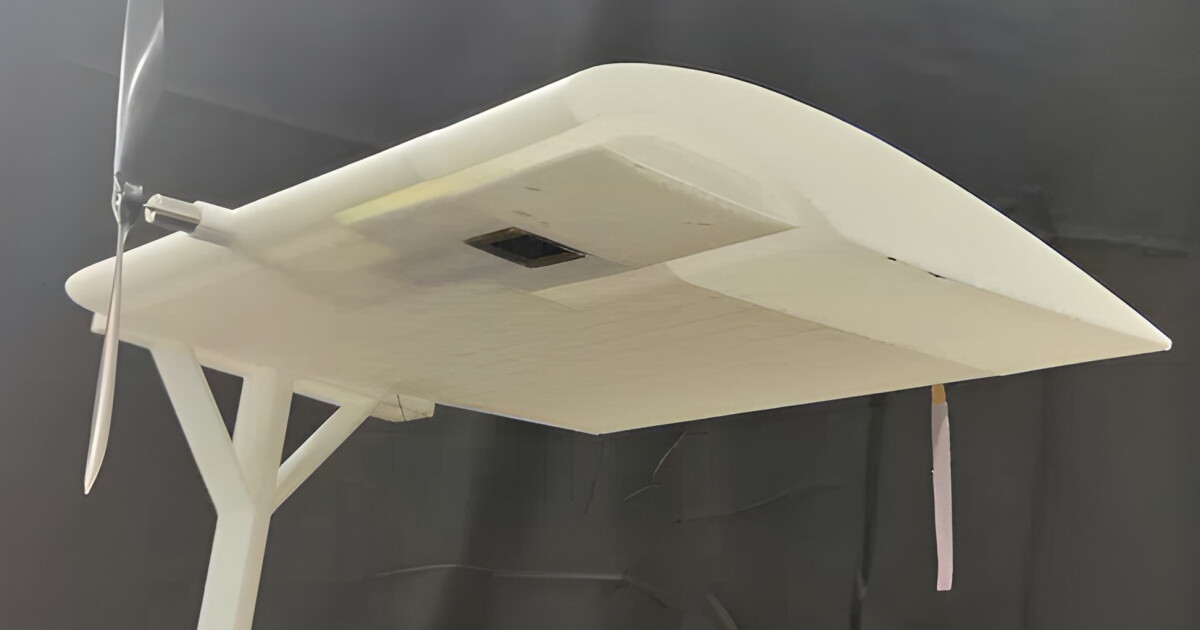
The researchers placed the receiver beneath the wing of a stationary drone and carved air channels through the wing to improve cooling even more. When they shone a green laser on the receiver, it generated enough electricity to spin the drone’s propeller, while the airflow from the propeller helped cool the thermoelectric layer. In numbers, the receiver converted 38.49% of the incoming laser energy into electricity, which is a pretty impressive result for this type of system.
The next step is to test the technology outdoors, in flight, under real-world conditions. There are still quite a few challenges to overcome before laser-powered charging becomes practical, but this study is definitely a huge step forward.
A paper on the study was recently published in the journal Matter & Light.
Source: Cell Press via EurekAlert

