


Robots – that is, self-guided mechanisms interacting with or changing their environments – exist in the popular imagination as large, blocky, metallic beings like R2D2 or TARS from Interstellar. But the field of soft robotics offers a vast array of robotic limbs, sensors, and body types that greatly expand our understanding of what shapes a robot can manifest and what tasks it can perform.
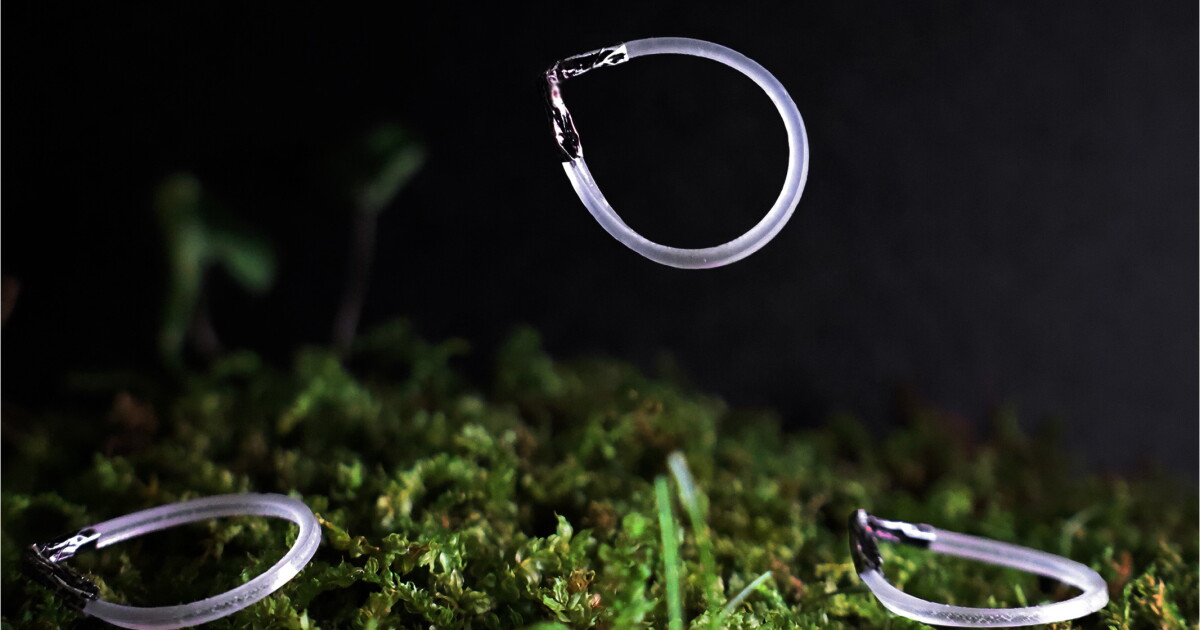
Enter the bent-hoop, non-electronic robot that looks like an earring and acts like a sprite in a video game, jumping forever as powered by infrared light.
In a paper recently published in Proceedings of the National Academy of Sciences, PhD students Caizhi Zhou and Haoze Sun, PhD graduates Haitao Qing and Yaoye Hong, along with Prof. Jie Yin and postdoctoral researcher Fangie Qi – all from North Carolina State University – describe their “soft ring jumper.” In crude terms, it moves using the principles that drive an elastic-band balsa wood toy airplane.
“We use torsion to store elastic energy,” says Yin, professor of mechanical and aerospace engineering. By releasing all the stored energy at once, the robot “does not need to be reset between jumps. It resets itself.”
Composed mainly of a liquid crystal elastomer cord, the bent-ring robot incorporates a thin, V-shaped aluminum stopper joining the two ends of the cord. Infrared light contracts the cord, causing it to twist and tighten without rolling or unravelling because of the V-stopper. When the cord reaches maximum stored energy, the aluminum stopper snaps downward, striking ground and driving the leaper forward or upward. While moving, the cord returns to its original shape, ready to power its next leap so long as the infrared light is still shining.
As first author Fangjie Qi explains, the NC State team could “control the nature of the robot’s movement by making minor design changes. If the V at one end of the teardrop is very wide – an angle of 120 degrees – the robot simply crawls forward. If you reduce the angle to 90 degrees, it jumps forward. And if you reduce the angle further to 50 degrees, the robot leaps vertically. In other words, a single geometric parameter determines whether it crawls, jumps forward [three body lengths], or leaps upward” 80 body heights.
The team learned that to make their robots jump further simply required adding a small weight to the ring-side opposite the V-stopper, which as Qi says, “changes the robot’s center of mass and leads to a more powerful and stable forward motion, much like a swimmer leaning forward as they dive off the starting block.”
Until now, repetitive jumping in autonomous soft robots has been a difficult requirement, largely because such an action demands, as the PNAS paper describes, “external resetting, complex control, or spatiotemporal stimulation.” But because the NC State ring-leaper uses infrared photothermal twisting in its tear-drop form, it can jump, land, reset, and jump again continuously while adapting to varying terrain, liquid environments, and obstacles – and all autonomously.
While designers have no current use for their jump-otronic robots, the sheer amount of robotics development for terrestrial and extra-planetary exploration suggests that the photoleapers are a solution that will eventually find their problem. After all, at one point no one knew rubber would have such wide use in vehicles that undeniably changed the world. If combined with a range of low-powered, low-mass microsensors, these robots could autonomously gather useful data over vast and even inaccessible distances.
“There are no immediate applications for this work,” says Yin, “but it’s a fundamental advance that is worth exploring for potential use in environmental navigation, swarm robotics, and unstructured terrain navigation.”
Source: North Carolina State University

