


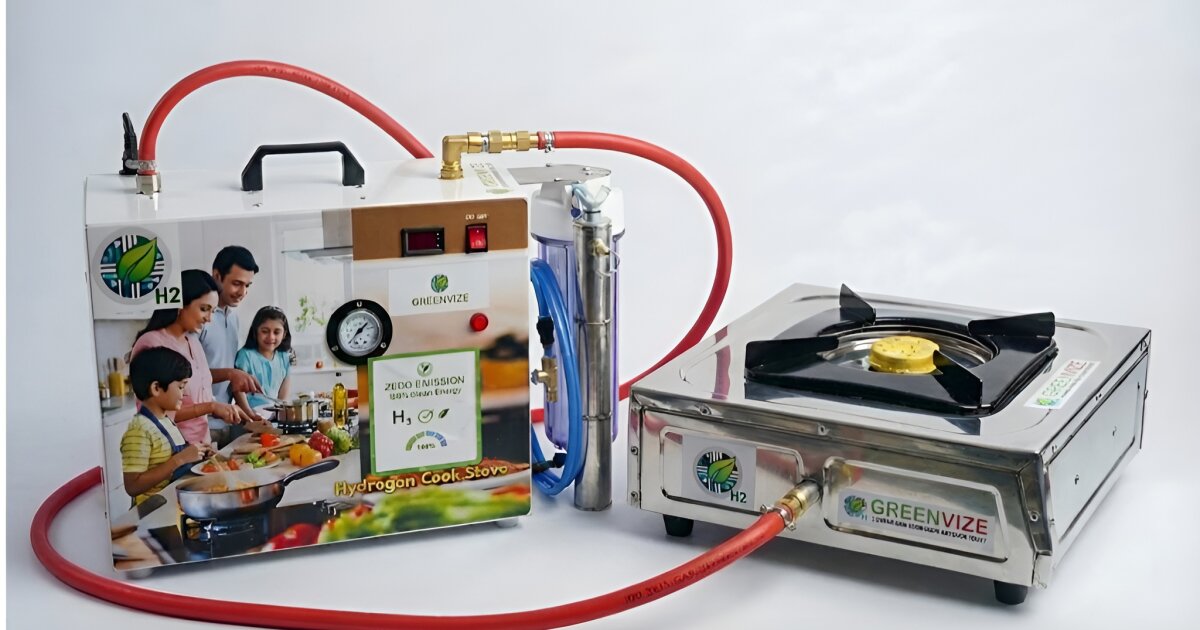
Imagine slashing your cooking electricity bill by a factor of six. That would almost be as wild as cooking with water! Well, a green-tech startup from India called GreenVize says it has made both possible with a hydrogen-based cooking unit that runs on water and a little bit of electricity.
The system utilizes an existing technology known as Proton Exchange Membrane electrolysis to produce hydrogen from water. This technology uses electricity to split water (H₂O) into high-purity hydrogen (H₂) and oxygen (O). A solid polymer electrolyte allows protons to pass through while separating the gases.
Hydrogen is collected and stored for various applications, while the oxygen is simply vented into the atmosphere. The startup’s system makes the hydrogen immediately available as fuel, eliminating the need for storage. As the hydrogen burns, it interacts with oxygen in the air, creating harmless water vapor as a byproduct.
According to GreenVize, its plug-and-play system requires around 100 milliliters (3.38 oz) of distilled or reverse-osmosis water and approximately 1 kWh of electricity to deliver up to six hours of continuous cooking. By comparison, standard induction cookers are rated 1.5 to 2 kW. This means that for the same six hours of cooking, they consume 9-12 kWh.
“While both induction stoves and the GreenVize hydrogen cooking system use electricity, the efficiency, flexibility, and real-world usability are fundamentally different, especially for hotels, community kitchens, and high-demand cooking environments,” said Sanjeev Choudhary, founder of GreenVize Energy Solutions, as reported by pv magazine.
Another beneficial feature of the system is the elimination of the requirement for storage, as it generates the hydrogen on demand. However, users also have the option of storage.
“In its standard configuration, the electrolyzer is directly coupled with the cooking unit, with hydrogen generated and consumed in real time, eliminating the need for storage. However, the system can also be configured with hydrogen storage, allowing production during off-peak hours or periods of solar generation and subsequent use during peak demand,” said Sanjeev.
The product is priced at 105,000 Indian Rupees (about US$1,130) for a single-burner stove, and 150,000 Indian Rupees (US$1,610) for a double-burner stove.
So, should you rip out your induction cooking systems? After all, 1 kWh of electricity for six hours of cooking is simply a steal, plus there’s “free oxygen” being released into the environment.
Well, hold your horses! It’s time for some good ol’ energy mathematics.
First of all, PEM electrolyzers are about 65-75% efficient. Since energy can neither be created nor destroyed, that already limits how much usable energy you can get out. After accounting for both electrolysis and combustion losses, you are realistically left with around 0.5 to 0.6 kWh of actual heat from 1 kWh of electricity.
Now, as per the company’s “six hours of cooking” claims, 0.5 to 0.6 kWh amounts to a max power rating of 100 W per burner. This is extremely low. In comparison, most induction burners operate between 1,500 and 2,000 W, with higher power in some settings. A 100-W burner would take well over one hour to boil one quart (0.95 L) of water. For context, it would take its 2,000-W counterpart four minutes max.
So, yes, the “1 kWh for six hours’ worth of cooking” claim is technically possible, but the flame would have to be really, really low. That meal that takes 30 minutes to cook on your standard induction burner? Get ready to wait at least 7.5 hours.
Regardless, it is quite an interesting technology with the potential for cleaner cooking.
Source: GreenVise via pv magazine

