


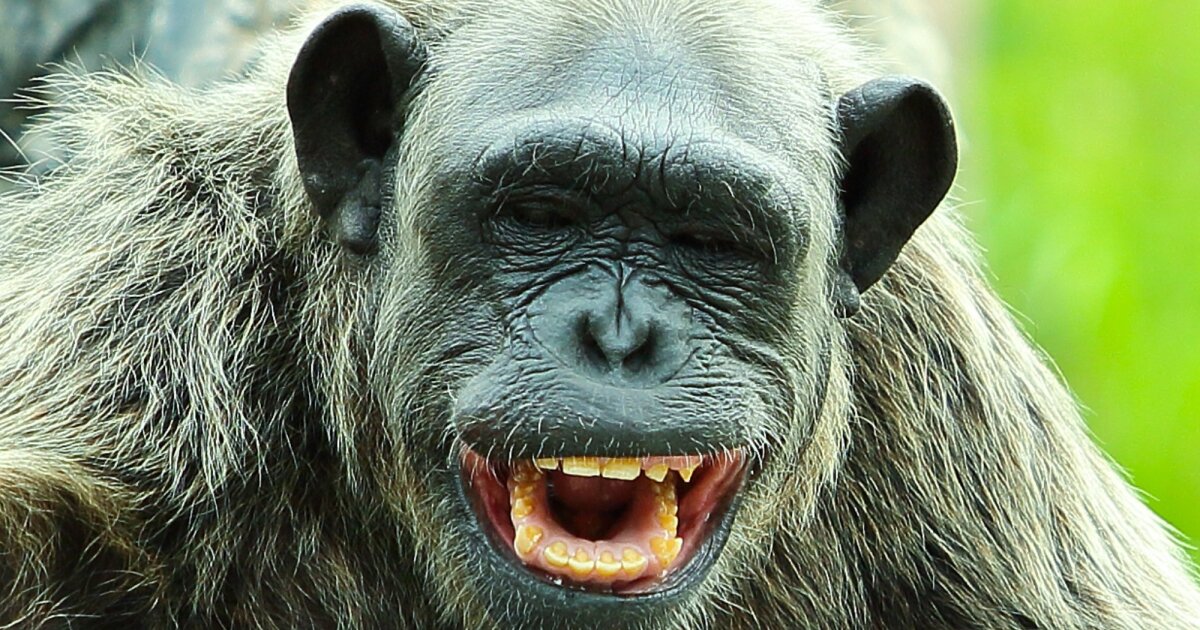
Did you hear the one about the chuckling chimpanzee?
Sorry, there’s no punch line. But it is a fascinating story about the evolution of not just laughter among great apes, but of the origins of our own vocal prowess.
University of Warwick psychologists Chiara De Gregorio and Adriano R. Lameira, together with Marina Davila-Ross from the University of Portsmouth in the UK, compared the laughter of all great apes, finding a steady shift in the speed, variation, and context of our most mirthful vocalizations.
All great apes exchange calls of some sort, whether it’s an orangutan’s hoot, a bonobo’s chatter, a gorilla’s grunt, or a human sonnet. Yet one sound remains recognizable across all extant hominid species – the sound we make when we’re happy.
Laughter is a noise apes like ourselves make when we’re engaged in play. It facilitates social coordination, making peace with a ho-ho-ho and a he-he-he.
But why we all laugh as we do is something of a mystery. At some point in our shared evolutionary history, our ancestors must have developed this odd form of communication out of necessity.
“Sound does not fossilize,” De Gregorio, Lameira, and Davila-Ross write in their recently published report, “making it difficult to trace the vocal origins of song, speech, and language.”
While the behavior of laughter is conserved across our branch of the simian tree, there are clear differences in how it manifests between species. Yet previous studies have focused primarily on just a few ape species, and even then, only under limited contexts.
So the researchers recorded episodes of laughter from three bonobos (Pan paniscus), four chimpanzees (Pan troglodytes), four orangutans (Pongo pygmaeus), two gorillas (Gorilla gorilla), and four humans (Homo sapiens), all aged between six months and seven years.
They then applied statistical modelling to features of the laughter, such as its tempo and rhythm, to gauge variability in the sequences.
The similarities between all forms of great ape laughter suggest we’ve been sharing a chuckle or two for at least 15 million years.
Yet the context of how we laugh reveals an evolution of the laugh researchers had never homed in on. Tickle laughter was highly regular, they found, while laughing while playing exhibited significant deviation.
The team’s findings supported previous conclusions that found the rhythm of laughter sped up as we drifted apart, with humans literally getting the last laugh.
“Indeed, when breaking down laughter tempo by species, only humans modulated laughter tempo according to context, producing faster laughter during tickling than during play,” the researchers note. “Context-sensitive modulation was absent in great apes.”
It’s likely that the anatomical and neurological shifts that facilitated the emergence of complex language and communication in humans also supported the variation in how we laugh, establishing a new way to examine the evolution of speech.
Humor evolved as a method of uniting social groups against weird, incongruent, or imposing situations. We collectively bare our teeth, make chortling sounds, and leak feel-good hormones from our brains to help us deal with threats as a team.
It stands to reason that the roots of laughter lie deep in our evolutionary past, shared with the same joyful sounds our cousins make as we connect in play.
This research was published in Communications Biology.
Source: University of Warwick
Fact-checked by XXXX

