


Transformation leaders judge idea and challenge management software on one thing above all: whether people keep using it. That comes down to how fast employees can submit, how much work each idea creates for reviewers, how quickly contributors hear back, and whether results can be traced to value. The eight checks below show what to test in a trial and what good looks like.
Most idea programs stall months after launch, when reviewers fall behind and contributors stop hearing back. Usability decides which way it goes, and a short, structured trial shows it far better than a feature list.
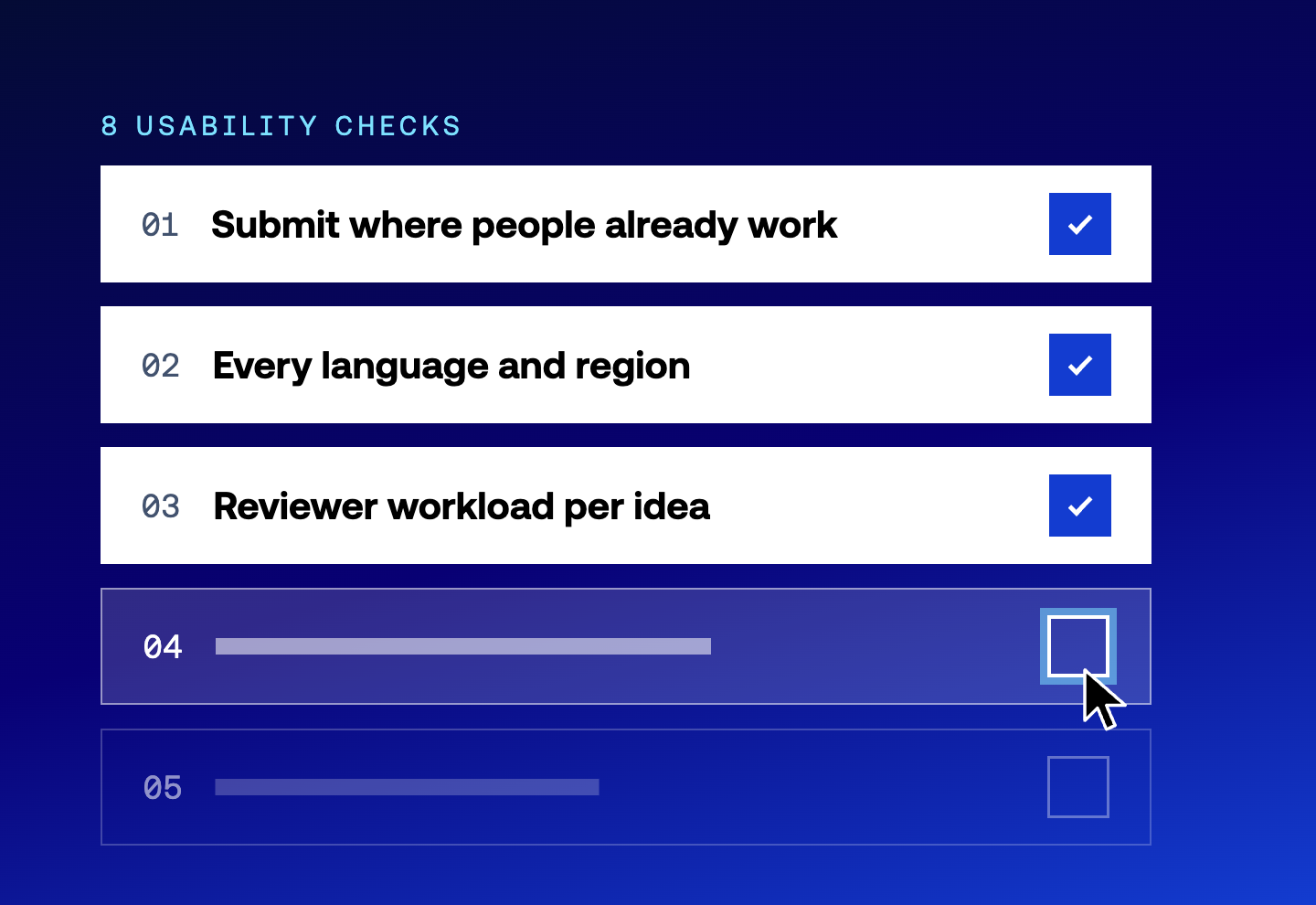
The 8 checks at a glance
- Can people submit an idea from where they already work?
- Does it work in every language and region you run?
- How much work does each idea create for reviewers?
- How fast do contributors hear back?
- Can your program manager launch a challenge without IT?
- Does the crowd provide idea feedback, or only submit them?
- Can you follow one idea from submission to measured value?
- What do people who run it every day say about ease of use?
1. Can people submit an idea from where they already work?
Every extra login or new tool costs participation, especially among frontline staff. The best test is simple: ask three employees in different roles to submit a real idea from Microsoft Teams and from a phone, and watch where they hesitate.
What good looks like: single sign-on, a short form that asks only what reviewers need, and submission inside the tools people already open every day.
How HYPE handles it: Microsoft Teams where people can jump from a profile straight into a Teams chat, and campaign launches can post to a Teams channel, plus SSO through SAML 2.0, OIDC and OAuth 2.0 (HYPE integrations).
2. Does it work in every language and region you run?
A challenge that runs in English only reaches part of a global workforce. Run your trial in the two hardest languages you need, not the easiest.
What good looks like: the full interface, notifications and evaluation forms in each language, with no workaround for local works council or approval rules.
How HYPE handles it: English and German as standard, and up to 30 interface languages with HYPE’s Internationalization Pack, plus up to 10 of your own and support for works council and local compliance processes in German-speaking markets (HYPE idea management).
3. How much work does each idea create for reviewers?
Reviewer time is where most programs run out of road. Give one reviewer 20 real ideas in the trial and count the minutes per decision.
What good looks like: short summaries, duplicates flagged before review, and each idea routed to the person who can actually decide.
How HYPE handles it: AI summaries, smart categorization, duplicate and similarity detection, and smart routing to the right reviewer, with people keeping the final decision (HYPE idea management).
4. How fast do contributors hear back?
Contributors accept a “no”. Silence is what loses them. Track the days from submission to decision during the trial, and ask how the platform tells people what happened to their idea.
What good looks like: a visible status for every idea, automatic updates to the contributor, and a decision time you can report on.
Proof from a customer: Klauke cut its idea processing time from 30 days to 15 and generates €120,000 in annual cost savings (Klauke case study).
5. Can your programme manager launch a challenge without IT?
Ask the person who will run the program to build a time-boxed challenge, with its own evaluation stages, without help from IT or the vendor.
What good looks like: configuration without code, and staffing you can plan for. As a guide from HYPE’s consulting team (program data from before AI support was added): one consumer goods customer runs about 10 campaigns a year with half a full-time role; one pharmaceutical customer runs about 30 a year with 1.5 full-time roles shared by three people; one chemicals company runs hundreds a year with about 20 people giving a quarter of their time each.
An honest note on HYPE: HYPE is built for program managers that set up and run campaigns themselves; your IT team is only needed to connect other systems , and G2 users rate its ease of setup at 83%, a little under the category average of 86% (G2 Winter 2026 results). Programme design takes some upfront work, which HYPE’s consultants support through the Success Plan (HYPE idea management).
6. Does the crowd provide idea feedback, or only submit them?
Comments are where a weak idea becomes a strong one. In the trial, look at how many comments each idea attracts and how many submissions miss the brief.
What good looks like: HYPE’s consultants see the healthiest programs run at about three comments per idea. A high share of off-topic ideas usually means the brief, tone or channel needs work.
7. Can you follow one idea from submission to measured value?
Pick one idea in the trial and follow it all the way: submission, evaluation, implementation, and the value reported at the end. If you cannot trace one idea, you will not be able to report on a thousand.
What good looks like: status, owner and value recorded on the idea itself, and dashboards that roll up to the program.
Proof from customers: Ricoh NZ has collected 5,000+ ideas and implemented 3,500+, a 70% implementation rate (Ricoh NZ case study). Liberty Global generated €18M ROI from 16,000 employee ideas (Liberty Global case study).
8. What do people who run it every day say about ease of use?
Demos show the best path. Reviews from administrators and participants show the everyday one. Read reviews filtered to companies your size.
How HYPE scores: in G2’s Winter 2026 reports, users rate HYPE’s ease of use at 98% against a category average of 89%, ease of admin at 92% (88%) and quality of support at 95% (92%), with a Net Promoter Score of 90 against 69 (G2 Winter 2026 results).
Analyst recognition: HYPE was named a Leader in the IDC MarketScape: Worldwide Innovation Management Software 2026 Vendor Assessment (IDC doc #US53010426, August 2026) (press release). HYPE was also named a Leader in the 2025 SPARK Matrix for Innovation Management by QKS Group (announcement), and received the Gartner Peer Insights Customers’ Choice distinction in 2023 (analyst recognition).
How to run a usability trial
-
Pick one real business challenge and a pilot group of employees from two or three locations.
-
Run checks 1 and 2 on day one: submission from Teams and mobile, in your two hardest languages.
-
Give reviewers real ideas and time each decision (check 3).
-
Let your programme manager configure the challenge without help (check 5).
-
At the end, follow one idea end to end and report the days from submission to decision (checks 4 and 7).
Where HYPE fits
HYPE has specialized in idea management and innovation management since 2001. It runs always-on suggestion programs and targeted challenges on one platform, with consultants who help design the program as well as configure the software. If you want to run these eight checks on HYPE, talk to an expert.

