


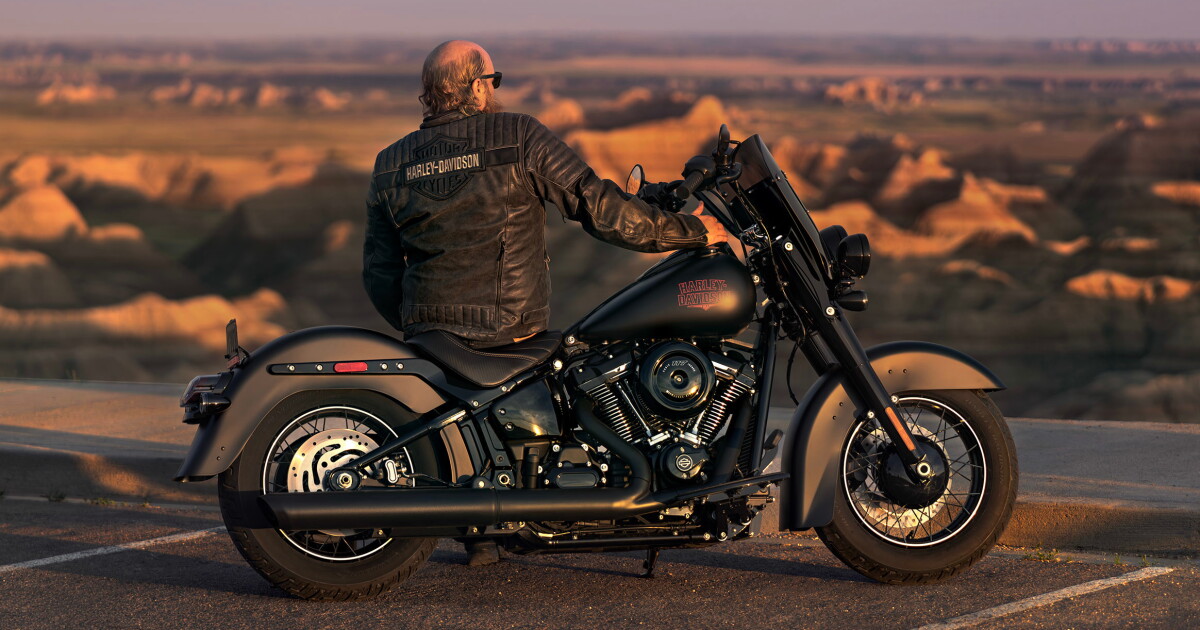
“Stripped back” – moto publications are screaming this term at the top of their lungs for Harley-Davidson’s latest release. And for good reason, too. Technically, it is very much a softail, but scratch the surface, and you’ll find a stripped-back bobber underneath.
Almost every unnecessary component is held back. And what remains is all blacked out, except for the lower rocker covers and pushrod tubes – from the fork covers, the controls, the handlebar, the turn signals, the headlight bucket, the engine, exhaust, and even the rear fender struts.
It’s not just another chrome-heavy cruiser. Instead, it’s a bike that borrows heavily from the custom scene that Harley itself helped develop decades ago: Barebones, lightweight bobbers stripped back from all of the useless decoration in the post-World War II era, focusing mainly on simplicity and performance. This is the all-new Deadwood.
It’s named after an Old West town around Sturgis, which, because of its Gold Rush-era architecture, was designated a National Historic Landmark District. The name alludes to the Rally’s origins, when 400 horsemen visited the towns of Spearfish, Lead, and Deadwood on a tour of the Black Hills region in 1947. Picture that!
Harley-Davidson
Visually, I’d pit it somewhere in between a Street Bob and a Fat Bob. Wire-spoke wheels, a solo seat, chopped mudguards, and a minimalist silhouette that eliminates almost all of the visual bulk you’d typically associate with most modern Harleys.
The Deadwood comes fitted with the 1,917cc Milwaukee Eight 117 Classic engine that’s linked to an Electronic Sequential Port Fuel Injection (ESPFI). Visually, it’s just that part of the motorcycle – the pushrod tubes and lower rocker covers, precisely, that still have a hint of chrome – perhaps to emphasize the V shape of the engine
That’s the same motor you’d find in much of Harley’s big twin range, but it’s been tuned to offer useful low and mid-range shove. The result is 94 hp at 4,600 rpm and 120 lb-ft (163 Nm) of torque at 2,500 rpm.
And to maintain the appearance of a conventional hardtail, the chassis uses Harley’s Softail platform, which conveniently conceals the rear suspension. In reality, that entails a dual-bending valve, 49-mm telescopic fork at the front with aluminum fork triple clamps, dual-rate springs, and beer can covers, with a shortened, hidden, free-piston, coil-over rear monoshock with cam-style preload adjustment at the rear.

Harley-Davidson
Elsewhere, the black tubeless laced wheels are fitted with a single disc at the front gripped by a four-piston fixed caliper and a single disc at the back clamped by a two-piston floating caliper.
But that’s where the minimalist fantasy pretty much ends. There’s a host of electronics on board – from cornering ABS, cornering traction control, drag-torque slip control, and tire pressure monitoring. It doesn’t end there: three riding modes – Road, Sport, and Rain – all electronically modify safety system intervention and throttle response.
This ought to feel like one of the most rider-friendly offerings in HD’s portfolio, all thanks to the rather nifty tuck-and-roll solo seat and the compressed rear suspension, which help keep the seat height at 25.5 inches (647.7 mm), laden. The wheelbase, though, is very similar to the Heritage Classic at 64.2 inches (1,630.6 mm).
A 7-inch headlamp, additional fog lamps, and combo rear lighting are all LED. You get a USB-C port and a 5-inch tank-mounted instrument cluster that combines an analog speedometer with a multipurpose LCD. And get this – Harley has also been generous enough to offer two heated gear linkages beneath the seat, which seems generous for a bike that doesn’t officially come with a passenger seat.

Harley-Davidson
You can catch a glimpse of the new motorcycle at the upcoming Sturgis Rally. But get this: the Deadwood will not be available globally. Harley reveals it is only meant for sale in the US and Canada, at least for now.
Performance-wise, the Deadwood lands squarely in the heart of the American cruiser segment, matching the Indian Chief‘s massive torque while giving away only a handful of horsepower to Harley’s own Low Rider S. But its biggest selling point isn’t outright performance – it’s value.
At US$17,999, Harley has essentially packaged the attitude of a custom bobber with the proven Softail platform, creating one of the more compelling factory-built cruisers in its lineup. But love or hate Harley, you can’t argue that this isn’t a good-looking motorcycle.

Harley-Davidson
Your take?
Source: Harley-Davidson

