


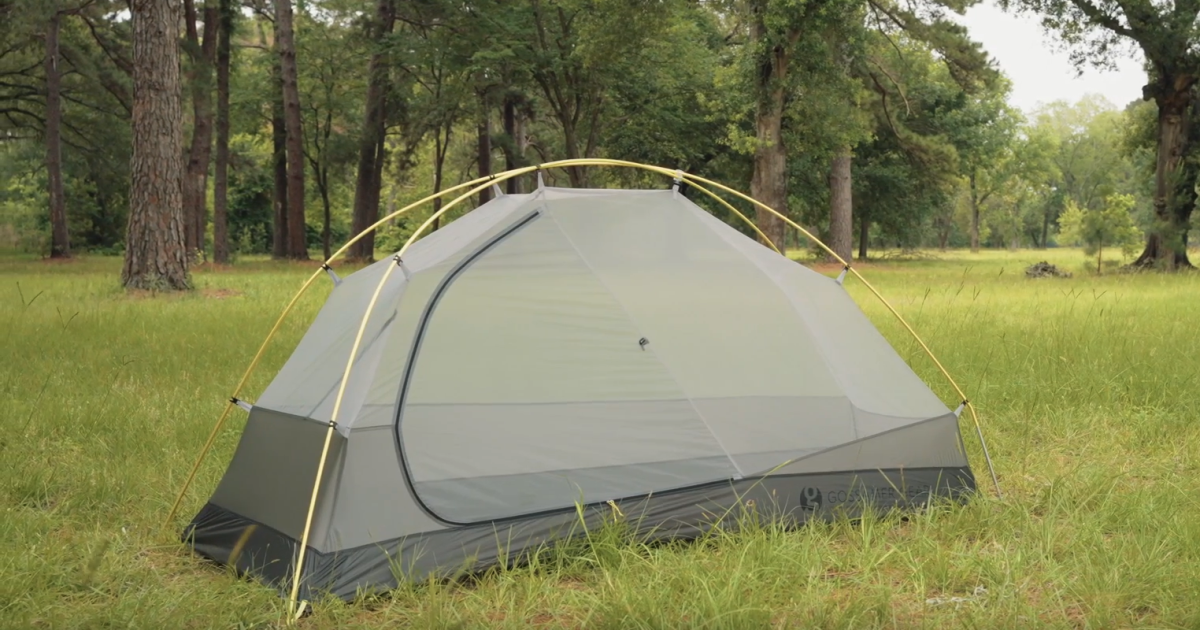
After a 2023 to 2025 stretch that saw seemingly every boutique ultralight backpacking brand jump in on the featherlight freestanding tent trend, the first half of 2026 has been rather quiet. There was the 29-oz (822-g) Hyperlite Crosspeak 1, but beyond that, the heavy, burly expedition tents have stolen the spotlight. But now a new ultralight player shatters the silence with an impressive solo tent that not only drops in right around 2 lb (907 oz) but does it at half the price of some of the competition. And the tent features a complete double-wall design with independent rainfly and full-mesh tent body.
With nearly 30 years’ worth of skin in the backpacking gear game, Austin, Texas-based Gossamer Gear certainly isn’t new to the market at large, but it is new to the freestanding ultralight tent segment. It makes that clear by announcing The Free solo tent as its first freestanding ultralight shelter ever, noting that it’s truly freestanding and doesn’t require a single stake to stand tall. Users can easily lift it up and move it from one pitch to another without having to rebuild anything, even with the fly on.
For those who choose not to carry stakes at all, The Free slides in under 2 lb with a trail weight (tent, poles, fly) of just 29.8 oz (845 g). For those worried the weather might get rowdy enough to require pinning their tent down, the six included stakes add just over 1.5 oz (43 g), keeping the setup right under that 2-lb mark. It’s not until you factor in the pole bag, guy lines, pole repair segment and tent stuff sack that the package pushes just over 2 lb to a total packed weight of 33 oz (936 g).
Gossamer Gear
That’s still extremely light for a freestanding tent, especially a true double-wall model with independent rainfly. Running it against the other ultralight solo standalones we’ve seen over the past few years, it’s just over 4 oz (113 g) heavier than the aforementioned Hyperlite Crosspeak 1 that debuted earlier this year, and that tent is a hybrid single/double-wall tent that costs more than twice as much as The Free.
On the flip side, The Free is about 2 oz (57 g) lighter than Durston’s X-Dome 1+, a sturdy, roomier tent with full double-wall construction of its own. The Free is about 11 oz (312 g) lighter than the Six Moon Designs Lunar Orbiter solo tent, a lightweight hybrid-wall dual-door solo tent at a similar price point.
Long story short, the new Free tent jumps right into the same minimal weight lane as other those other new ultralight freestanding tents, ready to battle it out for backcountry supremacy. But weight, of course, is only one consideration. Comfort is another consideration – and a key factor driving the new wave of freestanding backpacking tents in the first place.

Gossamer Gear
Unsurprisingly, The Free floor area isn’t quite as wide as the one Durston bills as good for one or possibly two people. The Free features a similar tapered design but starts at 34 in (86 cm) wide at the head, slimming to 21.5 in (55 cm) at the foot over an 86-in (218-cm) floor length. The latest X-Dome 1+, on the other hand, tapers from 50 to 29 inches (127 to 74 cm) down an 85-in (216-cm) floor length. The Lunar Orbiter is also 34 in wide at the head but has a rectangular 90-in-long (229-cm) floor with no taper. The Crosspeak 1 meanwhile has a light taper from 32 to 29 in (81 to 74 cm) over an 88-in-long (224-cm) floor.
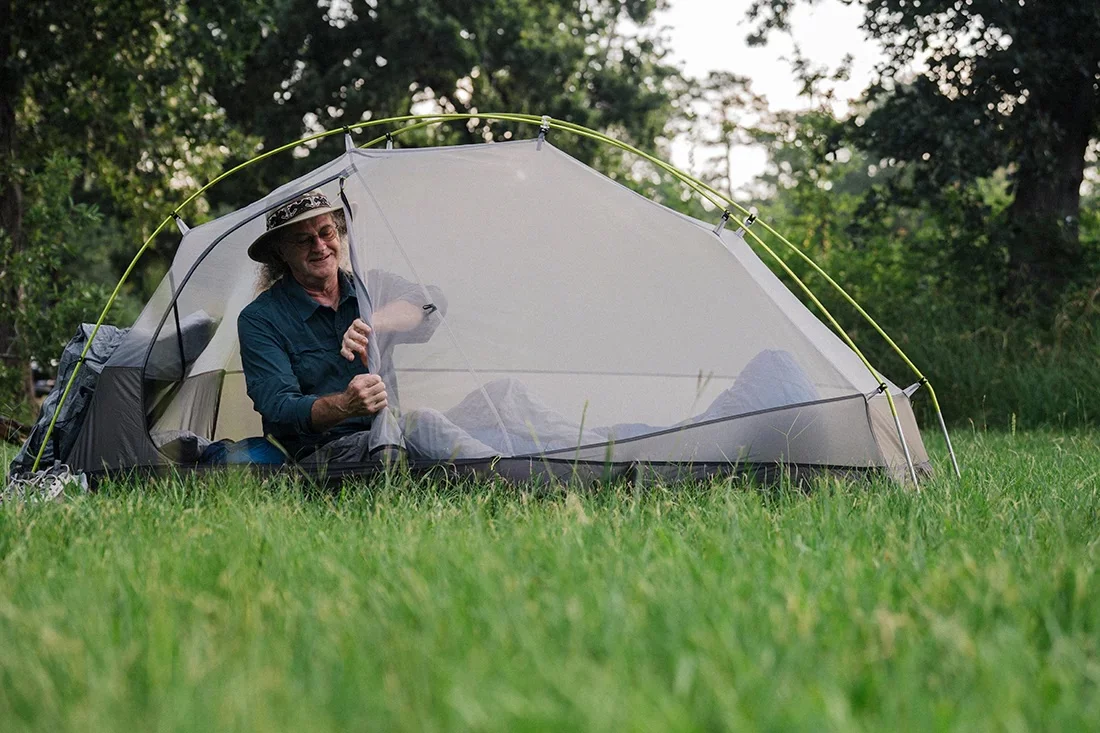
So The Free’s overall sleeping space is a bit snugger than others but not so snug as to deter ultralight backcountry explorers who are used to sleeping in minimalist shelters. The dome form erected via the crisscrossing dual-pole frame offers a peak height of 39 inches (99 cm), plenty for sitting up comfortably inside, even if you’re on the taller side.
Gossamer Gear
The Free tent fly is crafted from a blend of recycled high-tenacity 15D Robic nylon Gossamer calls Clearskies. Coupled with its silicone/PU hydrophobic finish and 20D ripstop grid, the fabric promises 4,900-mm waterproofing, stout UV resistance and rugged durability. Factory taped seams shore up the waterproofing.
The Free’s X-shaped pole set comprises DAC NFL 8.7-mm tubes secured at the center via a swivel connector. External clips and color-coded corners make for easy setup.
The full Free kit packs into a compact stuff sack carry size of 17 inches (43 cm) long by 5 inches (13 cm) in diameter, making it easy to stow in a backpack or lash to a pack or bike.

Gossamer Gear
All in all, the Gossamer Free looks like an intriguing addition to the reheating ultralight freestanding solo tent market, making backpackers’ job in picking just the right tent that much tougher (or easier, depending how you look at it). At an even $400, it just undercuts Durston’s $419 X-Dome 1+ and Six Moon’s $425 Lunar Orbiter and better than halves Hyperlite’s $825 Crosspeak 1.
Intriguing, indeed.
Source: Gossamer Gear via Bikepacking

