


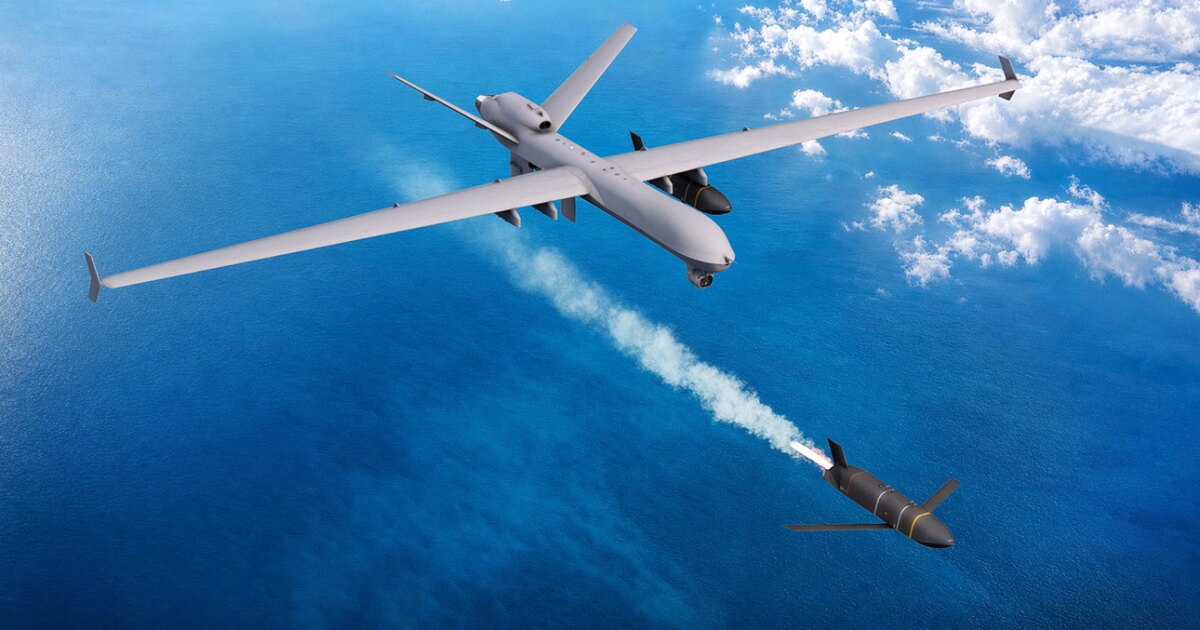
General Atomics has unveiled its proposal for the next generation of Medium-Altitude, Long-Endurance (MALE) drones in the form of its Wildfire Uncrewed Aircraft System (UAS). Designed as a lower-cost, high-volume counterpart to the venerable MQ-9 Reaper, the platform aims to restore combat mass in high-threat environments.
In 2007, when the General Atomics MQ-9 Reaper entered service with the US Air Force, it seemed like a remarkable technical advance. Here was an aircraft that was built without any accommodations for passengers or crew, and that could be controlled from thousands of miles away.
That was less than 20 years ago. To show how far things have progressed, the Reaper today is regarded as not only obsolescent, but a growing liability. According to reports that have yet to be verified, the US-operated Reaper is having difficulty in Iran dealing with modern air defenses, and its primary Ku-band and C-band satellite control links have a habit of failing.
Wildfire
This, plus the result of ground strikes by Iranian forces, may have resulted in the loss of as many as 45 Reapers, or 25% of the total US inventory, at a cost of over US$1.3 billion.
Put simply, the Reaper is out of date, expensive to build, and slow to replace when it becomes a casualty. With this in mind, the Defense Innovation Unit (DIU) and the US Air Force established the Massed Modular Aircraft (MMA) program to seek a successor that is cheaper and faster to build, quicker to develop and update, and optimized for high-volume deployment.
General Atomics’ response is the Wildfire, which is also part of a wider initiative to build swarms of drones and to develop new systems at a rate that would have been unheard of even a decade ago.
General Atomics
Based on previous General Atomics drones, the Wildfire is designed to have greater capabilities and performance than aircraft like the Reaper, while being better suited for mass production at lower costs. That way, the Wildfire can be used more freely in hazardous areas without worrying about emptying the hangars.
Using advanced autonomous systems designed for man/machine teaming, the Wildfire is likely to be turbo-prop powered, with a ferry range of 8,000 nautical miles (9,206 miles, 14,816 km). It is controlled through constellations of Proliferated Low-Earth Orbit (pLEO) satellites capable of handling dozens of networked aircraft simultaneously.
It’s also a heavier hauler than the Reaper with hard points for heavy munitions, including a pair of standoff anti-ship cruise missiles or four Joint Strike Missiles, as well as modular sensors, strike munitions, and cargo pods.
“This is exactly the right design for high-demand missions and cost-conscious customers,” said GA-ASI President David R. Alexander. “Our tailor-designed, attrition-tolerant Wildfire balances the high capability our aircraft are known for with huge flexibility and great scalability. There’s never been anything like it before.”
Source: General Atomics

