


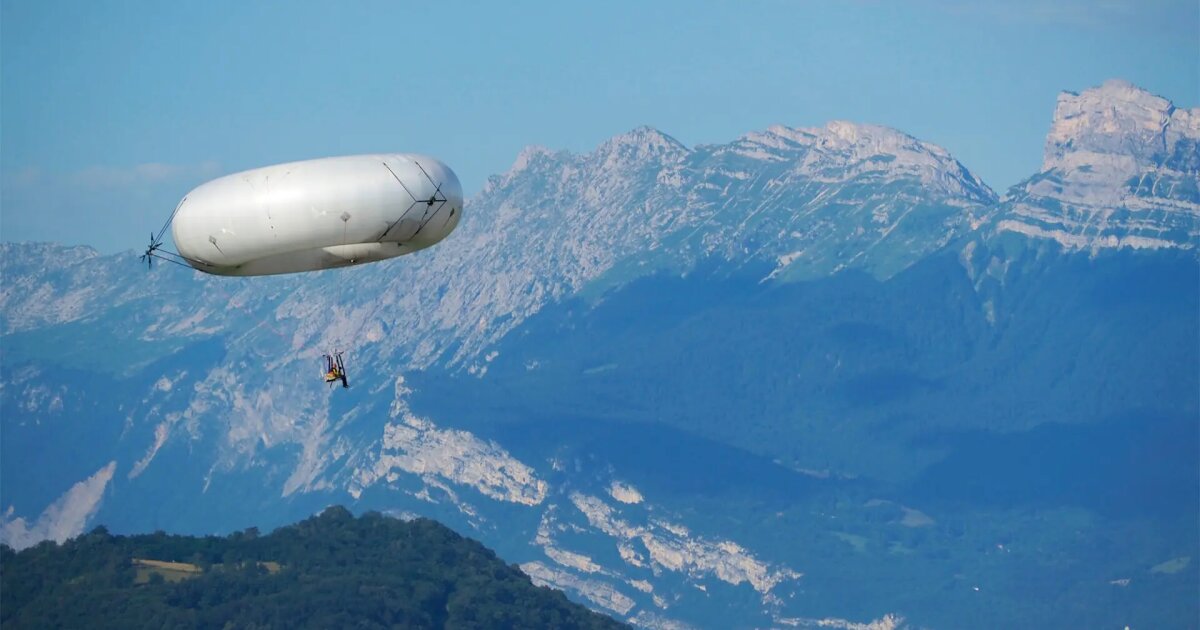
If you’re a longtime viewer of The Simpsons, then you know at least two things about Homer: he loves doughnuts, and he’s an absolutely terrible designer of vehicles. But that doesn’t mean no one should ever combine vehicle design with doughnuts, as French company aérOnde has shown us with its aérOnde (“Air-Round”) airship that looks like a giant, flying doughnut covered in white icing.
So, why would anyone bother to make a giant, white, doughnut-shaped aircraft? Aren’t airplanes, helicopters, gliders, blimps, zeppelins, and rockets already doing a great job of moving people through the atmosphere? Well, yes and no. Several of those vehicles burn massive amounts of extremely expensive fuel and release giant volumes of carbon dioxide. Airplanes alone cause approximately 2.4% of annual global CO2 emissions.
Airships, on the other hand, emit little carbon because their vertical lift comes from lighter-than-air gases such as helium instead of burning fuel during diagonal ascent, and their propeller propulsion can be entirely electric. And while they’re much slower than airplanes, the big ones really deserve the name airships for their massive carrying capacity of passengers and/or cargo: close to 220,000 lb (100,000 kg).
aérOnde
For those general reasons, the aérOnde from designer and CEO Jérôme Delamare is a very tasty confection indeed. Winner of France’s i-Lab competition and based partly on work at the Grenoble Electrical Engineering Laboratory (G2ELab), the aérOnde uses completely electric motors and around 106,000 gallons (400 m3) of helium for its vertical take-off and landing, meaning it’s an eVTOL.
Now, while you wouldn’t expect anything nicknamed a doughnut to do the work of a cargo ship, the 33-foot (15-m)-wide aérOnde is more than capable of performing important labour. Using three arrays of four propellers each, the vehicle has “a five-hour flight time and can reach speeds of 25 to 30 km/h [16 to 19 mph] in all directions, with a payload of 200 kg [440 lb],” Delamare told Presences. “All this, without any noise and with very low energy consumption” – a total of 1 kWh (about $1.17) per hour of flight, compared with a helicopter’s use of 48 gallons (180 L) of kerosene for the same flight time.

aérOnde
As you can see in the following video (if you can’t understand spoken or typed French, set the subtitles to English), the silent, two-person aérOnde features an open cockpit (like a ski-hill chair lift, rather than a hot-air balloon’s basket) allowing the crew to perform high-altitude repairs, for instance, of power lines, gondolas, or transmission towers, and its application for emergency or medical rescue is obvious. As well, the aérOnde needs only a few hours to recharge.
“Silencieux, aérien, léger” : à quoi sert ce donut géant qui survole les environs de Grenoble ?
Because of the aérOnde’s toroidal shape, wind has less ability to blow it off-course than it does against a balloon, even at gusts of 44 mph (70 km/h), so whether people are piloting it for work, leisure, observation, or rescue, the vehicle offers stability. As this second video shows, the airship, piloted with the simple use of a joystick, moves with such stunning grace and precision that it made me say, “Wow!” aloud in my bland, motionless, non-helium writing room.
Une autre facon de voler
Want to ride an aérOnde? For now, you’ll need to go to France to do that, and a 20-minute ride isn’t cheap: €200 (about $US234) per flight. The company website doesn’t give a price to rent or buy one – sorry, Homer.
Source: aérOnde

