


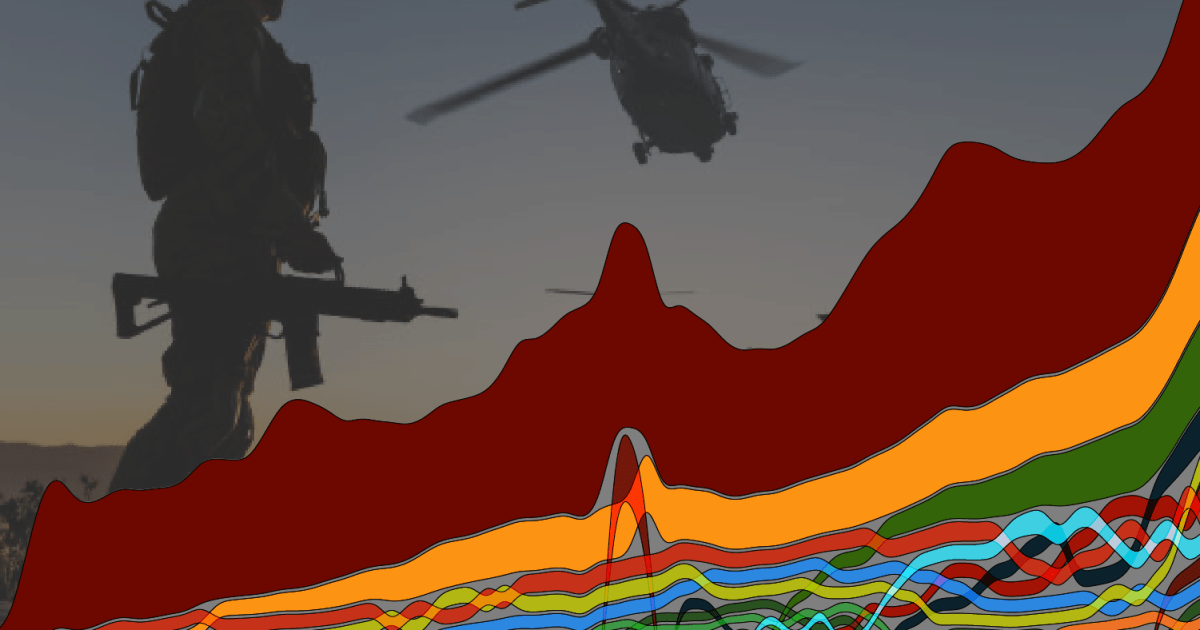
The world’s militaries spent $2.88 trillion in 2025, an increase of 2.9 percent from the year before, according to the Stockholm International Peace Research Institute’s (SIPRI) latest report.
To put that number into perspective, $2.88 trillion amounts to $350 of military spending for each person on the planet.
In this visual explainer, Al Jazeera unpacks the rise of global militarisation, including how much each nation spends, which countries sell the most weapons, and how military spending compares with spending on healthcare and education.
The US again tops the list in military spending
In 2025, the five biggest military spenders were the United States ($954bn), China ($336bn), Russia ($190bn), Germany ($114bn) and India ($92bn), accounting for more than half (58 percent) of world military spending.
The US is by far the biggest spender, as it has been every year since World War II. The $954bn spent by the US is more than the next six countries combined.
Since 1949, the US has spent at least $53.5 trillion on its military, accounting for more than half (51.5 percent) of the global total of more than $100 trillion.
Military spending has generally followed the predictable pattern of rising during wartime and falling during more peaceful periods.
The chart below shows the total global military spending over the past 75 years.

Post-World War II, global military spending surged rapidly in the early 1950s, jumping from $284bn in 1950 to $788bn by 1953, largely reflecting the impact of the Korean War. Through the late 1950s and early 1960s, spending stabilised at about $700-800bn per year, indicating a sustained but controlled buildup during the early phase of the Cold War.
This was followed by a sharp increase in the late 1960s, when spending crossed $1 trillion for the first time. This jump was driven largely by the Vietnam War and intensified superpower rivalry and arms race between the US and the Soviet Union, which saw a peak of $1.7 trillion by 1988. The end of the Cold War saw military spending fall globally back down to $1.4 trillion by 1991.
Following the September 11, 2001 attacks, US military spending increased once more. Long US-led wars in Afghanistan and Iraq saw global spending exceed $2 trillion for the first time in 2009.
In the past decade, global military spending has again been on the incline, with the 2014 Russian annexation of Crimea marking an inflection point, when NATO members set a target of spending 2 percent of their gross domestic product (GDP) on defence. Since 2016, military spending in Europe has doubled, with Eastern Europe seeing a 173 percent increase, the highest of any other subregion in the world.
And, 2025 marks the highest levels of military spending in history, increasing to $2.88 trillion from $1.69 trillion in 2016 – a rise of 41 percent.
Which countries are arming most rapidly?
Not all countries are arming at the same pace.
A small group spends between $2,000-$5,000 per capita, while most of the world remains below $100-$500.
In dollar terms per capita, Qatar spends the most on its military, growing from $1,231 per capita in 2006 to $5,428 by 2022, an increase of 340 percent.
Israel follows, rising from $1,360 to $5,108 per capita, an increase of 276 percent. Norway is third, up 181 percent from $1,080 to $3,040.
As a percentage, Ukraine shows the largest rise at 3,387 percent, from $63 per capita in 2006 to $2,197 in 2025, reflecting its ongoing conflict with Russia.
The chart below shows the 10 highest increases in spending over the past 20 years.

Who sells most of the world’s weapons?
The trade of global arms is dominated by a select few countries, which often have strong military-industrial complexes.
Between 2016 and 2025, $295bn worth of weapons were sold worldwide.
Other than spending the most on its own military, the US is also the largest exporter of weapons in the world, making up 39 percent ($115bn) of the total global share. A large part of Washington’s dominance is driven by its foreign policy plans, the relationship between the defence industry and the government, and the level of innovation in the industry.
Between 2020 and 2024, private firms received $2.4 trillion in Pentagon contracts – more than half of the department’s discretionary spending, according to the Quincy Institute for Responsible Statecraft and Costs of War at Brown University’s Watson School of International and Public Affairs last year. A third ($771bn) of those contracts went to just five companies: Lockheed Martin, RTX, Boeing, General Dynamics and Northrop Grumman.
The second largest arms exporter is Russia, accounting for 13 percent ($40bn) of global share, followed by France – 9.3 percent ($28bn), followed by China – 5.5 percent ($16bn), and Germany – 5.5 percent ($16bn).

How does military spending compare with healthcare and education?
When a country is asked to spend more on defence, that money has to come from somewhere.
Unless governments expand their budgets or raise new revenue, increased military spending can strain other sectors that people rely on every day – like healthcare and education.
Across 137 countries analysed by Al Jazeera, we classified each country by which sector it spends most on as a function of GDP – healthcare, education, or the military:
- 114 countries spend the most on healthcare
- 14 countries spend the most on education
- 9 countries spend the most on the military
The table below highlights these results. Click on the category names to sort the values from highest to lowest or use the search box to find a specific country.
What’s changing in modern militarisation?
The traditional military is changing.
While the 20th century was defined by mass mobilisation, heavy armour and air power, today’s defence is fusing those with artificial intelligence, autonomous systems and digital warfare infrastructure, often combining classic defence contractors with cutting-edge tech companies.
Recent technological shifts have advanced because of the information age, which has also allowed the proliferation of drones and AI-assisted targeting and surveillance, cyber-warfare capabilities, precision-guided weapons and nuclear modernisation programmes.
For example, the US Department of Defense and the Pentagon are consistently folding privately-developed software systems into their war apparatus.
In summer last year, the Department of Defense awarded OpenAI a $200m contract to implement generative AI into the US military, alongside $200m contracts for xAI and Anthropic. Palantir’s AI-assisted targeting has been used by the likes of the Israeli government during its genocidal war on Gaza.

