


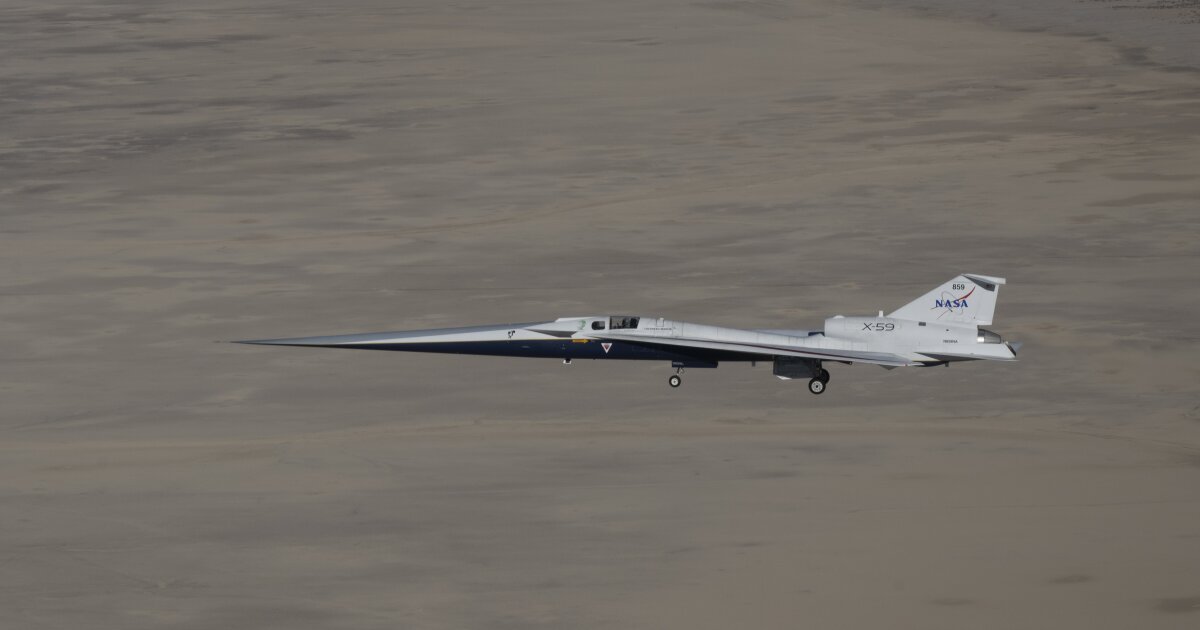
The US Federal Aviation Administration (FAA) is clearing the way for the return of commercial supersonic air travel by revamping regulations for faster-than-sound aircraft for the first time since 1973 – to reflect progress in aviation engineering and the removal of prejudicial attitudes.
In 1973, the FAA enacted a strict prohibition of civilian supersonic flight in the US through Title 14 of the Code of Federal Regulations (CFR), Part 91, Section 91.817. Essentially, what this did was to ban non-military supersonic flights through provisions that were so strict that there was no way to get around them.
There were a number of reasons for the ban. Ostensibly, it had to do with the infamous sonic boom caused by the buildup of the pressure wave at the nose of a supersonic aircraft that could be heard on the ground as a very loud double thump. It was something that the American public in many areas was familiar with from military aircraft flying overhead, and it was very unpopular – especially with dairy and chicken farmers as well as environmental activists.
However, there was more to the story. In the 1960s, the US government and major aircraft manufacturers were keen to be in on the race to build the first supersonic airliner. Congress, along with Boeing, poured about US$1 billion dollars into the project. Then, in 1971, the US Senate voted to terminate funding for the Boeing 2707 supersonic prototype – killing all US development in that field.
That’s where things got a tad vindictive. The only other competitors were the Anglo-French Concorde and the sporadic Soviet Tupolev Tu-144 program. Concorde was seen as the greater commercial threat as the consortium regularly marketed the aircraft in the livery of the world’s major airlines, indicating that Concorde would do for supersonic flight what the Boeing 707 did for jet passenger travel.
The US had no desire to suffer this loss of face, so the environmentalists made common cause with the US aircraft sector in writing and supporting the new FAA regulations to ban supersonic flight. This not only froze Concorde out of one of the world’s major airline markets, but it also affected global regulations, since the FAA set the standard for other countries and regions.
For the next half century, that’s where things stood. The T-144 was terminated by 1983 after a decade of anemic service, while Concorde never went beyond 20 airframes that were only flown by British Airways and Air France on a handful of transoceanic routes, ensuring that the aircraft never had a chance of reaching economies of scale. Meanwhile, the technological and financial hurdles of fighting the sonic boom appeared insurmountable.
Today, things have changed with a number of companies, plus NASA, working on new fuselage and wing designs that minimize the sonic boom by spreading the shockwave along the whole of the aircraft and directing it skyward instead of at the ground until it can only be heard as a thud about as loud as a car door closing. This is further reduced by a better understanding of aerodynamics and the ability to design planes so they can monitor real-time air data and automatically adjust speed for the quietest passage over a particular area.
But that still left the regulatory side of things to be dealt with. You can have the best technology in the world, but it won’t do you any good if the bureaucracy has a piece of paper to oppose it. So the FAA is revisiting the old regulations and revising them to match recent advancements and remove the hostile provisions by making the new regs based on an absolute noise performance standard.
These changes will be informed by flight tests using NASA’s X-59 supersonic prototype, and the technical noise and operational certification standards are expected to be finalized by mid-2027.
Source: FAA

