


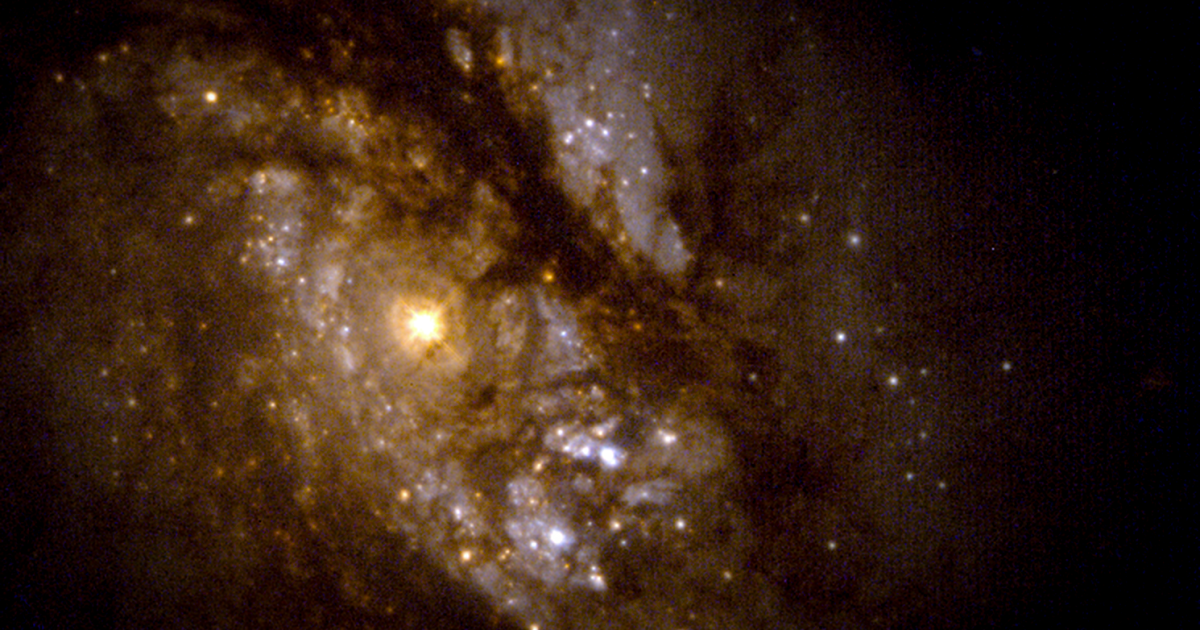
For the first time, astronomers claim they’ve found a way to reconstruct a galaxy’s entire ‘life story’ – from a single snapshot in time.
It’s a little like looking at a single photograph of a stranger, and being able to infer where they were born, how they grew up and who they met along the way. The new method is called “extragalactic archaeology,” and instead of trowels and brushes, it uses AI analysis of chemical ‘fingerprints’ to write multi-billion year biographies of galaxies far beyond our own.
A new paper in Nature Astronomy, its authors argue, could be the foundation of a new field guide to learning more about how galaxies formed, merged and changed over the eons. But to get there, the researchers started small, looking at tiny variations in oxygen in a single galaxy, called NGC 1365.
The centers of galaxies typically have the highest concentrations of oxygen, with a steady downward gradient of this relatively heavy element expected as you move toward their outer reaches. But irregularities in this pattern can be caused by major events in a galaxy’s ‘life story” – when new stars or black holes form, when old stars go supernova, when galaxies crash through one another or merge together.
Effectively, the team ran about 20,000 simulations of different galaxies going through all kinds of growing pains, creating simulated backstories tracking star formation, black holes, and the motion of gas and evolution of different chemicals within them – and by using AI to compare this simulated data with real-world observational data, they were able to find a match close enough to infer how NGC 1365 got to where it is today.
“We could reconstruct a detailed growth history for an individual spiral galaxy, just from its present‑day chemical fingerprints,” lead author Lisa Kewley, director of the Harvard-Smithsonian Center for Astrophysics, told Refractor.
B. Madore, The Observatories, Carnegie Institution for Science
They discovered that NGC 1365 had a central region that was formed close to when the universe was formed, 13.7 billion years ago, forming oxygen. In roughly 12 billion years, gas at the periphery of the galaxy continued to build out as NGC 1365 crashed into dwarf galaxies. Gas at the outer edges, however, came in later as stars from the merging dwarf galaxies provided more supply.
That’s just a single galaxy’s history. Taken on the scale of the universe, extragalactic archaeology aims to find the “life stories of galaxies outside the Milky Way.” The aim is to look for the “fossil record” of these galaxies. While galaxies are not made up of bones like creatures on Earth, they do have a structure of gas, dust, stars, dark matter and more.
The weakness with traditional galaxy studies, Kewley said, is they tend to chart galaxies by “redshift,” or by how much the galaxies’ light wavelengths are stretched into the red part of the light spectrum. Simply put, galaxies with a higher redshift are galaxies that are older. That’s because the entire universe is expanding, and the earliest galaxies are moving the fastest away from each other.
Redshift is useful for charting age, but extragalactic archaeology aims to look at how galaxies have merged, or exchanged gases and other supplies, over the eons. Luckily, this ambitious aim is matched by emerging technology: AI, simulations, and high-resolution telescope observations of the galaxies are all working together to chart this course for astronomers.
Looking at NGC 1365, Kewley said, is a good case study for how to do this kind of archaeology. “It shows that detailed oxygen maps of a single galaxy, when compared systematically to thousands of simulated galaxies, can narrow down an evolutionary path” for this galaxy, she said.
Of course, this is just one of untold billions of galaxies in our cosmos, and the researchers say there is a need to go further – to find the histories of different kinds of galaxies, with different merger sequences. If all goes well, the researchers hope to eventually produce a “field guide” for a typical galaxy. Like looking at a bird on Earth, astronomers could “describe how it [the galaxy] looks today, and also infer how and when it assembled its stars and gas,” Kewley said.
As this field of study is still young, Kewley added, there is much to learn: “The method will get more powerful as we add more elements, more galaxies, and better simulations.” But she said her team’s hope is that distant galaxies’ histories will better come to light with extragalactic archaeology, to better give information not only about the universe at large, but our own home in the Milky Way.

