


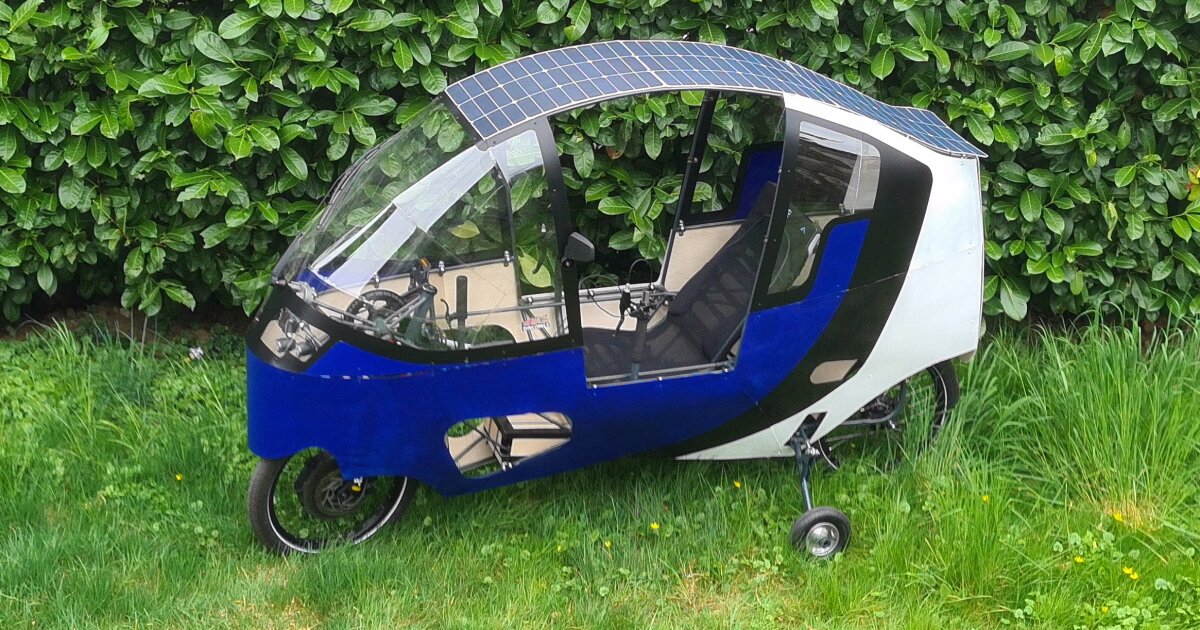
Fully-enclosed velomobiles may offer weather protection and an aerodynamic advantage over bicycles, but their three wheels do add weight and rolling resistance. The outrigger-equipped Manta ebike, however, takes a unique alternative approach.
Made by Swiss company ecowerk, the Manta “two-wheeler” could actually be considered a part-time quadcycle.
When cruising, it rolls along on two inline wheels just like a regular ebike. It has a steel frame along with ETFE (ethylene tetrafluoroethylene) and plywood body panels, a polycarbonate windshield and side windows, plus removable zippered doors made of tent fabric.
This setup does provide protection from the elements and a reduction in wind drag, but what happens when you need to put a foot or two down when coming to a stop? Well, there are cutouts in the side panels (of the production version) for doing so, but there are also those manually-deployable and -retractable wheeled outriggers.
Vivien Olivier Dettwiler
“The ‘landing gear’ is primarily used for stability and balance when the vehicle is stationary or moving at very low speeds,” Manta inventor Vivien Olivier Dettwiler tells us. “Taking off (depart/start) and landing (arrive/stop) using the landing gear requires some practice. It takes about 50 takeoffs and landings to perfect the sequence and balance.”
The outrigger design actually dates back to 1984, when it was first used in Swiss company Peraves’ Ecomobile fully-enclosed motorcycle. That vehicle was subsequently replaced by upgraded models known as the Monoracer and Zerotracer, one of the designers of which was Tobias Wülser. Wülser subsequently founded a company called Designwerk, and Dettwiler was a shareholder in that company.

Vivien Olivier Dettwiler
The Manta rider’s pedaling power is augmented by a Grin V3 front hub motor, taking them to a top assisted speed of 25 km/h (16 mph) on city streets or 45 km/h (28 mph) on highways. That motor is powered by a 1,500-Wh lithium-ion battery, which is in turn kept topped up by a set of roof-mounted solar panels.
On longer trips, riders can additionally bring along a second set of folding solar panels. These are kept stowed in the bike’s “trunk” while riding, then pulled out and set up to charge the battery when parked for extended periods.
A 500-watt regenerative braking system also helps with battery charging.

Vivien Olivier Dettwiler
Vivien claims that battery range without direct sunlight is about 150 km (93 miles), although that figure can be extended by as much as 40 km (25 miles) on sunny days via the roof-mounted panels alone.
And no, the Manta isn’t just made to be a grocery-getter.

Vivien Olivier Dettwiler
Two years ago, Dettwiler took the vehicle on the 7,300-km (4,536-mile) Sun Trip Sahara 2024 solar-powered bike race from Lyon, France to Morocco and back. He slept in it at night, facilitated by the fact that its seat can be removed (and converted into a camp chair), opening up a 200 x 60-cm (78.7 x 23.6 in) sleeping area that can be used with an included 6-cm (2.4-in)-thick mattress.

Vivien Olivier Dettwiler
And should you be wondering, Vivien tells us that the whole rig tips the scales at 55 kg (121.25 lb).
If you’d like a Manta of your own, ecowerk is now taking reservations of 200 Swiss francs (about US$256) towards the full price of 9,850 francs ($12,610). Estimated delivery time is currently 16 weeks.
Source: ecowerk

