


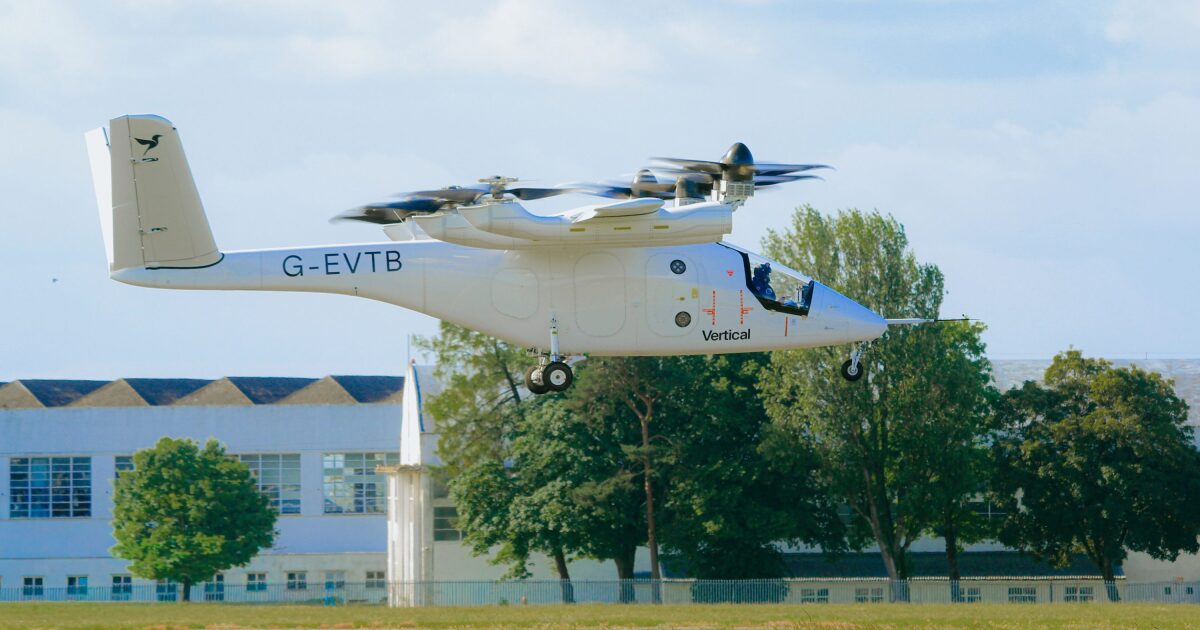
An electric aircraft that takes off like a helicopter and cruises like a conventional plane just completed its first piloted flight with a new full-scale prototype. British company Vertical Aerospace is accelerating toward commercial certification, targeted for 2028.
On June 5, 2026, at 8:49 AM local time, test pilot Paul Stone lifted off at the controls of Vertical Aerospace‘s latest full-scale prototype from the company’s Flight Test Centre in the UK. It is the second such aircraft the company now has in the air – doubling its flight-testing capacity.
The flight followed the Civil Aviation Authority’s issuance of a Permit to Fly – a formal regulatory instrument granted after extensive ground testing. “Getting our latest prototype into flight testing is an important milestone because it allows us to learn faster in real-world conditions and keep building momentum towards certification,” said CEO Stuart Simpson.
Both aircraft are full-scale prototypes of the Valo, Vertical Aerospace’s flagship eVTOL (electric vertical take-off and landing) design, and they are now operating in parallel. The earlier prototype has already completed all flight test phases – thrustborne flight (where the aircraft is held up purely by rotor thrust, like a helicopter), wingborne flight (where the wings generate lift, like a conventional plane), and the full bidirectional transition between both modes – and continues flying to gather additional data. The newcomer starts its own cycle from scratch, working through each of those same phases in sequence.
Once the new prototype completes those phases in electric configuration, Vertical Aerospace plans to convert it into a testbed for a hybrid-electric variant – a future development aimed at applications requiring greater range and payload for sectors like defense, logistics, or extended commercial transport.
This prototype is also the last before the Critical Design Review (CDR), the program milestone that locks in the baseline design for certification. Once that hurdle is cleared, Vertical Aerospace will begin assembling its first pre-production aircraft.
Vertical Aerospace has been developing eVTOL aircraft since 2016, but the Valo’s flight test program reached a key early milestone in September 2024, when the prototype completed its first crewed hover flight in a tethered configuration.
Vertical Aerospace | Final Phase – Transition
By February 2025 it was demonstrating vertical flight maneuvers, and by May, it had made its first wingborne flight – cruising like a conventional fixed-wing aircraft. On July 16, a landmark flight between Cotswold Airport and RAF Fairford in Gloucestershire – covering 17 miles (27 km) at up to 115 mph (185 km/h) – marked the high point of that phase. By November 2025, the team had begun bridging the two modes, working toward what it calls full transition.
The decisive moment for the company came on April 14, 2026, when chief pilot Simon Davies executed what Vertical Aerospace describes as the first complete, piloted, bidirectional transition under civil regulatory oversight – from helicopter mode to airplane mode and back, in a single continuous flight.
“This is now the most significant technical milestone in our history,” Simpson said after that April flight. “The full piloted transition is the most critical and complex challenge in eVTOL development, and we achieved it under more rigorous regulatory oversight than anyone else in this category.”
The Valo has eight electric rotors, four fixed at the rear that stow during cruise, and four at the front that tilt 90 degrees, switching from lift to thrust as the wings take over at around 80 knots (92 mph). Honeywell fly-by-wire systems – a system that replaces mechanical flight control linkages with electronic signals – manage the radical aerodynamic changes that transition demands. Partners Syensqo and Aciturri contribute advanced materials and aerostructures, respectively. Since both prototypes share the same configuration, they likely share the same performance targets. According to Vertical Aerospace’s published specifications, the Valo is designed to carry a pilot and up to four passengers at 150 mph (130 knots) for up to 100 miles (161 km).
Vertical Aerospace
The market seems already convinced. The company has accumulated around 1,500 pre-orders from customers on four continents, including American Airlines, Japan Airlines, and Bristow.
Vertical Aerospace’s Valo isn’t the only aircraft chasing one of aviation’s longest-standing engineering challenges: the flexibility of a helicopter combined with the efficiency of a fixed-wing plane. But the history of VTOL aircraft is littered with costly stumbles. The Harrier entered production with enormous delays and remains maintenance-intensive. The Bell Boeing V-22 Osprey took decades to become operational after multiple fatal crashes. The F-35’s VTOL variant, despite being supersonic, was no exception. Even DARPA’s well-funded SPRINT program – which tapped Bell to develop a jet-powered VTOL X-plane capable of far higher speeds than any rotorcraft – shows how technically brutal this design space remains.
A more radical proposal comes from California-based Pterodynamics and its Transwing aircraft. Rather than tilting the motors – as the Osprey or Valo do – its solution is to tilt the entire wings. The motors stay fixed relative to the wing surface, and the whole wing rotates from a position perpendicular to the ground for takeoff to parallel for cruise.
The company claims the result is an aircraft as efficient in hover as a helicopter and as fast in cruise as a conventional plane, with a dramatically reduced ground footprint and cargo that always stays level. Pterodynamics says the design can scale from a 6.6-lb (3-kg) drone to a 77,162-lb (35,000-kg) commercial aircraft.
In May 2026 the Royal Australian Navy awarded it its first international defense contract, ordering P4 Transwing drones for autonomous maritime logistics, with an option on larger P5 models from 2027. Still, it remains far from the piloted flight phase where Vertical Aerospace already operates.
Source: Vertical Aerospace

