


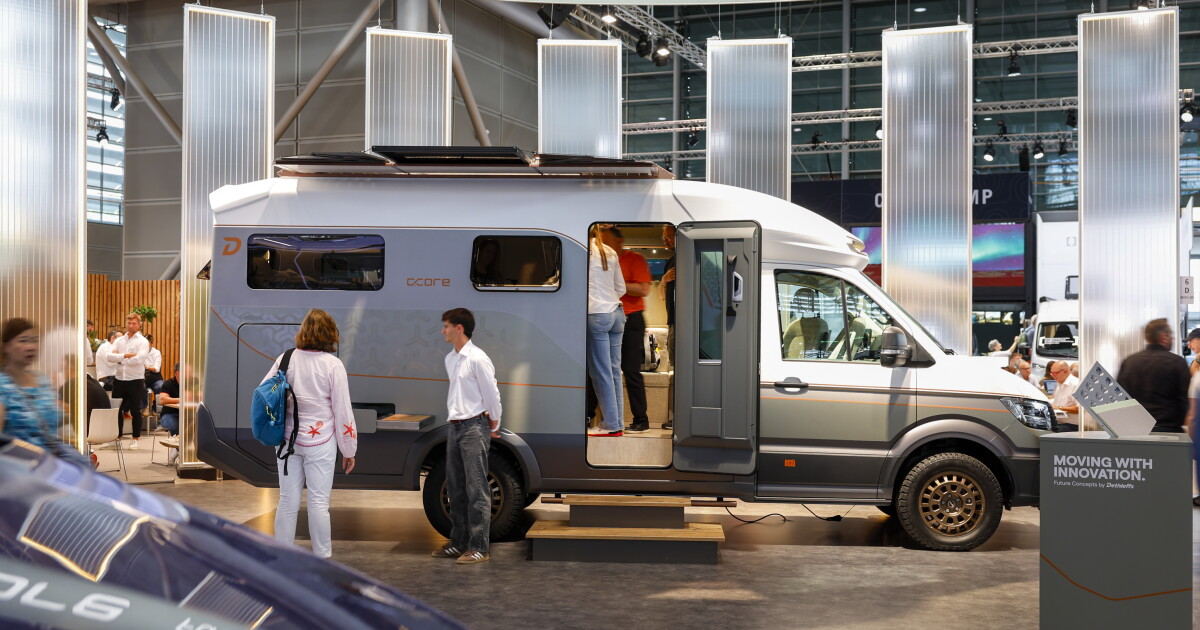
Building upon the foundation it laid with last year’s E.Home Eco, Dethleffs is showing an even more innovative, envelope-pushing green RV concept at this year’s Düsseldorf Caravan Salon. The all-new C.Core brings biomimicry, solar expansion and closed-loop recycling into the fold to create a mobile environment in which campers treat every resource with the utmost thought and care. The space also transforms to help travelers get the most out of their trip.
We looked back at Dethleffs’ near-decade-long history of presenting environmentally friendly design studies in last year’s E.Home Eco article, so we won’t rehash it beyond saying that the all-new 2026 C.Core concept follows not only all those previous-year concept debuts but also the C.Fold expandable caravan concept Dethleffs prepared for the CMT show this past January. So it appears “C” has officially replaced “E” as the new buzzword in green RV design, at least for now, in Dethleffs’ HQ city of Isny im Allgäu.
All of Dethleffs’ eco-friendly concepts have been strictly design studies not meant for production, and the C.Core is no exception. But while there are no plans for production, it will serve as a rolling R&D lab in which potential technologies can be explored and tested in real world conditions. In that way, it appears to draw more closely to the annual concepts developed by other Erwin Hymer Group brands, which often serve as test and launch beds for rather wild technologies and features.
Dethleffs/Erwin Hymer Group
With the C.core, Dethleffs begins by sculpting a new motorhome module atop a Volkswagen Crafter van chassis. Relying heavily on a material called Necto, a specialized bird-bone-inspired form of multi-layer aluminum panels, the company builds out a Class C motorhome that offers a calculated weight savings between 25 and 45 kg (55 and 99 lb) in comparison to one built from more conventional materials. Dethleffs’ use of recycled PET for insulation follows in the vein of a few RV products we’ve looked at, including Escapod teardrop trailers.
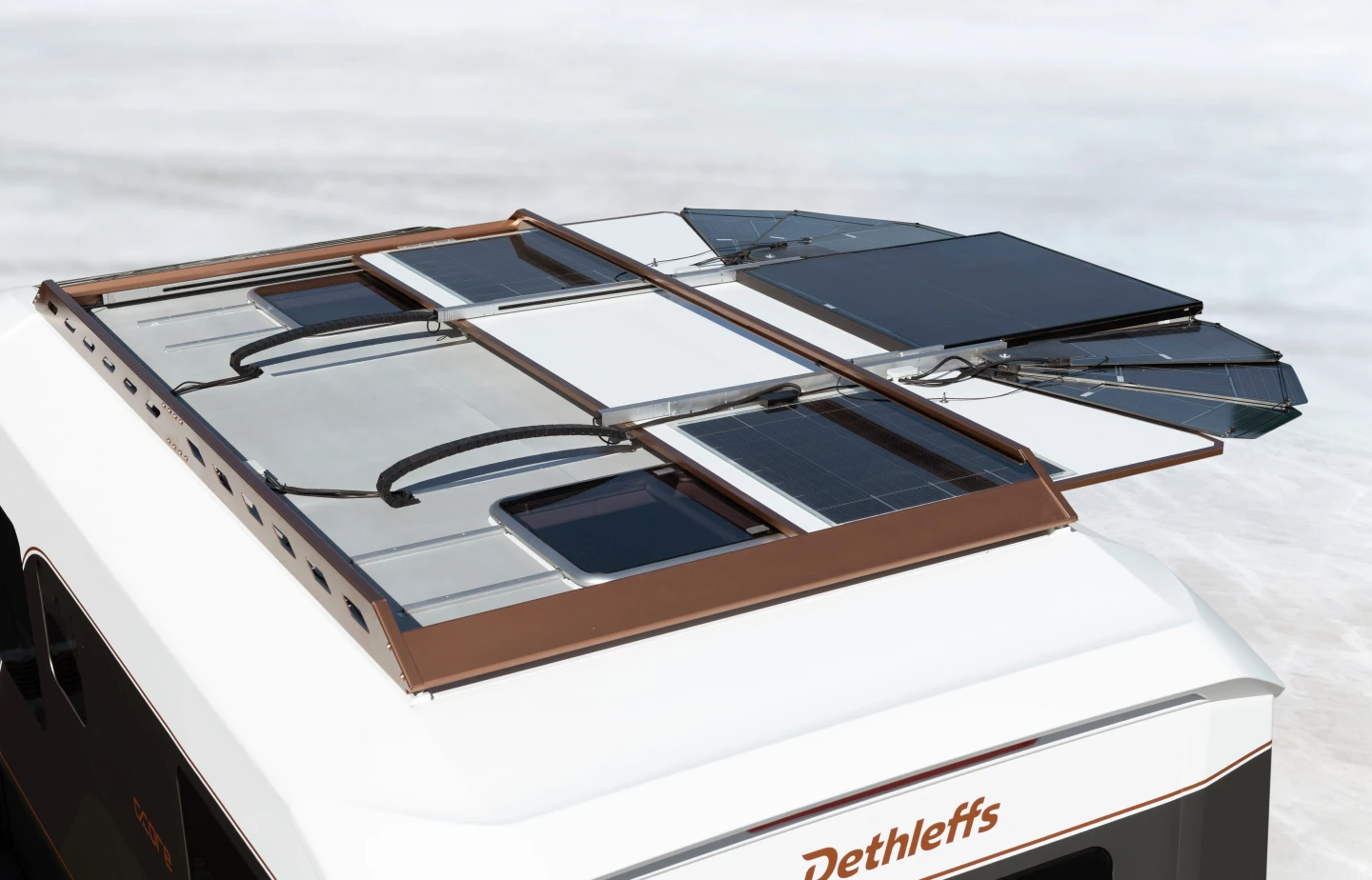
Further building up the C.core’s green credentials, Dethleffs equips the RV with what it classifies as a virtually self-sufficient electrical system based on an expandable “solar flower” rooftop panel array. The panels store within the roof rails when driving but expand at camp to deliver up to 600 watts of charging while doubling as an awning, saving space and weight as compared to separate awning and charging systems.
Dethleffs/Erwin Hymer Group
Coupled with a 400-Ah lithium battery bank, Dethleffs says the system could deliver independent power between May and September. Assuming that assessment is based on German weather conditions, it could probably run for longer, perhaps year-round, somewhere like the Middle East or American Southwest.
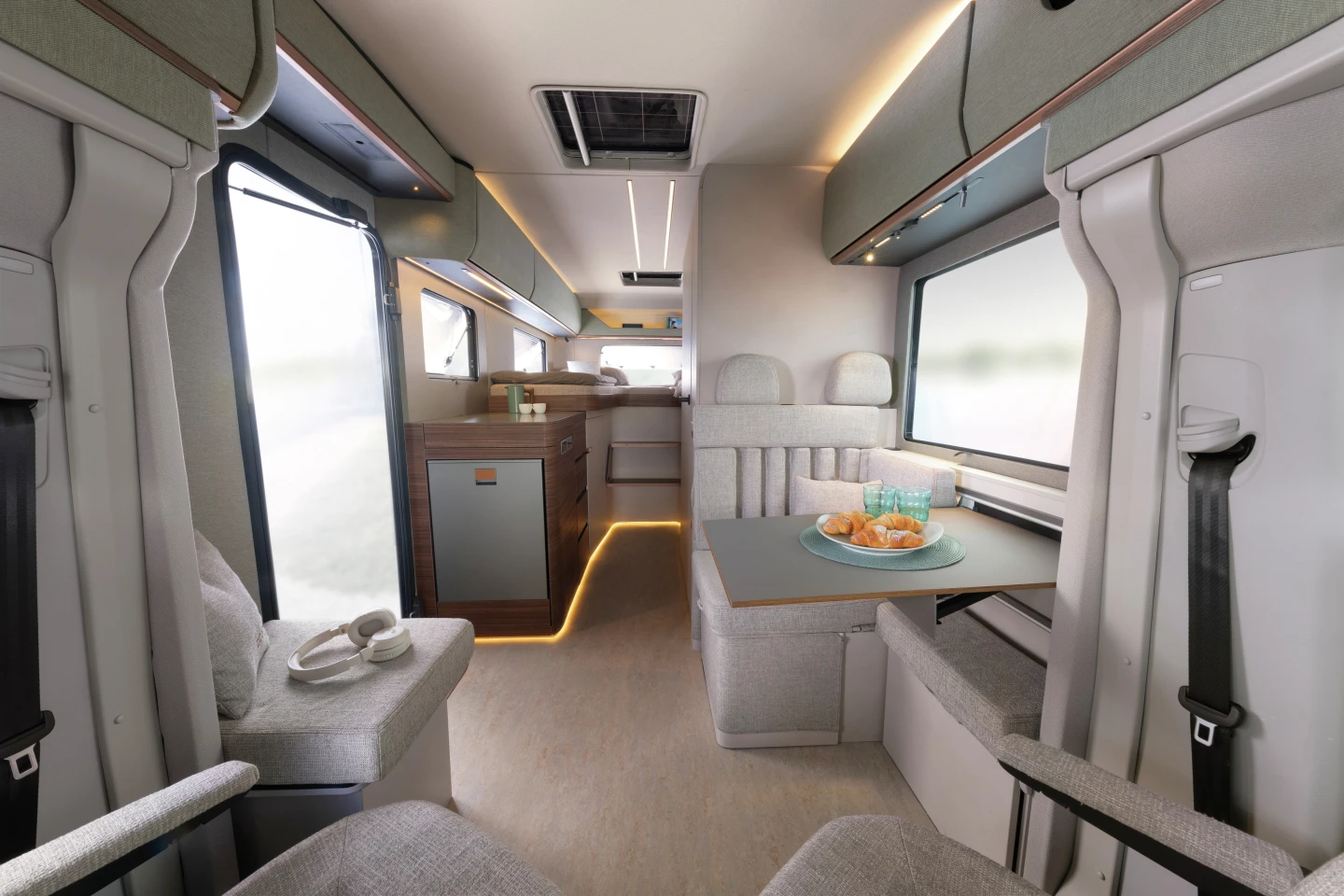
The C.core interior is laid out in a fairly conventional fashion, with a set of raised longitudinal single beds anchoring the rear, a dining lounge up front, and a kitchenette and bathroom between them. Dethleffs works some innovation into the individual areas, however, ensuring campers can get the most out of their time in the finite cabin space.
Dethleffs/Erwin Hymer Group
As the first example, the dining lounge features a front-facing bench, wall-secured tabletop and swivel cab seats when it’s time to eat or play games. The table then stows away, and the bench cushions rearrange to create a side-facing love seat positioned perfectly for viewing the drop-down projection screen just above the entryway.
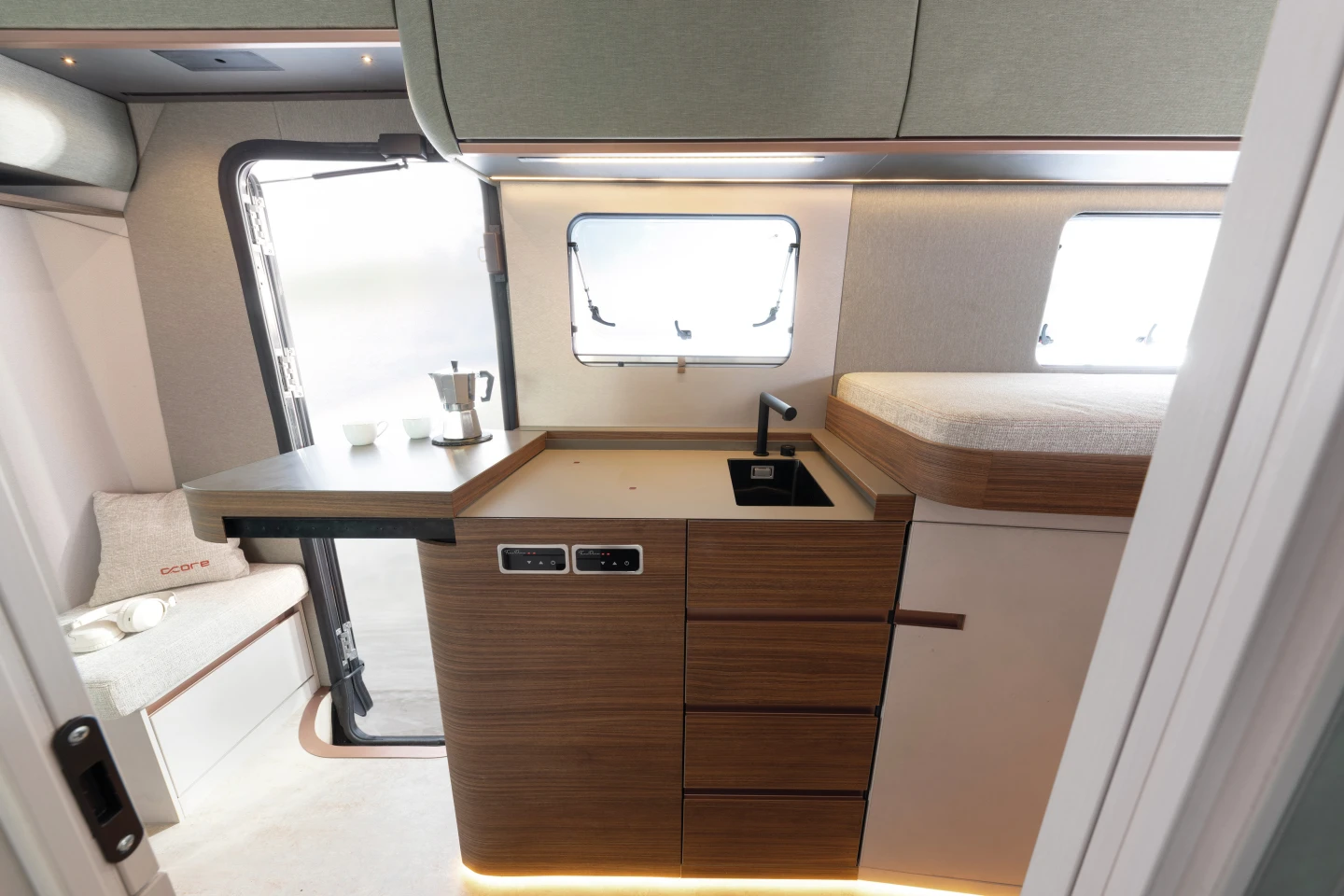
The kitchen, meanwhile, looks more like a mini-armoire or small bar cabinet than it does an RV galley. That’s because the sink and invisible dual-burner induction cooktop are concealed below a sliding top that works just like a bar or table when retracted. Once deployed, it creates a separate prop space and opens access to the cooktop and sink.
Dethleffs/Erwin Hymer Group
Once the two-part top is closed back up, the only part of the galley area hinting at its status as a fully equipped kitchen is the 100-L stainless steel drawer fridge integrated into the front end for easy indoor and outdoor access.
Dethleffs also supports cooks who prefer fresh air and natural light, equipping the C.core with a slide-out external kitchen with dual-space induction cooktop and cutting board worktop. The unit folds in half to fit neatly inside the storage compartment below the solar awning.
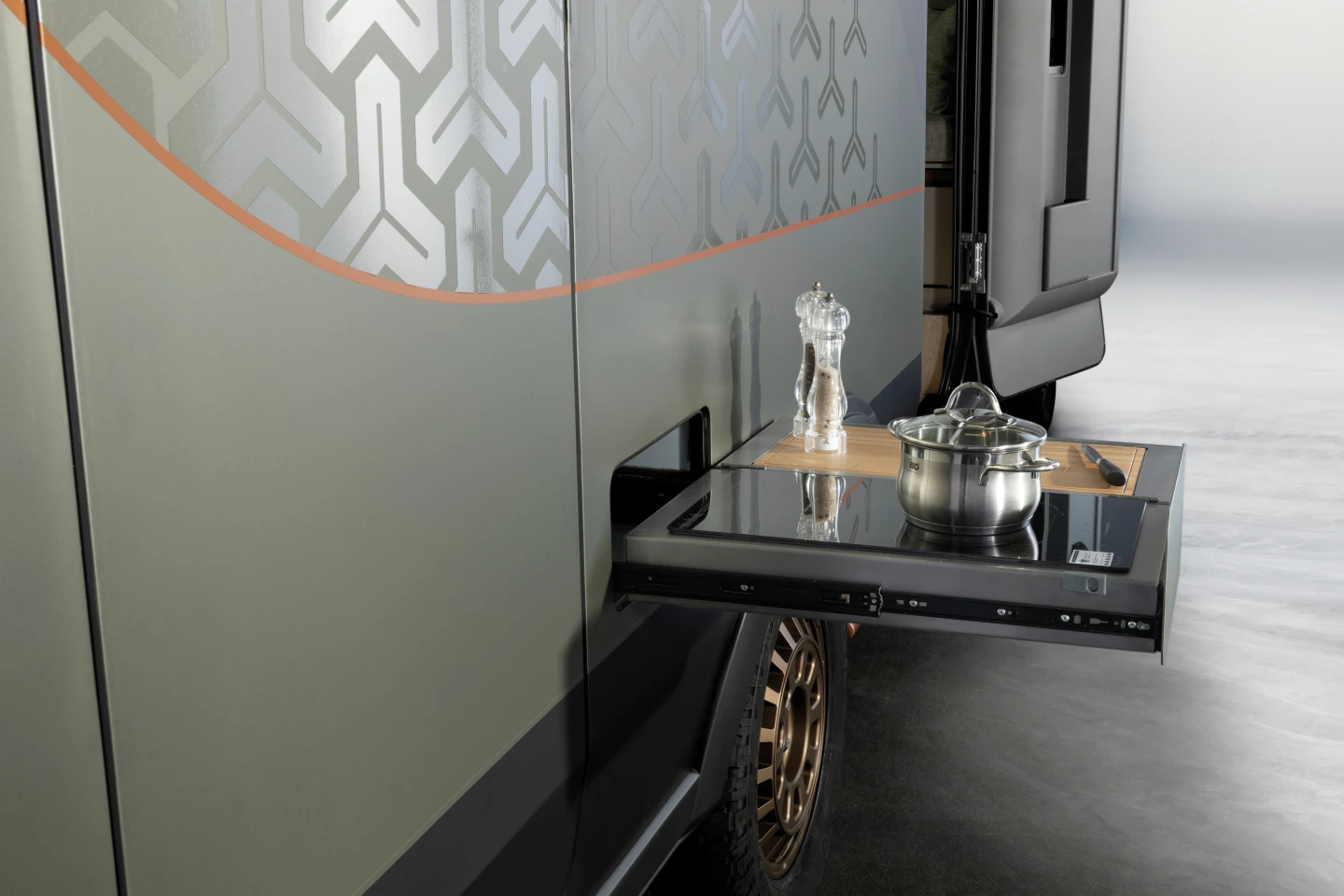
Outdoor kitchen fully deployed
Dethleffs/Erwin Hymer Group
Given the presence of that compact, efficient outdoor kitchen, we’d actually have liked Dethleffs to take the idea one step further and eliminate the indoor kitchen block all together. During a recent RV trip, we realized that we prefer to spend virtually all our time cooking and eating outdoors while camping and it would be interesting to see an RV reflect that kind of usage by replacing the obligatory indoor kitchen area with something else – perhaps a dry bathroom setup or even just extra open living space.
We do understand that plenty of RVers rely on their indoor kitchens as primary or secondary meal prep areas, but for a concept vehicle – particularly one designed around exploring new ideas and weight-saving possibilities, it would be interesting to see what else could be done with that space if all the cooking were pushed to the outside. We suppose the custom route is still best for that particular style of outside-the-box RV design.
Interestingly, Dethleffs avoids stepping quite as far with its concept’s bathroom as some Erwin Hymer brands have gone with production bathrooms. Instead of a swiveling or sliding bathroom space, it relies on simpler solutions – a slide-away Clesana toilet and a swivel sink – to clear extra space for showering. The shower itself features a deep green wall digitally printed to appear like real tile. This gives it a homier feel without the weight or maintenance of actual tile.
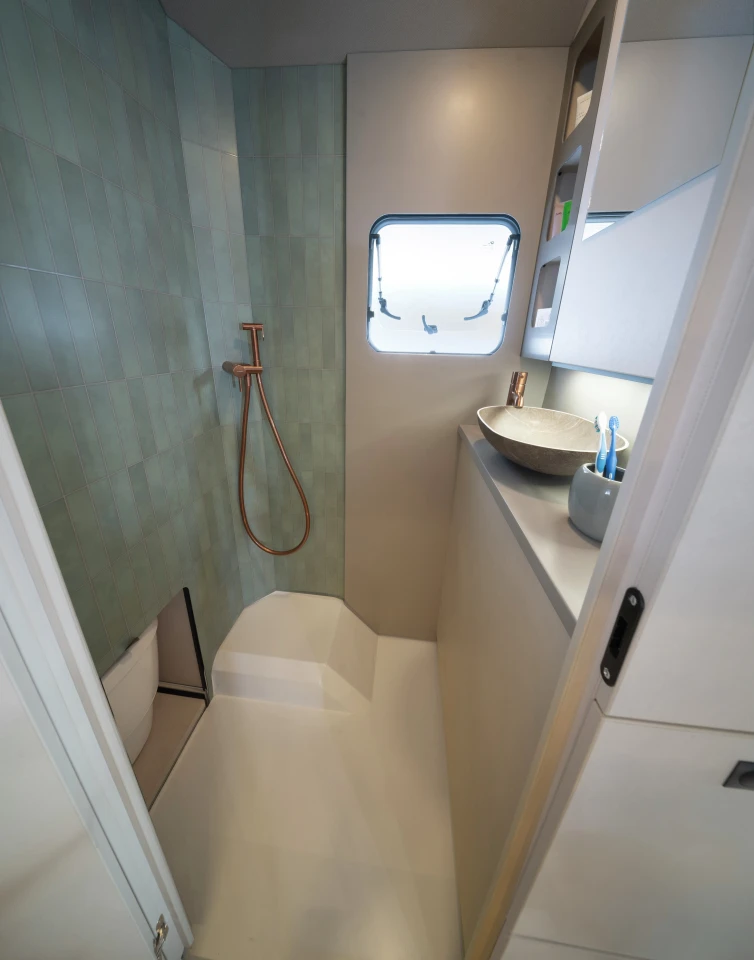
Dethleffs/Erwin Hymer Group
The C.core complements its self-sufficient power system with a closed-loop gray water system that repurposes water from the gray tank, running it back through a multi-stage filtration process before sending it back to the fresh tank and onward to the taps. Dethleffs classifies the treated water as “ultra-pure,” reaching a higher quality standard than basic drinking water. It also goes so far as to say that the same water can be used continuously throughout an entire camping season without changing the filters, greatly reducing the reliance on large amounts of fresh water capacity and the need to find water hookups during the trip.
As for climate control, Dethleffs installs a multi-fuel heater capable of running on renewable, cleaner-burning hydrotreated vegetable oil (HVO). The heater was developed by Truma, a top name in RV HVAC equipment and accessories.

Dethleffs/Erwin Hymer Group
We like how Dethleffs puts burgeoning technologies to work in next-generation sustainable systems. We’ve seen a few different expandable rooftop and awning solar systems emerging on the market, and gray water recirculation is also something that’s been growing in RV design. Meanwhile, we’ve watched consumer projectors getting smaller and more powerful, creating a viable alternative to heavier, less stowable TVs. Dethleffs effectively combines those various advancing technologies into a single concept, showing how they’ll contribute to more enjoyable, efficient RVing in the future.
Dethleffs introduced the C.core concept at the 2026 Düsseldorf Caravan Salon, which runs through Sunday. Taking a closer look at the concept will be among our first priorities when we arrive later this week.
Source: Dethleffs

