


What sounds more terrifying than a part-cockroach, part-robot cyborg? Definitely one that can also breathe underwater. Yet, this is exactly what researchers have just created, except they are replacing “terrifying” with “useful.” Scientists from Nanyang Technological University (NTU) Singapore and Waseda University in Japan have created a soft, flexible diving suit for cyborg cockroaches. The suits are equipped with miniature oxygen generators that allow the cockroaches to survive for up to three hours underwater or in low-oxygen conditions.
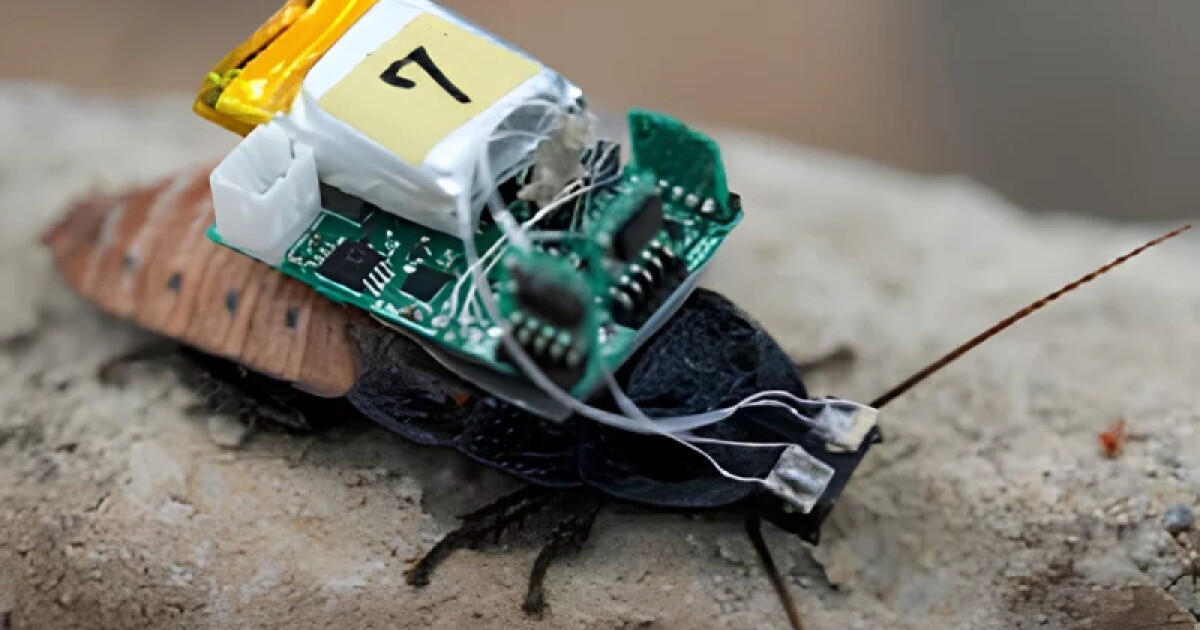
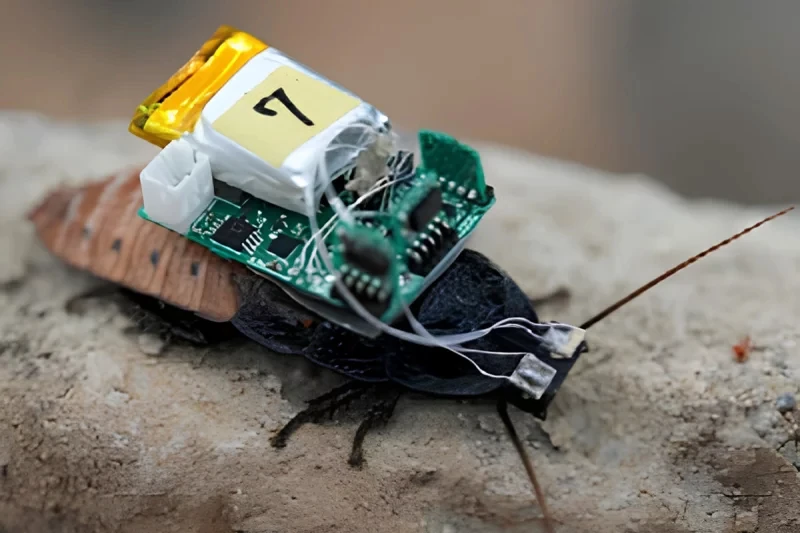
Now, you are probably wondering what in the world cyborg cockroaches are and why they would exist in the first place. First, the “what.” Cyborg cockroaches are created by embedding miniaturized, remote-controlled electronics into the bodies of living insects to enable various functions. Researchers achieve this by mounting a lightweight backpack, which houses a microcontroller, a radio receiver, and a power source, on the insect.
Eric Whitmire
For locomotion, researchers insert tiny electrodes directly into the cockroach’s antennae to hijack its natural obstacle-avoidance behavior. The insect naturally turns away when an antenna touches an obstacle. Therefore, by sending a low-voltage electrical pulse to either antenna, scientists can trick the cockroach into turning in the opposite direction, effectively allowing operators to steer the living robot via remote control.
That’s just one locomotion technique. Elsewhere, scientists at the University of Osaka successfully steered cyborg cockroaches using tiny UV helmets that shone light into the insects’ alternate eyes, causing them to turn in the opposite direction. Aside from locomotion, scientists can equip the cockroaches to attain various other functions such as detection, localization, tracking, visual mapping, and data collection. This brings us to the “why” part of the story.
We’ve established that, using embedded electronics and mechanisms, cyborg insects can be made to perform various functions. These functions can be critical in various applications and scenarios, such as inspections, covert surveillance, search-and-rescue operations, disaster monitoring, and agricultural pest tracking. However, a portion of the “why” remains unanswered. Why pimp out cockroaches in a world where miniature robots exist that could theoretically perform the functions required in these scenarios
Chowdhury Mohammad Masum Refat
The simple answer is that Cyborg cockroaches outperform mechanical micro-bots in battery life, agility, and overall resilience. Fabricating a purely electromechanical robot at the millimeter scale requires intricate, heavy motors that consume significant power, typically draining tiny batteries within mere minutes of operation.
By contrast, a biohybrid cyborg utilizes the insect’s own biological muscles for locomotion, requiring only an onboard electronic “backpack” to send low-power steering signals. This allows the hybrid system to operate continuously for days or even weeks with a tiny power system. A team from RIKEN even managed to power their cyborg cockroach’s onboard electronics with custom solar cells.
Furthermore, millions of years of evolution have granted cockroaches unparalleled agility and ruggedness; they can effortlessly squeeze through microscopic crevices, climb vertical walls, flip themselves over when inverted, and survive extreme crushing forces or radiation levels that would instantly shatter or short-circuit fragile mechanical components.

RIKEN
Combining these inherent capabilities with the functionalities of the embedded systems creates a remarkable cyborg. The NTU scientists have taken things a step further by developing an oxygen generator-equipped diving suit that allows cockroaches to breathe underwater.
“Our new insect diving suit works like the oxygen tank used by human divers. It generates oxygen and delivers it directly to the insect’s breathing holes, allowing the cyborg cockroach to survive and move in underwater or low-oxygen environments,” says Prof. Hirotaka Sato of NTU’s School of Mechanical and Aerospace Engineering, the project’s leader.
The wearable system comprises three main components: a 3D-printed oxygen-generation chamber, a soft waterproof shell that conforms to the cockroach’s body without hindering its movement, and four tiny silicone tubes that connect directly to the insect’s thoracic spiracles. Together, they form a self-contained life-support system that both prevents water from reaching the breathing openings and continuously supplies fresh oxygen.

Nanyang Technological University
The oxygen itself is produced chemically on demand rather than being stored in a pressurized tank, which would be far too bulky and heavy for the insect to carry. Inside the transparent 3D-printed chamber, the researchers placed a sponge coated with a manganese dioxide catalyst, then injected a small amount of dilute hydrogen peroxide and sealed the chamber.
The catalyst causes hydrogen peroxide to decompose rapidly into water and oxygen gas. As the reaction proceeds, the newly generated oxygen flows through the silicone tubes and directly into the cockroach’s spiracles, effectively bypassing the surrounding water or oxygen-poor atmosphere and allowing the insect to continue breathing normally.
The suit’s design replaced the rigid, electronics-containing backpack with a highly flexible, waterproof material that bends with the cockroach’s body rather than resisting its natural gait, preserving the insect’s remarkable mobility while protecting the oxygen generator and delivery system from leaks or mechanical damage.
The complete assembly weighs just enough for the Madagascar hissing cockroach, a species favored for cyborg research because of its large size, robustness, and wingless body, to carry without significantly impairing its movement. In laboratory tests simulating flooded tunnels and oxygen-starved environments, the suited cyborg cockroaches remained active underwater for up to three hours, effectively transforming them from purely terrestrial biohybrid robots into amphibious ones capable of traversing both dry and submerged terrain.
The NTU cockroach suit builds on decades of cyborg insect research that has developed various cyborg insects for applications across land, sea, and air. The insects have been deployed in real-life search-and-rescue scenarios, including Operation Lionheart, which followed the 7.7 magnitude earthquake in Myanmar on March 28. Adding underwater breathing capabilities means the cyborgs can also serve in water-related operations, crawling through flooded crevices to find victims or through infrastructure to inspect facilities. Talk about a true “Aquaroach” superhero!
“Real disaster sites can be challenging after heavy rain or flooding, blocking access routes in the rubble, drains and narrow gaps. By expanding the operating parameters of our cyborg insects to include underwater travel, we believe that they can enhance search and rescue efforts,” says Prof. Sato.
The researchers are working on several aspects of the diving suit technology, including improving durability, adapting the suit for other cockroach and insect species, and integrating additional sensors to enhance functionality.
The team says that insects were treated in line with research guidelines and that none were harmed during the project, which was published in Nature Communications.
Source: Nanyang Technological University

