


If you think that cockroaches are creepy and useless, we can prove you wrong. Well, at least the “useless” part.
In recent years, cockroaches have been utilized to play a very important role in urban search-and-rescue missions.
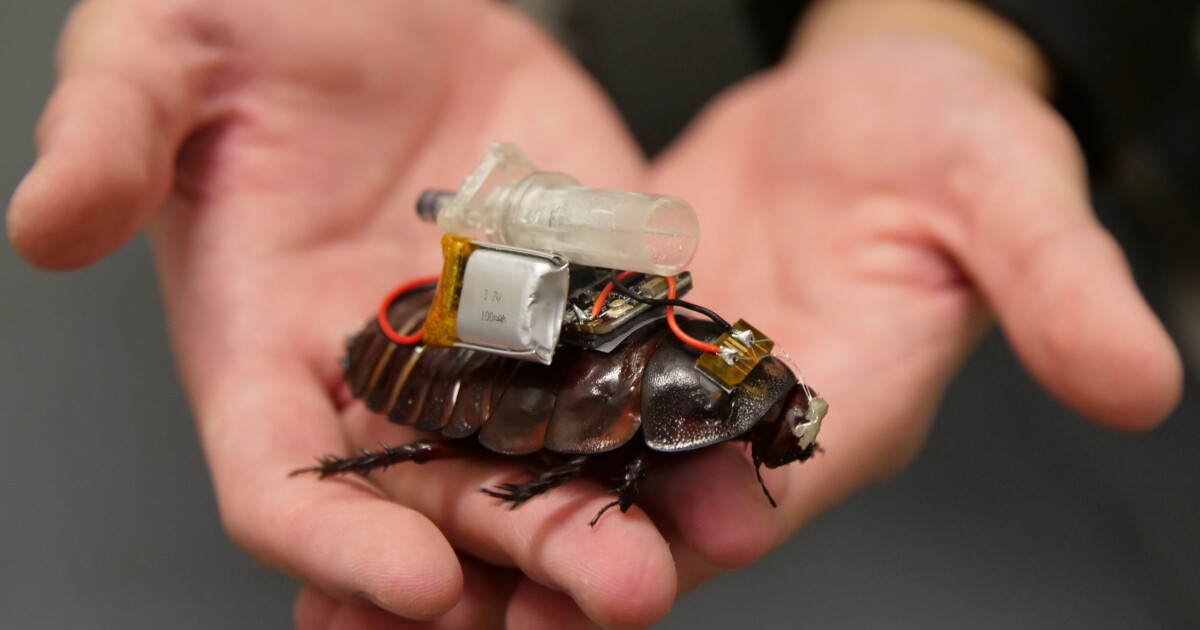
Engineers have turned them into cyborgs by attaching tiny electronic systems and cameras for remote control to their backs. Small and agile, cockroaches can get into places where conventional robots or drones can’t – not to mention people. Previous experiments have equipped cockroaches with underwater breathing system, improved their navigation skills, and even developed a machine that can turn them into cyborgs in seconds.
Now, researchers at the University of Queensland in collaboration with the University of New South Wales (UNSW) have taken the idea even further and turned cockroaches into … paraborgs – paramedic cyborgs.
The University of Queensland
The fact that cockroaches can squeeze through gaps in earthquake rubble, search for survivors, and help save their lives makes me like these insects a lot more. They obviously don’t know where to go on their own, so their movements are controlled by human operators. People can direct them by sending electrical stimulation to electrodes implanted near their antennae. In simple words, the bugs’ nerves are used as a steering system.
If you’re worried about cockroaches’ rights and well-being, they are given anesthetics when the electronic harness is fitted. Once the equipment is removed, they “retire” and live as long as other cockroaches, so the ethical side of their job seems to be taken care of.

The University of Queensland
But let’s get back to the rescue part. What happens after the cockroaches find someone?
Until now, finding a survivor was basically where their mission ended. The problem is that even when rescuers know where the survivor is, it might still take hours or sometimes even days to reach them. Providing medical assistance during this time could be crucial, and that’s now becoming part of the cockroach’s job.
So, on top of electronics and cameras, cockroaches are getting equipped with a needle-based drug-delivery system. The hardware is designed to be as small and lightweight as possible. It’s fitted to North Queensland giant burrowing cockroaches (Macropanesthia rhinoceros). Native to northeastern Australia, they are known as the heaviest cockroach species in the world, weighing around 35 grams (1.2 oz) and measuring roughly 8 cm (3.1 in) in length.
But even the world’s heftiest cockroach can only carry so much stuff on its back. That’s why, in the experiments, researchers used two of them. Both had “backpacks” with electrodes for remote control and, besides that, one acted as an observer, carrying the camera, while the other one was the paramedic, carrying the injection system – that spring-loaded system shoots out medication-filled hypodermic needles.

The University of Queensland
Positioning the paraborgs was another big challenge: when injecting liquid, they need to stay still for a little while. Researchers developed new control methods to help the insects not only move in the right direction and turn around, but also remain stable for long enough while delivering the medicine.
Even though it sounds almost like science fiction, this technology actually costs less than designing a miniature robot with comparable abilities.
The results of the tests were very promising. They showed 95% success with close-range injections within 15 cm (5.91 in) of the target. The complete navigation-and-injection task succeeded in 72% of trials, while the injection mechanism itself successfully delivered liquid about 90% of the time. It is important to note that all those tests weren’t conducted on people yet – researchers used silicone and pig skin instead.

The University of Queensland
There is still a lot of work to do before this technology can be used in real rescue operations, but so far, the study proves that the concept is feasible. The long-term vision is to create a whole rescue team of cockroaches, where each of them will be assigned their own role.
The whole idea of letting a giant cyborg cockroach crawl on your skin and letting it inject you might sound very off-putting for most people. But in a life-or-death situation, where nobody else is around, it must be more relieving than terrifying to see a brave cockroach showing up for you with medical supplies.
Source: The University of Queensland

