


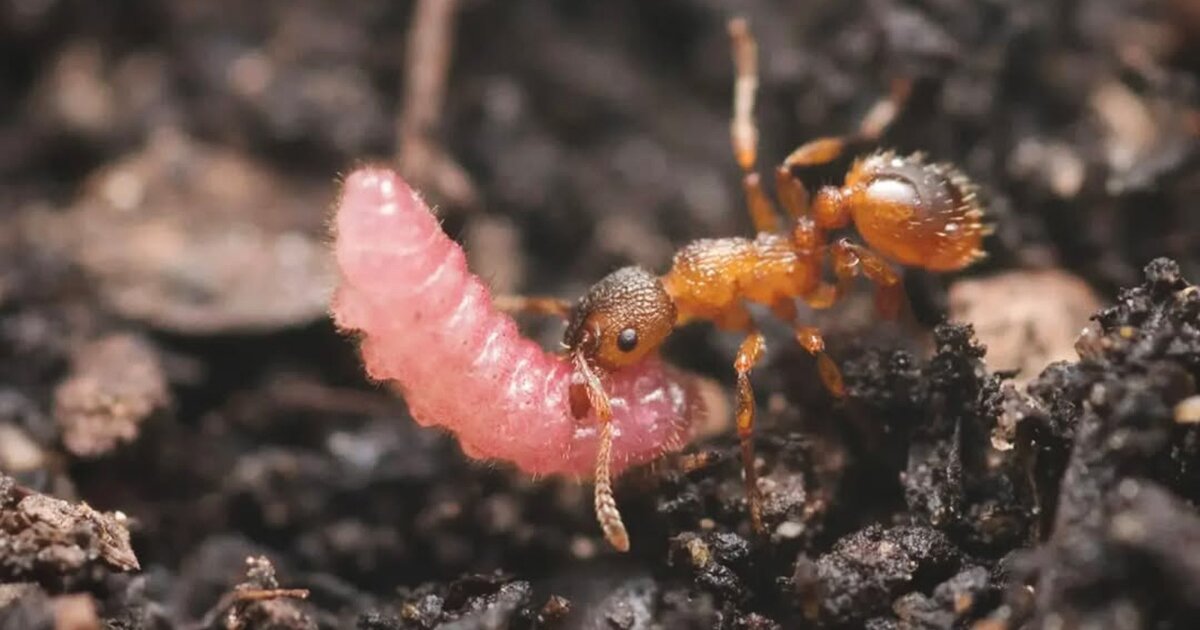
Baby caterpillars have figured out how to get themselves the royal treatment in certain ant colonies – getting carried around like precious cargo, fed on demand, guarded and being rescued from danger. But why would ants give this celebrity status to a caterpillar? The secret lies in perfect mimicry: the caterpillar copies not just the queen ant’s chemical scent, but the exact rhythm of her vibrations.
“In order not only to fool the ants, but to achieve a high social status in the colony hierarchy, they (caterpillars) are emitting sounds that are queen-like,” Francesca Barbero, a biologist at the University of Turin, told Refractor.
In an interview, Barbero told us that many butterfly larvae are myrmecophilous (ant-loving). These caterpillars have evolved in such a way that they need to be adopted by a specific genus of ants to complete their life cycles, “otherwise they cannot survive”. The level of myrmecophily varies; some caterpillars do this to secure shelter and food in the nest, while others just exploit the colony’s surrounding area.
This relationship may be parasitic or mutualistic, and is based on the butterfly’s ability to break the communication code of the host colony. Scientists have observed this myrmecophilous behavior for years, but the previous studies focused only on the chemical cues and simple acoustic signals, excluding the rhythms and precision.
Jeremy Thomas, a biologist at the University of Oxford, who was not involved in this study, tells us that in a paper in 2009, he and his co-authors found that Myrmica queens made distinctly different sounds from the workers’ acoustics, which, when played back, induced extra protection from workers within the colony. Both Maculinea larvae and pupae mimic these acoustics and gain similar royal protection from the workers.
To analyze the sounds produced by caterpillars in detail, Barbero and her colleagues studied the vibroacoustic signals from two ant and nine butterfly species, differing in the extent of myrmecophily. The team used a custom-made, highly sensitive recording device to record the vibrations produced by ants and caterpillars.
They found that every species they studied, regardless of whether they liked ants or not, used a regular rhythm, or isochrony. However, only highly myrmecophilous caterpillar species exhibit the complex rhythm known as double meter.
“The higher the level of myrmecophily, the more complex the signal, and this complexity is achieved through a specific rhythmic pattern,” Barbero told us. “This complexity in the rhythm is the first time, to my best knowledge, that has been recorded outside the primates.”
Daniel Sanchez / University of Warwick
Using these rhythmic patterns, highly ant-dependent caterpillars like Phengaris alcon and Plebejus argus convince the worker ants that they need queen-level care. James Mallet, a biologist at Harvard University, told us that since the caterpillars are parasites on the ant nest, they eat ant larvae. Mallet was not involved in this study.
In a surprising twist, butterflies are as precise as the queen ant in terms of emitting the rhythmic beats, but they emit the signal less often. Barbero told us that this can be explained by the fact that caterpillars are conserving their energy. Emitting a signal means utilizing precious, scarce energy.
“Being more silent and saving energy can be an advantage for the butterfly. They can emit a signal just when they need attention from the ant,” Barbero concluded.
The study has been published in the journal Annals of the New York Academy of Sciences.

