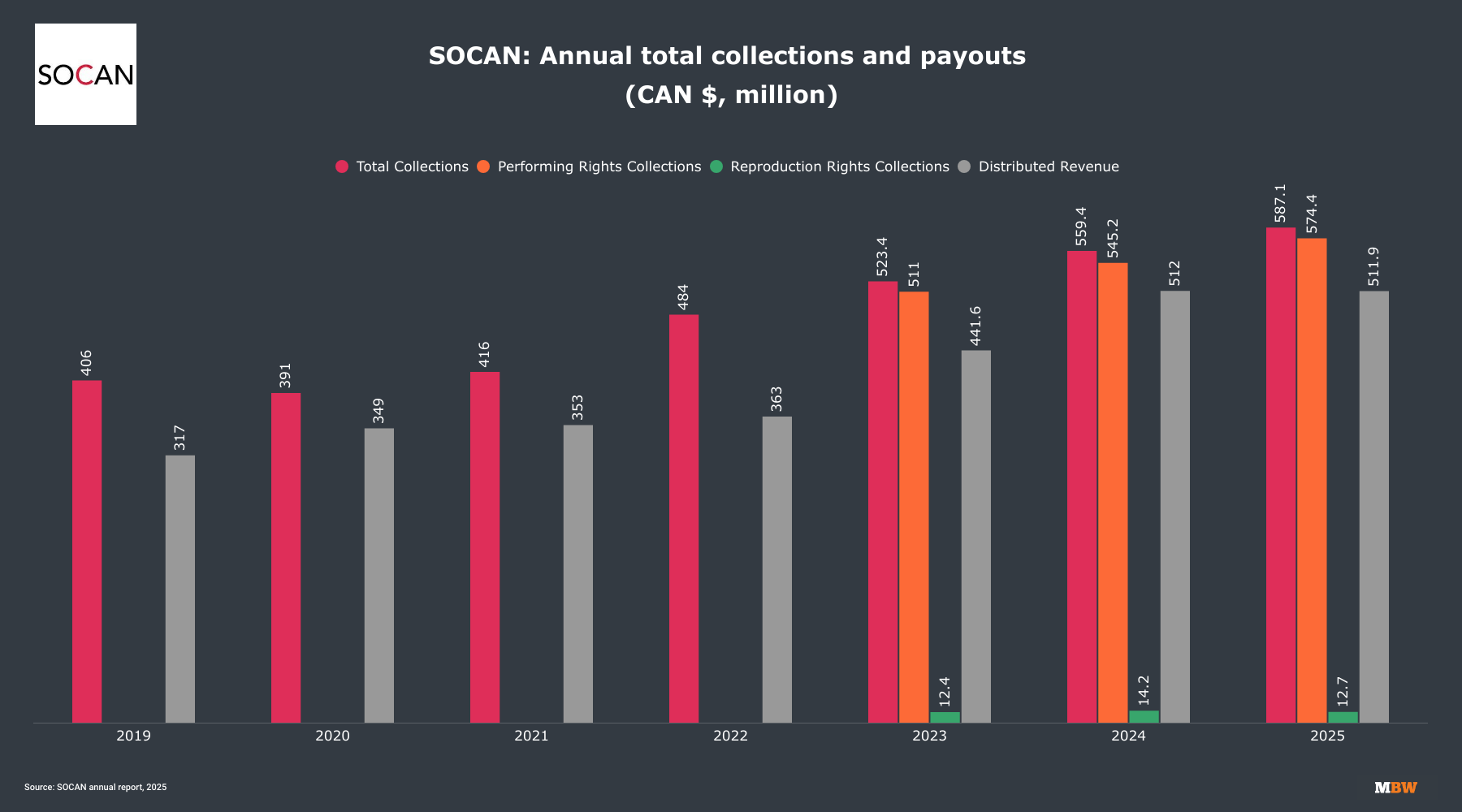



Canadian performing rights society SOCAN generated revenues of CAD $587.1 million ($420m) in 2025, up 5% compared with 2024.
That’s according to the society’s 2025 financial results published April 8, which showed that digital streaming continued to drive growth across the domestic market.
SOCAN distributed CAD $511.9 million ($366m) in royalties to members during the year, just below the CAD $512.4 million distributed in 2024.
Of the total, CAD $183.8 million ($131m) went to rightsholders for music used within Canada, CAD $126 million ($90m) came from international performing rights, and CAD $11.8 million ($8.4m) from reproduction rights.
Revenue from music used in Canada climbed CAD $23.9 million ($17.1m) to CAD $445.5 million ($319m), with digital sources accounting for CAD $232.8 million ($166m) of that total, up 11.5% YoY.
Elsewhere, General Licensing and concert revenue rose 16.1%. International revenue, reflecting demand for Canadian music abroad, grew CAD $3.9 million ($2.8m) to CAD $141.7 million ($101m).
SOCAN used the announcement to stress how “AI is placing mounting pressure on music rights and the livelihoods of music creators.”
A 2025 survey conducted by SOCAN and Pollara found that 81% of Canadians believe supporting local music creators is essential to the future of Canadian culture.
SOCAN says it has mobilized a national campaign that generated 8,700 letters to government urging policymakers to block any exception that would allow unlicensed use of music for AI training purposes.
“There is an urgent need for modern protections rooted in consent, credit and compensation, to provide songwriters and composers with a reliable foundation from which to support their families and continue making music.”
Jennifer Brown, SOCAN
The lobbying has reached Canadian Prime Minister Mark Carney, with SOCAN CEO Jennifer Brown and CISAC President Björn Ulvaeus meeting with Carney to discuss protecting human creativity in the age of AI.
Brown said: “SOCAN’s financial results show increased revenues but we all need to acknowledge that Canadian songwriters and composers are living a different reality.”
“There is an urgent need for modern protections rooted in consent, credit and compensation, to provide songwriters and composers with a reliable foundation from which to support their families and continue making music.”
Meanwhile, SOCAN’s operating expenses rose alongside its revenue, with the expense-to-revenue ratio reaching 13.4% in 2025. The organization attributed the increase to investment in enterprise technology initiatives and expanded educational and career development programs for members.
In October 2025, SOCAN, alongside US PROs ASCAP and BMI, announced an alignment of their AI registration policies. The organizations said they will now accept registrations for musical works that are partially generated using artificial intelligence.
All CAD-USD conversions made at the average annual exchange rate for 2025 rate as published by the IRS.
Music Business Worldwide