


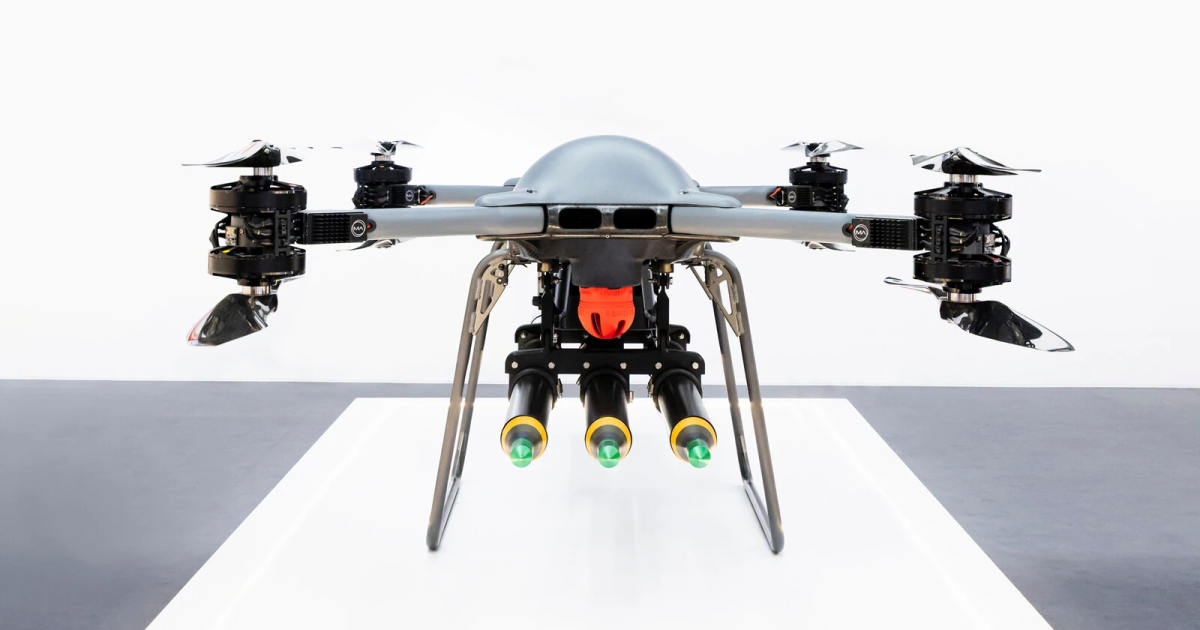
BAE Systems has upped the counter-drone firepower of a quadcopter while keeping costs down by equipping a Malloy T-150 UAV with enough laser-guided precision missiles to counter multiple drone threats during a recent test at a US Air Force base.
Destroying incoming attack drones is relatively simple. Modern interceptor missile technology has advanced to the point where even massive, multi-tiered attacks can be blunted with a high degree of probability. However, that isn’t much to boast about when the interceptors are many times more expensive than their targets and take much longer to manufacture in large quantities.
That’s the reason why a major trend in military spheres is to create counter-drone systems that are not only effective, but can be built cheaply and in vast numbers in a short time. It’s even better if that involves actually increasing the firepower and precision of the interceptors.
BAE Systems’ Advanced Precision Kill Weapon System (APKWS) transforms standard 70-mm rockets into laser-guided precision missiles. The company has now installed a production-ready three-pod launcher loaded with APKWS missiles on a modified Malloy T-150 (TRV-150) quadcopter.
The TRV-150 is built by BAE Systems’ Malloy Aeronautics subsidiary and was originally designed as a heavy-lift tactical drone for the Royal Navy and US Marines for resupply missions before being repurposed for drone interception missions. Equipped with the new multi-missile launcher, the TRV-150 was tested by the US Office of the Under Secretary for Research & Engineering at Eglin Air Force Base in Florida. During the exercise, the interceptor was able to engage with and neutralize several targets without having to land or reload.
What this means is that it’s possible to build interceptor swarms in sufficient numbers with enough firepower to deal with large, hostile swarms. Not only that, but such interceptors can be developed much faster by using already deployed technology and components, and that these interceptors can be dual use, so that during relatively quiet periods they can be used for resupply and reconnaissance missions.
“Our customers are facing drone threats right now, so we’ve worked at pace with our partners to move from concept to a proven system, which can engage multiple targets in a single mission,” said Thomas Lancashire, Head of UAS Business Development, BAE Systems’ FalconWorks. “Military technology is evolving faster than ever and it’s vital that effective capabilities reach those who protect us as quickly as possible. In today’s environment, the speed at which we deliver equipment can be just as important as the system itself.”
Source: BAE Systems

