


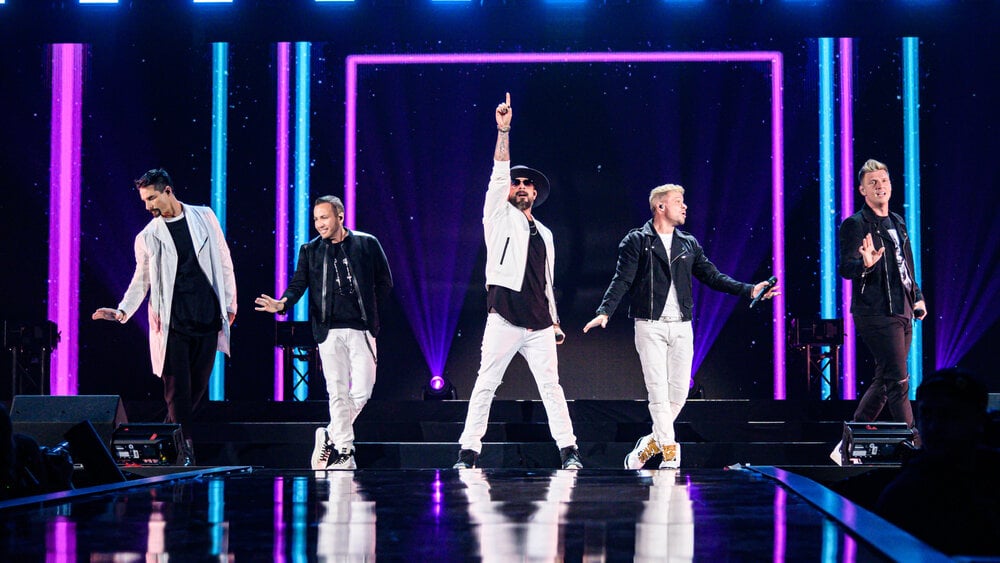
The Backstreet Boys have filed a trademark to protect the sound of their voices from AI.
The application, made with the US Patent and Trademark Office (USPTO) on June 24, covers the group saying: “Hi, we’re the Backstreet Boys.”
The filing was first reported by intellectual property attorney Josh Gerben of Gerben IP.
It takes a page from Taylor Swift’s playbook, after the pop star applied to register her voice saying “Hey, it’s Taylor” in April.
If the mark is granted, it would give the group an additional means of contesting AI-generated imitations of their voices online: content that has grown cheaper and easier to produce as the technology improves.
The strategy rests on how online platforms already police trademarks, according to Gerben.
He points to platforms such as Google, Amazon, Meta, Etsy, and eBay, which already pull listings flagged as trademark-infringing without waiting for a court.
The bet, Gerben wrote, is that AI platforms will eventually extend that treatment to registered sound marks, blocking audio that mimics an artist before it spreads.
“Whether that strategy succeeds remains an open legal question,” Gerben wrote.
Trademark law “has never really been used this way,” he added, noting that marks have historically protected words, logos and slogans rather than the sound of a voice.
Registered sound marks include the Netflix “tu-dum,” the NBC chimes and the Metro-Goldwyn-Mayer lion’s roar.
A sound qualifies only if it works as a “source identifier,” meaning listeners tie it to a specific company, according to Gerben IP.
The Backstreet Boys are not the first music act to try the approach.
Lionel Richie filed four applications in June, each covering a phrase from one of his songs, including “Hello, is it me you’re looking for?”
Actor Matthew McConaughey has registered audio of his Dazed and Confused line “Alright, alright, alright.”
Talk-show host Jimmy Kimmel has filed similar applications this year, according to Gerben IP.
A trademark is only one route, and in the US, a person’s name, image, likeness, and voice have more often been covered by right-of-publicity laws.
Those rights are recognized by statute in around two dozen US states, with roughly a dozen more relying on common law, and the protections vary.
Tennessee went furthest with its ELVIS Act, which in 2024 became the first US state law to extend voice protection explicitly to AI-generated replicas. States including California had long protected a person’s actual voice under right-of-publicity statutes, but not against AI deepfakes.
Copyright protects recordings and songs, not the sound of a voice itself, and offers the Backstreet Boys little recourse against an imitation.
A separate effort is underway in Congress.
The US Senate Judiciary Committee on June 18 advanced the NO FAKES Act, the bipartisan bill that would create a federal right protecting Americans’ voice and likeness from AI-generated deepfakes.
The committee passed it by unanimous voice vote, as reported by MBW, sending the measure toward a vote by the full Senate.
Formally the Nurture Originals, Foster Art, and Keep Entertainment Safe Act, it would create a federal intellectual property right in a person’s voice and visual likeness – the first in US law.
It would cover every American, not only public figures.
The bill runs on a notice-and-takedown system modeled on the DMCA, with a counter-notice process for material removed in error and carve-outs for First Amendment uses such as news reporting and parody.
The penalties are tiered: $5,000 per work for an individual, $25,000 per work for a company that creates or distributes a replica, and up to $750,000 per work for an online service that fails to comply.
That $750,000 ceiling is the flashpoint for the bill’s critics.
Three Republican senators, Mike Lee, Ted Cruz, and Eric Schmitt, raised First Amendment concerns as the measure cleared committee.
It is the third attempt to pass the bill, after a July 2024 version ran out of time and an April 2025 reintroduction failed to advance out of committee.
A bipartisan group reintroduced the latest version, S.4591 in the Senate and H.R.8915 in the House, on May 20.
Backers include Universal Music Group, Sony Music, and Warner Music Group, alongside Spotify, Google, OpenAI, IBM, and YouTube.
YouTube has begun rolling out an AI likeness-detection tool, built on the same principle as its Content ID system, and has opened it to celebrities and talent agencies.
Sony Music asked streaming services in March to remove more than 135,000 tracks it said were AI fakes impersonating its artists.
The trademark filings are a bet that a registered USPTO mark will slot into those takedown systems.
How AI platforms handle the new marks, Gerben wrote, will be “one of the most interesting trademark stories to watch over the next 12–24 months.”
The Backstreet Boys are now among a swelling group of artists betting that trademark law can be stretched to fit the AI age, even as Congress weighs a federal alternative in the NO FAKES Act.Music Business Worldwide

