


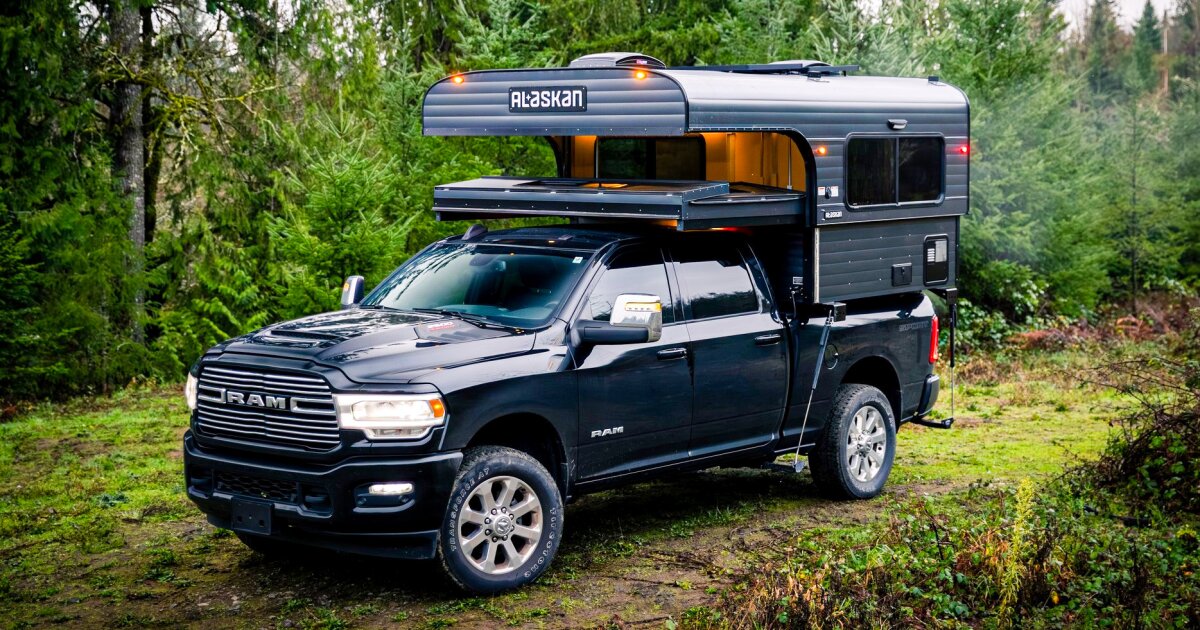
With the sheer preponderance of flappy, fabric-walled pop-up truck campers, hard-sided pop-up pickup camping systems feel cutting edge, even today. But they actually have a long, proud history dating back to the mid-20th century. And no manufacturer then or now has been as integral to that history as Alaskan Campers, a true pioneer that’s been building telescopic-roofed pickup campers for over 60 years. Now the company takes a detour and turns its attention to a different style of camper, launching a fixed high-roof composite camper meant to save weight and expand availability to more truck platforms. The all-new HS640 kickstarts a new era in Alaskan truck camping.
We knew Washington-based Alaskan Campers predated the overlanding craze of the 21st century by a fair number of years, but we didn’t realize just how deep its gnarled roots ran until just recently. When we were looking back at some vintage telescopic hard-sided campers in covering the revival of the Australian-developed Prattline Low Tow, we discovered that Alaskan founders Don and Irene Hall were working on their first-of-its-kind telescopic pickup camper around the same time Prattline and Hi-Lo were kickstarting the telescopic camping trailer market.
Inspired by mishaps on an Alaskan adventure of their own, and the sliding top-over-bottom action of hat and match boxes, the Halls started building their prototype in 1953 and took it for an official Alaskan shakedown in 1957. Just like today, you can’t take a conspicuous new camper on the long road without getting peppered with questions and purchase inquiries, and even on a trip to lonely, remote Alaska, the Halls found themselves fielding inquiry after inquiry. The decision to turn their camper design into a business became an obvious one, and they showed it at a sportsmen’s expo in Los Angeles in 1958.
Alaskan became the original trailblazer of the hard-sided pop-up pickup camper concept, which has received some new attention in recent years. The truck camper market at large was little more than a decade old when the first Alaskan campers arrived, and older models like the Cree Truck Coach were fixed-roof designs. Alaskan, then, was even a pioneer of pop-up pickup campers in general, predating other long-running innovators like Four-Wheel Campers by over a decade.
Alaskan Campers
At first, Alaskan specialized exclusively in boxy non-alcove hydraulic lifting-roof campers, but by the early 70s it expanded into a cabover style that eventually proved so popular it became Alaskan’s signature and, in some model years, its only available body style. It’s these cabovers that we best recognize as Alaskan Campers today, and while the manufacturer has made tweaks and improvements over the years, a 2026 Alaskan camper still looks very much like one from the 1970s.
The campers are also known for their rugged, heirloom-grade durability, so that Alaskan you see in 2026 might in fact be from the 1970s.

Alaskan Campers
So why switch tacks when you have such a deep, successful history in a market niche that you invented?
After changing hands several times over the years, Alaskan came under its current ownership in 2024. There’s no sign the new owners are abandoning the company’s bread-and-butter hard-walled telescopers, but they are working to adapt and evolve for modern market realities, both in terms of product offerings and development and production methods. The HS640 has been developed from the ground up as a lightweight, well-insulated camper that’s compatible with a wider variety of truck platforms.
Alaskan started off by leaving the traditional aluminum-skinned wood frame construction behind in favor of 1.5-in fiberglass-skinned PIR foam-core panels supported with an aluminum/PVC hybrid frame designed to break up thermal bridging at critical points for better insulation.
The HS640 takes the form of a fixed-roof cabover that reminds us more of the Scout family of campers than anything that’s previously worn the Alaskan badge, only a bit more crisp-edged and angular than Scout’s design. Weight starts right around 1,200 lb (544 kg), about 350 lb (159 kg) lighter than anything else in Alaskan’s current lineup.

Alaskan Campers
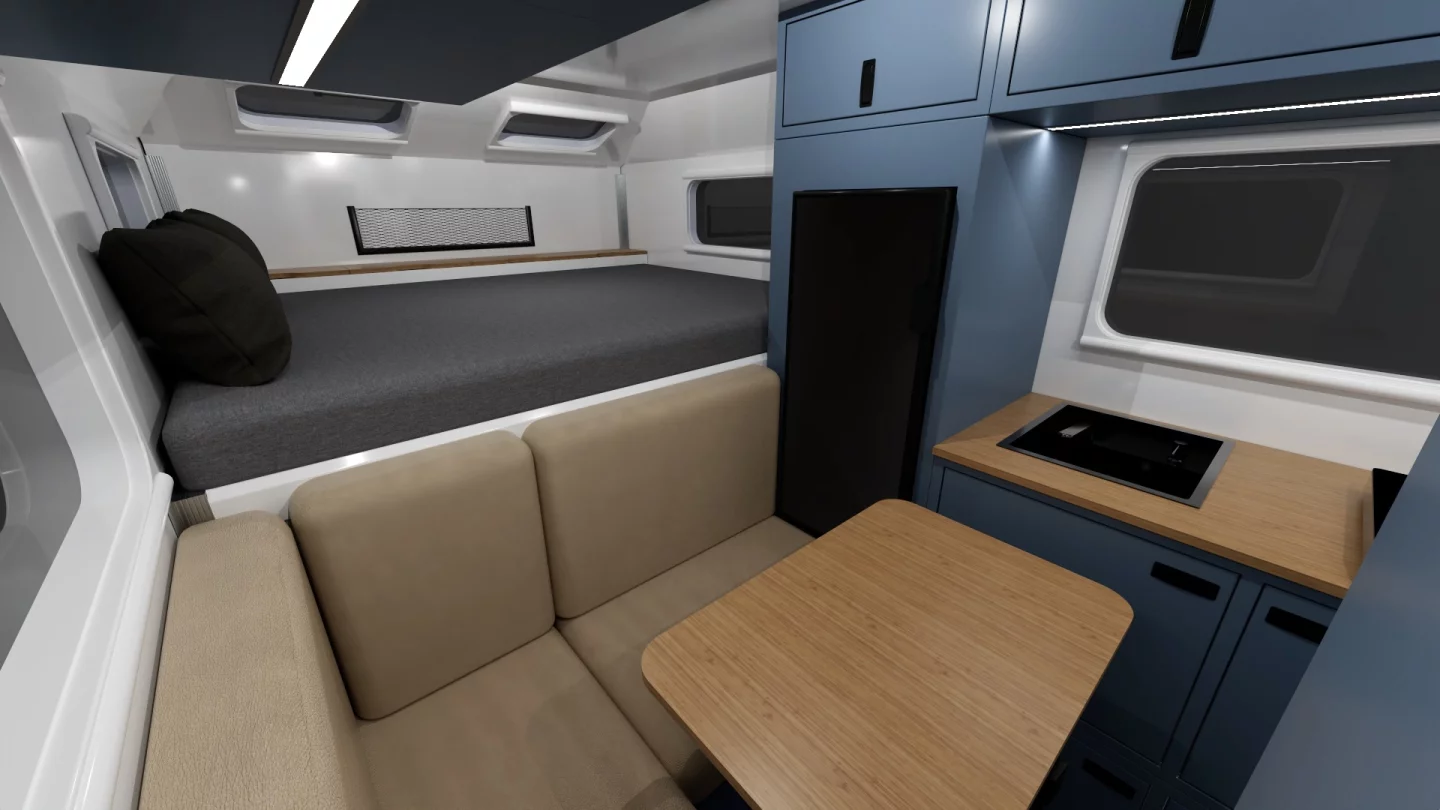
The initial HS640 renderings show a familiar layout with a 60 x 76-in (152 x 193-cm) east/west bed up in the alcove and a wraparound sofa and dining table just below. The galley starts directly next to the lounge with an available 90-L Isotherm door fridge/freezer and extends down the passenger sidewall with a countertop with inbuilt sin and available portable induction cooktop. The kitchen area also includes under-counter and overhead aluminum cabinetry.
Across the aisle, the entry is flanked by a full-height cabinet, and a row of overhead cabinetry runs back to the bed. It’s a more fixed, permanent layout than the common modular interior on campers from Scout and others, creating more of a stable, familiar place to stay from one campsite to the next. In addition to all the aluminum cabinet storage, Alaskan mentions underfloor storage and offers multiple available MOLLE panels all around the exterior for securing gear.
Alaskan Campers
Alaskan plumbs in a 57-L fresh water tank as standard and also builds out a full electrical system with 324-Ah battery bank and Victron 3,000-W inverter, touchscreen command center and DC-DC converter. It also wires in a 200-W solar panel, 30-A shore power hookup, and external solar and Starlink ports. Equipment like air conditioning, diesel heating, water heating, dry separating toilet and indoor/outdoor shower system are optional.
The “Premium” floor plan and equipment package shown in renderings is one of four individual offerings available and starts at US$48,995 before add-on options. Other packages start at $44,995. Alaskan launched HS640 ordering last week and says it’s available to fit inside the closed tailgates of 6.5-foot-bed full-size trucks from Chevy, Ford, Ram and Toyota.
Source: Alaskan Campers

