


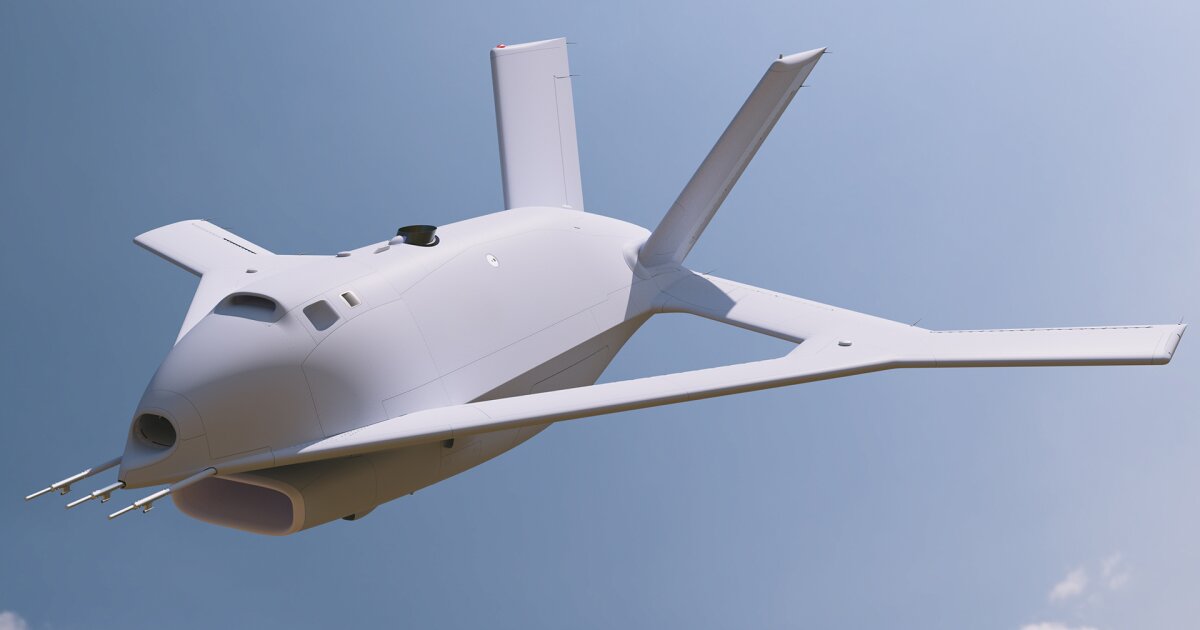
Aurora Flight Sciences just announced that the triangular wings of the X-65 have arrived at its Virginia assembly facility, where they are now being integrated onto the fuselage. With that milestone cleared, DARPA – the Pentagon’s advanced research arm – and Aurora are targeting a first flight before the end of 2026.
It’s a welcome update for a program that’s accumulated years of delays. The X-65, developed under DARPA’s CRANE program (Control of Revolutionary Aircraft with Novel Effectors), was originally scheduled to fly in the summer of 2025. Cost overruns, technical hurdles, and supply chain disruptions forced the team to pause. Now, with the airframe coming together, both partners believe the finish line is in sight.
What makes this aircraft genuinely unusual isn’t its shape, though the “joined-wing” configuration – which fuses two pairs of wings at their tips to form a triangular silhouette on each side – is striking enough. The X-65 has no moving control surfaces at all. No flaps, no ailerons, no rudder.
The wings have arrived — the next big milestone for X‑65! Built at our WV facility, the triangular wings enable active flow control testing across multiple sweeps. Integration is underway in VA as we push toward first flight for the @DARPA CRANE program. pic.twitter.com/w6jhT7ptzI
— Aurora Flight Sciences (@AuroraFlightSci) June 23, 2026
Instead, the craft maneuvers using Active Flow Control (AFC), a system of 14 nozzles distributed across every flight surface. These nozzles blast precisely timed jets of high-pressure air into the thin layer of airflow hugging the wing. That disruption acts like an invisible obstacle, nudging the airflow in ways that tilt, yaw, or roll the aircraft with no mechanical hinges required.
The wing design is modular, with swappable outer panels and interchangeable AFC nozzles to allow future testing of different configurations.
For the early test flights, the X-65 will carry a set of conventional mechanical control surfaces as a backup – what former CRANE program manager Richard Wlezien called “training wheels to help us understand how AFC can replace traditional flaps and ailerons.” The plan is to progressively lock them out as the air-jet system proves itself.
Fourteen air-jet nozzles replace all moving surfaces, steering by nudging airflow.
According to Aurora, the drone has a wingspan of 9.1 m (29.9 ft), a maximum speed above 800 km/h (497 mph, or roughly Mach 0.7), and a gross weight of approximately 3,175 kg (7,000 lb).
As DARPA states, virtually every other system on an aircraft has been transformed since the Wright Brothers flew in 1903, except the way pilots steer. The X-65 is the most serious attempt yet to change that at full scale.
Eliminating external moving parts has concrete payoffs. A cleaner airframe is more aerodynamic, lighter, easier to maintain, and has fewer mechanical failure points. For military unmanned aircraft, it also removes the physical constraints that come from designing around a human pilot.
But the stealth implications may be the most strategically significant. Traditional control surfaces, by definition, create gaps and edges that scatter radar energy and inflate a plane’s radar cross-section. AFC could allow engineers to design genuinely seamless airframes that are far harder to detect.
X-65: Designed to Demonstrate Active Flow Control
This isn’t the first time AFC has been tested in flight. BAE Systems flew a small-scale demonstrator called MAGMA in the late 2010s using supersonic air jets for control. But the X-65 operates at a different order of magnitude – a full-size, high-subsonic aircraft designed to prove the concept outside the wind tunnel.
If the first flights go well, the data could eventually inform the next generation of both military drones and, further down the line, commercial aircraft.
Source: Aurora Flight Sciences via X

