


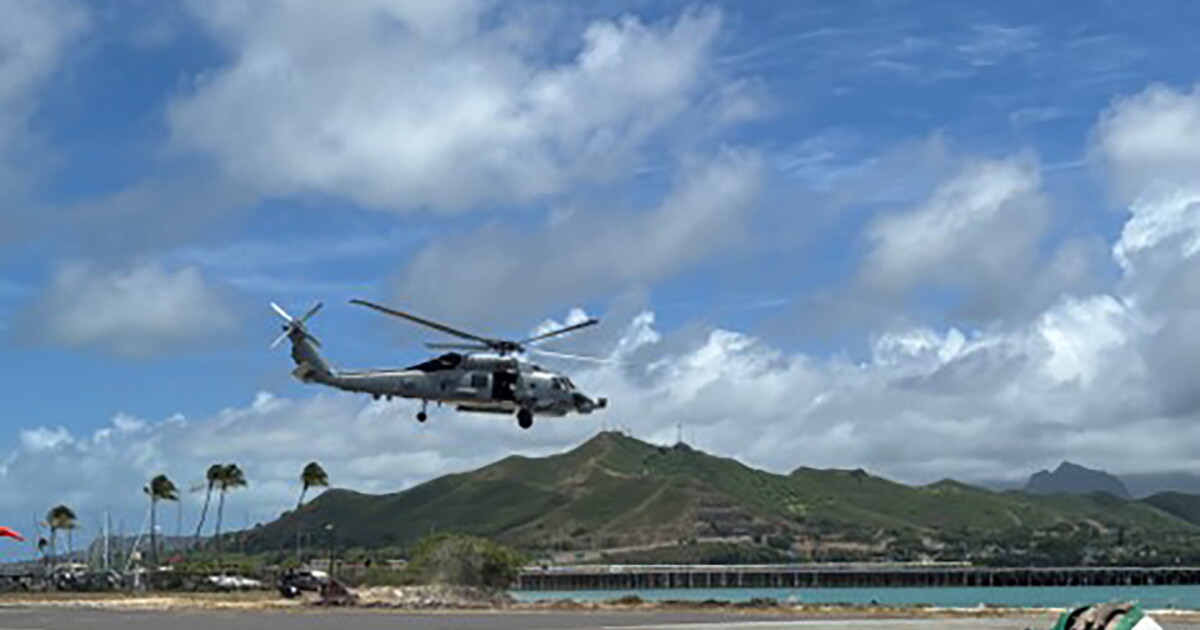
AI-equipped helicopters went on the offensive off the islands of Hawaii as the US Navy and Lockheed Martin set two modified Sikorsky MH-60R Seahawk helicopters to hunt submarines using a new AI sonar system as part of the RIMPAC 2026 naval exercises.
Thrillers like 1990’s Hunt for Red October and similar fare make submarine hunting look like the most exciting thing this side of pulling a nose hair out of an angry grizzly bear, but the reality is entirely different.
Sub hunting goes on all the time, usually to keep crews in practice as well as to monitor the locations and capabilities of potentially hostile boats lurking beneath the waves. Unless a vessel commander has gone raving mad, these exercises tend to be boringly routine: friendly submarines and surface ships tow long sonar arrays, sonar experts listen for hours on end for specific acoustic signatures, and helicopters drop sonobuoys across vast areas to plumb the depths for submarines across as large an area as possible.
What major navies want is to automate as much of this skulking about as possible to free up human crews for more complex and interesting tasks. Achieving that requires much more than self-flying helicopters dropping the odd sonobuoy. Aircraft must also be able to collect and expertly interpret the data that the sensors send back to them.
To bridge this gap, the US Navy tested AI on Seahawk helicopters as an assistant to human aircrews.
The purpose of the RIMPAC demonstration was to showcase a new artificial intelligence and machine learning (AI/ML) sonar processing system called SensorMAX. Essentially a portable acoustic expert, SensorMAX continuously processes spectral energy profiles and data from up to eight subsurface sonobuoys simultaneously – doubling the feed capacity of legacy systems. Through continuous data capture and signal labeling, SensorMAX assists aircrews by keeping an eye on the data stream and flagging potential threats.
Anything that cannot be classified or is completely new is sent by operators to a ground station for further analysis. Lockheed Martin highlights that the system can be retrained based on this analysis in under five minutes while the helicopter remains airborne, transmitting updated models over encrypted data lines, which is a great time saver all around.
The result is a system that, in the long term, could carry out sub hunting autonomously, but in the short term acts as an onboard co-pilot, freeing up human operators while doubling sonobuoy processing capacity. Furthermore, because SensorMAX is a machine-learning platform, it can improve itself based on the increasing amount of data collected by various sensors.
“Today’s battle-space requires the defense industry to accelerate capability delivery and seamlessly integrate commercial technology; at RIMPAC 2026 our mission‑focused engineers demonstrated exactly how we are meeting that challenge,” said Devon Rodgers, vice president and general manager, Undersea Mission Systems. “Lockheed Martin is investing its own resources to mature AI capabilities, blending commercial innovation with our engineering expertise so the Navy has the technology it needs for tomorrow’s battles.”
Source: Lockheed Martin

