


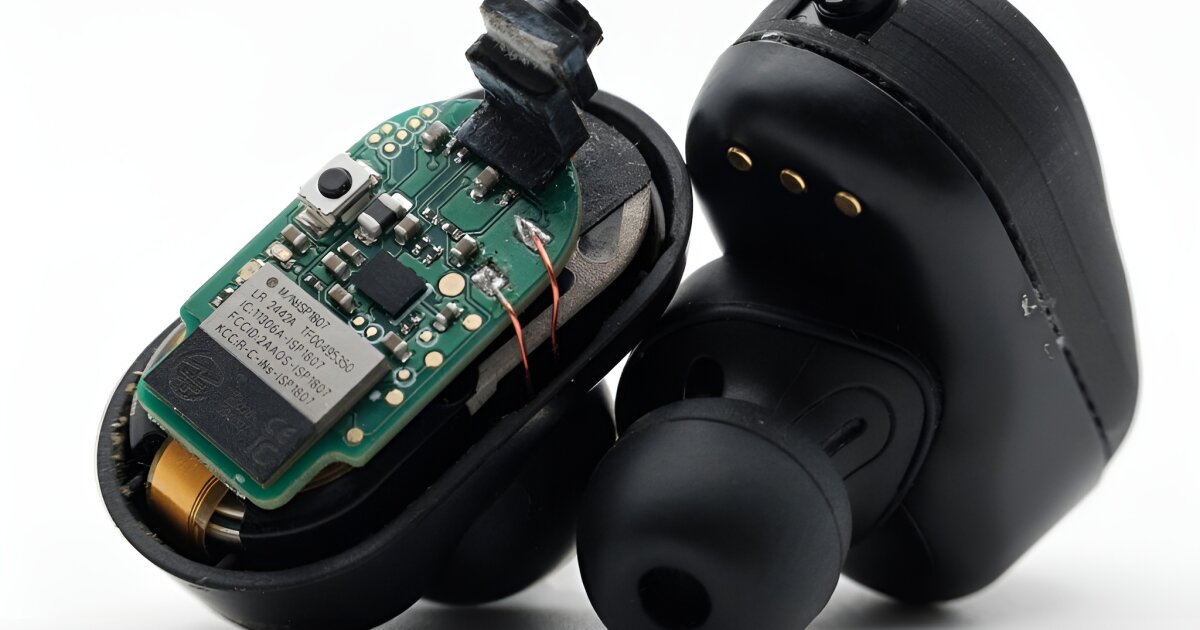
Earbuds are small, which is great for comfort, but their tininess is a serious limitation for actually doing things other than letting you hear and talk. You can’t use them to fly, fry, pry, or purify. Compare them with a smartphone and they’re one-hit (two, actually) wonders, right? They’ll never even compete with a Swiss Army Knife. Pathetic.
But what if you shoved cameras inside your earbuds and connected them to a voice-activated, speaking LLM (large language model) that could answer your questions about anything you were looking at?
Uh, why would anybody do that? Well, ever hear of described audio (DA), bud? And while DA would be massively helpful to anyone with visual impairments, imagine the benefits for safety, productivity, and navigation from simply being able to ask questions and get answers from a disembodied voice in your ear (like the Great Gazoo, Harvey, or Head Six) that can “see” exactly where you’re looking. And no, not questions like, “Is God hiding behind that cloud,” but more like, “What does this Spanish road sign mean?” or “What are all these devices on my new work station?”.
So, why not just use Google Glass? Turns out that the public hated those enough to call their users “Glassholes,” partly because citizens didn’t appreciate ordinary people turning themselves into unwitting, nonstop spies for Big Data at a cost of $1,500 while looking like cyborgs.
Well, apparently Maruchi Kim, Rasya Fawwaz, and the rest of their University of Washington at Seattle co-authors must have understood all that, because as they explained in their Human Factors in Computing systems conference paper, they’ve created what are known as VueBuds. Their innovation houses tiny cameras inside standard Sony WF-1000XM3 earbuds, and uses a built-in vision language model (VLM) so users can verbally ask questions and get answers about what they’re seeing – an extremely convenient, mobile, and audio version of reverse image-search for description, explanation, and translation.
According to senior author Shyam Gollakota, a UW professor in the Paul G. Allen School of Computer Science & Engineering, VueBuds overcome the ghost of Google Glass in several ways.
First, they do so by embedding rice-grain-sized cameras inside earbuds, because even in the year 2026, “a lot of people don’t like wearing glasses.” As well, not only do people being observed hate the invasion of their privacy, so do the observers themselves, as “recording high-resolution video and processing it in the cloud” offers a user’s social-geographic life on a digital platter to our Big Data overlords. “But almost everyone wears earbuds already,” says Gollakota, “so we wanted to see if we could put visual intelligence into tiny, low-power earbuds, and also address privacy concerns in the process.”
According to the Gollakota and his colleagues, VueBuds are also fast and low-power, largely by turning a low-bandwidth, low-resolution bug into a feature. The low-res black-and-white cameras need less than 5 mW to work, and then automatically deactivate to save battery life. The authors claim that in a test with 17 visual question-and-answer tests involving 90 users, VueBuds achieve “response quality on par with Ray-Ban Meta,” demonstrating their “compelling platform for visual intelligence” that bring “rapidly advancing VLM capabilities” to earbuds, one of the world’s most widely used wearable devices.
In the following demonstration video, a man stands in an apartment kitchen while wearing VueBuds, which in the video are larger than typical earbuds – closer to the thumb-sized Bluetooth earbuds from 20 years ago. He asks for a description of where he’s looking, and in about a second, an AI voice imitating a relaxed human woman announces, “I see a kitchen area with a window letting it a lot of light. On the counter, there are some bottles and a book. The window has blinds, and there’s a sink to the left.”
Vuebuds: Tiny cameras on wireless earbuds
Then, while looking at the cover of an LP, he asks VueBuds to tell him the name of it. The voice quickly and correctly responds, “I see a photograph of an album cover on the table. It appears to be Abby Road by the Beatles.” According to the researchers, in tests with 16 participants, VueBuds was correct around 83% of the time during object-identification and translate, and 93% when identifying book titles and authors, meaning that one day every user who can’t read Mandarin could order from the “secret” Chinese menu (not secret to a billion people) or read manhwa that haven’t yet been translated from Korean.
But since the cameras are in earbuds at the sides of your face, wouldn’t your own head block the cameras’ views? No, thanks to the same principle that allows all of us two-eyed creatures to see and understand the world: stereoscopic vision. Just as your brain effortlessly combines visual data from two pupils about a palm’s width from each other, the VueBuds’ AI meshes two separate camera images into one.
The VueBuds tech does have limitations. Its use of monochrome cameras means VueBuds can’t answer any questions about color, and currently, real-world navigation and translation for readers and travelers requires higher-powered, high-resolution cameras. Nor can the battery sustain continuous video-streaming of large amounts of data from its still-image cameras.
Also, lest anyone imagine that VLM seeing-eye buds are nothing but a benefit for humanity, remember a few years ago when a tech company was boast-posting about their new product with the rhetorical question, “What if an app could snap a picture to tell you a stranger’s name?” The memed response was “Women would die.”
The current version of VueBuds likewise offers only minimal reassurance that it doesn’t pose a potential threat to public safety.
A small “on” light doesn’t mean much – how many people being watched would think an earbud is taking their picture? And while the device shoots only low-resolution, B&W still images, when combined with audio-capture and Bluetooth connection to the internet for third-party facial recognition, the threat to privacy is obvious and massive.
However, if regulators can assure public safety, devices such as VueBuds can offer enormous freedom and improvements in quality of life and leisure for countless people with access to them.
Source: University of Washington

