


The coolest thing about electric motorcycles is just how open the market is. Anyone – literally anyone – with a compelling idea, a competent engineering team and a way to get bikes into Western showrooms has a fighting chance of becoming the next big thing. That’s almost unheard of in the internal combustion world, where more than a century of engineering know-how, sprawling dealer networks and fiercely loyal fanbases make it incredibly difficult for newcomers to break through.
Electric motorcycles have effectively hit the reset button. Suddenly, a startup from Indonesia can grab as much attention as an established European marque, and Charged, an e-mobility startup from Indonesia, certainly looks like it’s trying.
The bike in question is the Ndara, and if you look purely at the spec sheet alone, it probably doesn’t look like anything special. A peak output of 11 kW and a top speed of 77 mph (125 km/h) places it roughly in the 125cc class.
Power is supplied by either one or two 4-kWh battery pack(s), which weigh around 26 lb (12 kg) for one and around 50 lb (24 kg) for two batteries. Claimed range is up to 60 miles (100 km).
What’s interesting is that it comes with a type 2 charger, which is exactly what you’d find on electric cars, meaning you wouldn’t waste your time finding a proprietary charging plug. Charging, by the way, takes 40 minutes to go from 5 to 80 percent.
Charged
Charged has offered a fair bit of electronic aids on board, starting with ABS, traction control, hill hold (hill start assist), and hill descent assist. There’s also an “Overtaking Boost” mode that’s designed to provide extra power when overtaking, and a handy energy regen mode that recovers some energy whenever you decelerate or brake.
It comes with a wheelbase of 54.2 in (1,378 mm), a decent ground clearance of 7 in (180 mm), and a rather approachable seat height of 31.4 in (800 mm). It weighs 242 lb (110 kg) and rolls on 17-inch wheels front and rear.
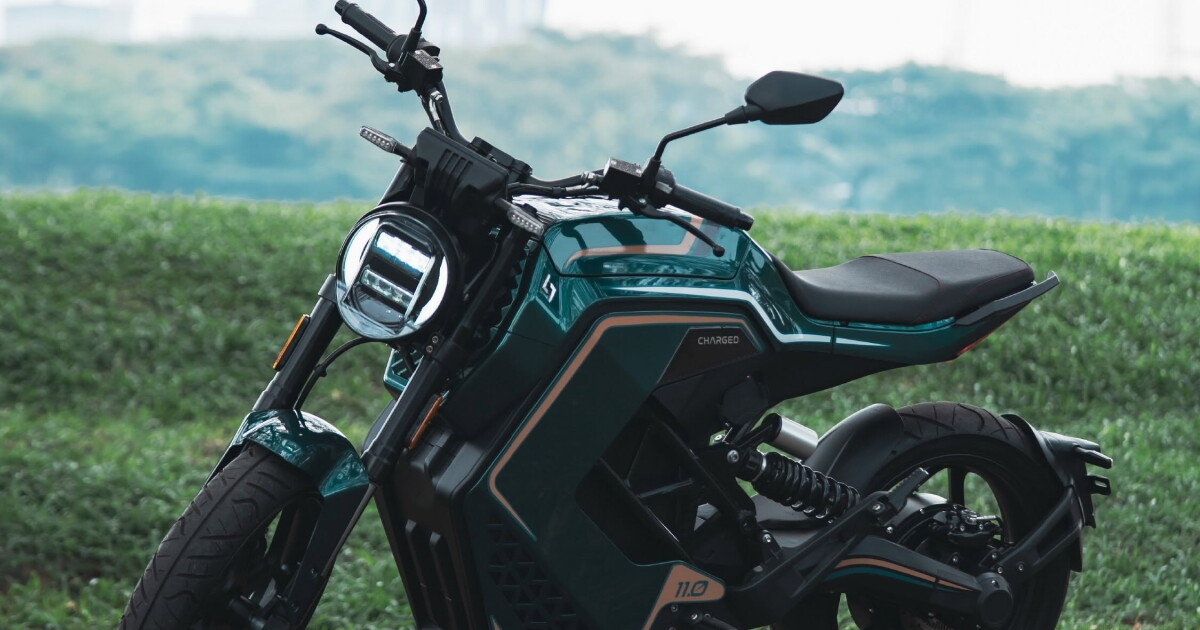
But when I look at it, I wonder how a company from Indonesia built an electric naked that looks like it wandered straight out of a futuristic design studio. It looks like the Honda CB300R and a Husqvarna Vitpilen had an electric baby.
Someone told me the frame on the Ndara reminds them of the Brammo EmpulseR. And now I can’t get it out of my head. The compact chassis wraps tightly around the powertrain, while the trellis-style frame and exposed swingarm lend it an honest, mechanical appearance.

Charged
I like the angular lines running across the bodywork. Up front, the circular LED headlamp injects just enough retro charm to soften that otherwise angular bodywork, creating a silhouette that feels like a cross between a café racer and a streetfighter.
The sharply sculpted faux tank, floating tail section and minimalist side panels leave little visual clutter, making the Ndara appear lighter than it actually is. It’s the kind of motorcycle that would still turn heads if you removed every badge from it – a rarity in the increasingly crowded electric two-wheeler market.
Now, coming to pricing, it starts at IDR 69,000,000 for the single-battery model in Indonesia. That’s about US$4,250 by direct conversion. Meanwhile, the dual-battery version comes in at IDR 79,000,000, or roughly $4,860.
While that is “affordable” by conventional Western standards, you have to consider it’s not exactly throwaway pricing by Southeast Asian standards. In its home country, Charged is positioning the Ndara as a premium offering compared to the countless electric city bikes sold there. For reference, Indonesia is one of the world’s largest motorcycle markets, with annual domestic sales between 6.4 million and 6.7 million units.

Charged
Back in the USA, I probably see the Ryvid Anthem as the closest e-moto to the Ndara. While the Ndara gives away a few horsepower and some clever features, such as the Ryvid’s removable battery, Level 2 charging, and adjustable seat, it counters with a larger battery, a lighter chassis, a higher claimed top speed, and an asking price that’s roughly 40% lower.
If the Ndara can deliver on its performance claims and match the build quality suggested by its design, it won’t just be another affordable electric motorcycle from Asia; it could become one of the most convincing alternatives to many Western-built urban EVs on the market.
Charged also didn’t simply launch the bike and call it a day. To demonstrate it could handle real-world roads rather than just a test bench, the company finished a five-day, 745-mile (1,200-km) ride throughout Indonesia before the launch. Now that’s something I’d want more manufacturers doing.

Charged
The Ndara is anticipated to go on sale later in 2026. Will it ever make its way to the US or European dealerships in the near future? Probably not. But it just goes to show geography is no longer a barrier to entry in the moto world.
It’s electric motorcycles like these that have democratized the industry in a way gasoline bikes never could, giving ambitious startups a genuine shot at rubbing shoulders with century-old manufacturers.
Source: Charged

