


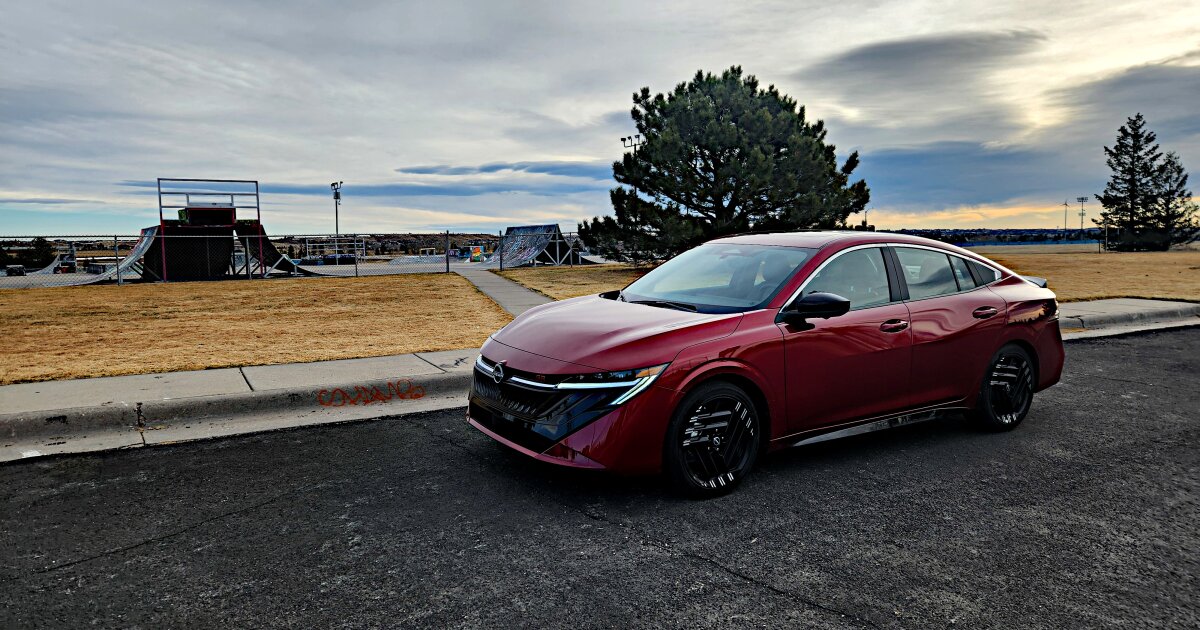
The newly-revamped Sentra is boring, sensible, comfortable, and easy to live with. Today’s market is full of splash headlines and flashy LEDs. The Sentra is just a sedan. That’s it. And that’s weird.
At a glance
- Just enough HP to get the job done
- Extremely good interior
- Fuel economy is barely average
- No hybrid, turbos, or all-wheel drive
- Super (and I mean super) affordable
The 2026 Sentra isn’t exciting or revolutionary or some kind of enthusiast’s dream. It’s just a simple, compact sedan aimed at people who just need a car in a world that seems overrun with oversized crossovers and six-figure electric pickups.
None of this means that the new Sentra is ugly. It’s not. The outgoing Sentra was already one of the better-looking compact sedans on sale. Nissan’s designers apparently looked at that success and decided to keep going that direction, using what is proven to work. No new ground was broken in the design process here, but a lot of familiar territory that creates good lines and a nice silhouette was crossed. The new Sentra is pretty nice to look at, but not so much that anyone will find anything to be critical of.
The ninth-generation Sentra also arrives with a more modern cabin experience, improved technology, and a handful of chassis refinements … all things that bring it up to date for the current market. Underneath, however, Nissan wisely avoided fixing what wasn’t broken. The familiar 2.0-liter four-cylinder and continuously variable automatic transmission (CVT) remain, producing 149 horsepower (110 kW) and 146 pound-feet (198 Nm) of torque. That’s plenty of motivation for everyday driving. Just don’t expect to beat anyone street racing or merging onto the freeway.
Nissan
The CVT has been recalibrated for 2026, and the improvements are noticeable. It behaves more naturally under acceleration and avoids some of the rubber-band sensation that CVTs have become infamous for. Nissan also revised suspension tuning and increased body rigidity for a more refined driving experience. This results in a sedan that’s surprisingly pleasant in regular, daily driving. It’s front-wheel drive only, but in a balanced way that feels good.
If you’re looking for a hybrid option, a turbocharged engine, or anything remotely sporty, you’ll need to look elsewhere. Nissan clearly decided that affordability and reliability mattered more than chasing horsepower figures. And that was probably the right call.
Most compact sedan buyers aren’t drag racing between stoplights. They’re commuting to work, taking kids to school, and trying to survive another week of grocery runs without spending a fortune. For that mission, the Sentra works perfectly well. You might say it’s been specifically tuned for it.

Aaron Turpen / New Atlas
Towards that end, most of the praise sent at the 2026 Sentra should be directed towards its interior. Previous Sentras punched above their weight in interior quality, but the 2026 model takes an even bigger swing. Nissan clearly prioritized interior and ride comfort when developing the new Sentra, and that decision pays dividends.
The seats deserve special mention. Nissan’s Zero Gravity seating philosophy continues to be one of the company’s best ideas. Even after several hours behind the wheel, the Sentra remains comfortable in a way many compact cars simply aren’t. Rear seat space is competitive for the segment, and the trunk offers 14.3 cubic feet of cargo capacity, enough for most daily needs and road trip luggage.

Nissan
Another uptick for the Sentra is that nearly every version receives a large 12.3-inch touchscreen, while higher trims add a matching 12.3-inch digital instrument display. Materials feel more premium, the design is cleaner, and overall presentation is much closer to what you’d expect from a vehicle costing several thousand dollars more. Wireless Apple CarPlay and Android Auto are available, USB-C ports are plentiful, and Nissan has managed to maintain a mostly intuitive user experience.
The only downside, which is common in vehicles with today’s touchscreen everything interfaces, is that if you’re a channel hopper (like me), it’s annoying. Changing XM or terrestrial channels is a chore. But that’s where Auto and CarPlay come in. They’re better for that.

Nissan
Road imperfections are absorbed with composure, wind noise is reasonably controlled, and the cabin feels quieter than many compact rivals. Road noise is present, but far less so than might be expected. I’ve been in more expensive cars that had more noise by comparison.
Fuel economy might be the most controversial point for the new Nissan Sentra. Most of its competitors now have hybrid versions or are hybrids by default. The Sentra returns 38 mpg (6.2 l/100km) on the highway, per the EPA. In the real world, the car gave me slightly over 36 mpg (6.5 l/100km) on the highway, but the loss is mostly due to the naturally-aspirated engine. I live on the High Plains at over 6,000 feet (1,829 meters). The thinner air means engines work harder. In general, turbochargers and some of the better-designed hybrid systems don’t have this issue.
For comparison, that MPG return is equal to most models of the 2026 Toyota Corolla, but well under the Corolla Hybrid’s returns. And not quite as good as the new 2026 Kia K4 in its non-turbo, sedan format.

Aaron Turpen / New Atlas
Pricing is where the Nissan wins out. The Sentra starts under US$24,000 (after destination charges) and remains noticeably cheaper than many similarly equipped competitors. Even the top end SL model stays below the $30,000 affordability barrier.
At a time when the average new vehicle transaction price continues marching toward absurdity (roughly $51,000 now), that affordability matters. A lot.
So here’s the thing. The 2026 Nissan Sentra won’t set your heart on fire. It won’t become a poster car on kids’ walls. Nobody is gonna take one to Cars and Coffee and draw a crowd. And it probably won’t be collectible in 50 years. But that’s not the point.
What Nissan has created is a compact sedan that looks better than expected, rides better than expected, and offers more technology than expected while maintaining a price that remains accessible. It’s comfortable, efficient, practical, and affordable.
And that’s a weird thing in today’s automotive market.
Product page: 2026 Nissan Sentra

