


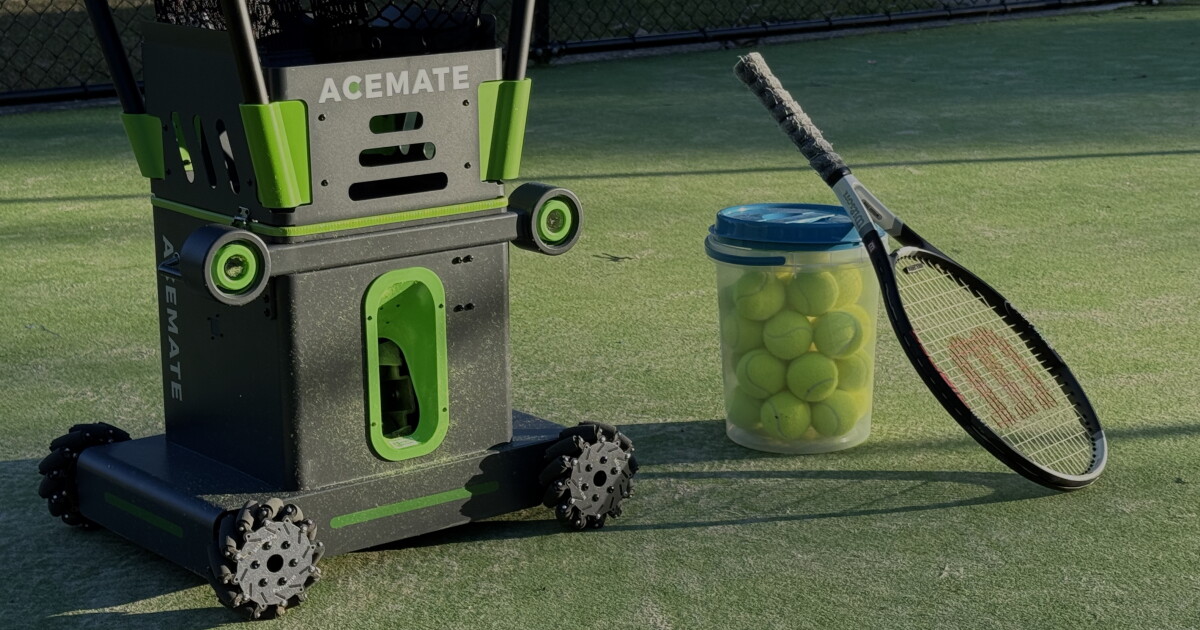
The Acemate S10 is one of the most ambitious tennis training products to hit the market so far. Unlike a conventional ball machine, even one that can move around the court, this robot coach is designed to behave more like a human opponent – zipping across the court to reach your return shot, then firing a ball back to you.
A while back I tried out the PongBot AI Tennis Robot, so I have some idea of the pros – and the cons – of this emerging sports technology. Acemate’s Tennis Robot S10 model first made a splash at the 2025 Future Innovation – Best of IFA Awards where it won for Best Health Tech. And judging by how my out-of-shape form pulled up the day after the machine put me through my paces on the court, I can definitely say it delivers one hell of a workout too.
The first thing you’ll notice is the size of the packaging the S10 arrives in – but don’t be alarmed, it has more to do with secure packaging than the size of the machine. Once unpacked, you’ll have a pretty simple assembly job, with the main body of the robot trainer requiring no additional work, and the ball feeder section on top clipping to the base with two metal brackets.
The trickiest part will be assembling the net for the first time – especially if you don’t read the instructions (guilty) and unclip two brackets that are deliberately placed to keep the corners of the material grouped together. But it didn’t prove to be the end of the world.
The net is threaded through four extending metal poles, one for each corner of the ball-feeder section, which you’ll need to first secure with the included screws and screwdriver. It’s a little finicky, as you’re working in a tight space, but it only took a couple of minutes. Then, once in place, if you’ve got four net brackets on each one, you can slowly extend the poles section by section to ultimately have a surprisingly tall and complete training machine. The accessories also include the handy screw-together ties you’ll then use to secure the base of the net around the edges of the ball feeder.

New Atlas
And this part you can absolutely manage without instructions. The battery system is quite unique, but provides versatility that you don’t often get with larger tech. The makers have created a compartment to hold the lithium-ion battery to power the unit when in play, but it can be removed to charge independently (or swapped out for a second battery if you buy an additional one). It takes around two hours to fully charge, which will then provide around two to three hours of play time. I used it for 90 minutes, as well as another 20 minutes steering it to and from the tennis complex and onto the court, so the company’s claims seem to back real-world experience here.
But because the 36V 7Ah battery is completely removable – without needing to fiddle around to get it out or in – it can be charged up anywhere you have an outlet. This is really handy if you plan on leaving your S10 in the car or in storage near where you play tennis. And you’ll also always be able to keep track of the charge, even if the machine itself hasn’t been on the court for days or weeks.
Another thing you’ll notice right away is the quality of the build. With an aluminum frame rather than plastics, it’s a tough unit. But it’s pretty mobile, too, with handles for lifting it in and out of vehicles, and considering its sturdiness isn’t as heavy as you might think (assembled, it’s 17.8 kg, or 39 lb). But one of the handiest features is being able to “drive” it through the phone app. Its multidirectional wheels essentially allow you to get it out of the car, turn it on and steer it alongside you as you walk to and from the court. In comparison with the PongBot, which has a metal suitcase-style extendable handle to move it around, it offers much better mobility – especially if you’re also carrying a bucket of balls, racquets and other gear.

I steered it across an uneven park and up a pretty steep, wet grassy slope to the court and it handled it with ease. Its locomotion is built around a four-wheel omnidirectional drivetrain, with its metal-core Mecanum wheels cased in rubber offering 360-degree movement. And while it handles rough terrain and gravel parking lots outside of the court, it won’t scuff or mark surfaces either.
I was playing on a fake grass court, with added sand, and found the speed it was able to move around the baseline really impressive – all without skidding, even when coming to an abrupt stop. Which is more than I can say for my own performance at the other end.
I did make the mistake of extending the net before entering the court, and I not-so-cleverly drove it into the wire fence surrounding the play area (to be fair, both the net and the fence were black, and I have terrible spatial awareness). And because I did it with some force, and kept pushing it without realizing, I managed to crack the rear two poles at one join on each side. So, not an ideal start. That said, I slightly reduced the net height so that link wasn’t fully extended, and it did the job.
But be aware that while this is a tough unit, driving its poles into immovable objects is not recommended. It’s much easier to keep the net down while you’re guiding it to the court, as the S10 unit itself can take a bit of a beating from a bad driver like myself. That said, reading about other people’s experiences with the tennis robot, it seems Acemate has excellent customer support when it comes to replacing damaged or faulty parts. Some have even received entirely new units within a few days. And it comes with a one-year warranty, too.
Right, now for how it plays. Unlike the PongBot, which requires clip-on sensors to track you at the other end of the court, the S10 instead follows you with its binocular 4K vision. It incorporates AI for human and ball tracking, speed detection and shot analysis with accuracy. You simply place it on the part of the court required with the drill or program you’re going to select on your phone, have it loaded up with balls, and then move to the other end and hit the start button on your phone. You’ll get a countdown so you have time to get into position.
Acemate S10
I like a good baseline test – no pun intended – of mixing up forehand and backhand shots, to get a feel for the machine’s operations. I chose a level somewhere between beginner and intermediate, as it’s been a long time since I last played competition tennis, and was pleased with the variety and speed of the balls coming to me.
The idea is that when you return a shot, the S10 scoots to where your ball is heading and catches it in its net, as it’s firing another ball at you from where it’s traveled to. This actually provides a nice challenge as it switches up launch angles, forcing you to think more about your footwork and own movement around the court.
The movement system is the star of the show, here. It’s incredibly speedy with its lateral movement, so it feels much more engaging than a static unit firing balls at you from the one spot. So in this sense, it’s far more coach-like than what similar technology has delivered so far.
That said, it’s not perfect. It’s worth noting, though, that on the day I played there was dampness on the court from recent rain, and my cheap balls lacked the kind of bounce you really need for good gameplay. In fact, I don’t think I noticed how bad they actually were until this outing with the S10. As a result, my returns stayed low and mostly hit the base of the robot, well below the fielding net on top of it. The robot scooted across the court to meet my returns, but there’s only so much it could do if balls weren’t sitting up to reach the catching zone.
It also wasn’t firing balls at me to keep me in the back of the court, so the baseline drill I’d chosen felt more mid-court, which in turn seemed to have it adjust its length again so that some balls it shot out didn’t make it over the net. Ultimately, sick of having to go pick up balls once they’d run out, I began trying to play to the S10 – which is not a great strategy in competitive tennis, giving your opponent the best opportunity to fire back a winning shot. Fortunately, my friendly battery-powered opponent was more forgiving, and kept the balls reasonably close within my reach on both sides.

New Atlas
Acemate has acknowledged that the S10 can’t catch and return every ball, particularly those hit back at tight angles and kept low – either with spin, or in my case, awful bounce-less things you’d be hesitant to call tennis balls.
On paper, Acemate says the machine can dish up topspin, backspin, flat and slice, with lobs up to 8 m (26.2 ft) in height. Some professional players who have tested the machine have had issues with ball speed and the type of shots delivered – like a lack of spin, for example – but even on the less-than-intermediate level I played at, and accounting for my terrible ball quality, the pace was impressive and challenging. It made me focus more on footwork, moving quickly to be in a better position to return well, and also work on my follow-through to combat the speed I was facing. And I was more than exhausted after an hour of drills.
Ultimately, this is not a machine for everyone; if your game is strong, you probably won’t improve more than if you were playing someone at your level. However, if like me, your game could do with some “finessing” – or even if you’re returning to tennis after a long break or picking up a racquet for the first time – the S10 is a really solid investment if you want to play more than a couple of times a year. Sure, it’s not cheap, but neither is one-on-one coaching per hour. Less than 20 lessons cost around the same as the S10 – and this robot will learn your game the more you work together.
What you may miss out on in terms of specific coaching – like grip changes for two-handed shots and adjusting how you defend and attack with spin – the S10 makes up for it in data feedback. After each chosen drill, you’ll get to see where your returns landed, a score and suggestions of drills you might benefit from trying. I didn’t really agree with the area the S10 suggested as the target – essentially, it’s hitting the ball back within reach of your opponent – but it teaches you shot selectivity and patience, which have never been my strong points. And if you want the S10 to catch your return, it’s best you aim within the target zone. (And also play with balls that have more bounce than a pair of wet socks.)
Ultimately, if the most important thing about having a robot opponent is that it’s going to finally save you chasing balls to refill it, you might be disappointed. That said, it catches more balls than any other machine coach I’ve played with.

New Atlas
And a few other positives worth noting: the S10 does a really good job at pacing. It actually felt like playing a human; a lot of trainers can feel a bit off, either firing balls out too quickly, or taking too long to do so. And the movement of the machine across the court forced me to move about more and adjust my positioning and returns because of the different angles the S10 was firing from. In a perfect world, it would have pushed me to my own baseline more, and used its versatile wheels to move forward and backward, more than side to side, but it feels like those things may come with firmware updates.
Oh, I also wondered why the S10 package came with a brush. Then, seeing the mossy green fluff covering the front of the machine after our session, it made sense.
We previewed the Acemate S10 before we got our hands on it, and I’m happy to say it largely lives up to the hype. Check the website for shipping costs, but customers in the US, the UK and EU can get this sizeable package for free. The company also promises to process orders within 48 hours.
Currently, the Acemate S10 is on sale for $2,199, discounted from its retail price of $2,499. The team behind the S10 is also very responsive, if you have questions about the product, give them a shout.
Product page: Acemate

