


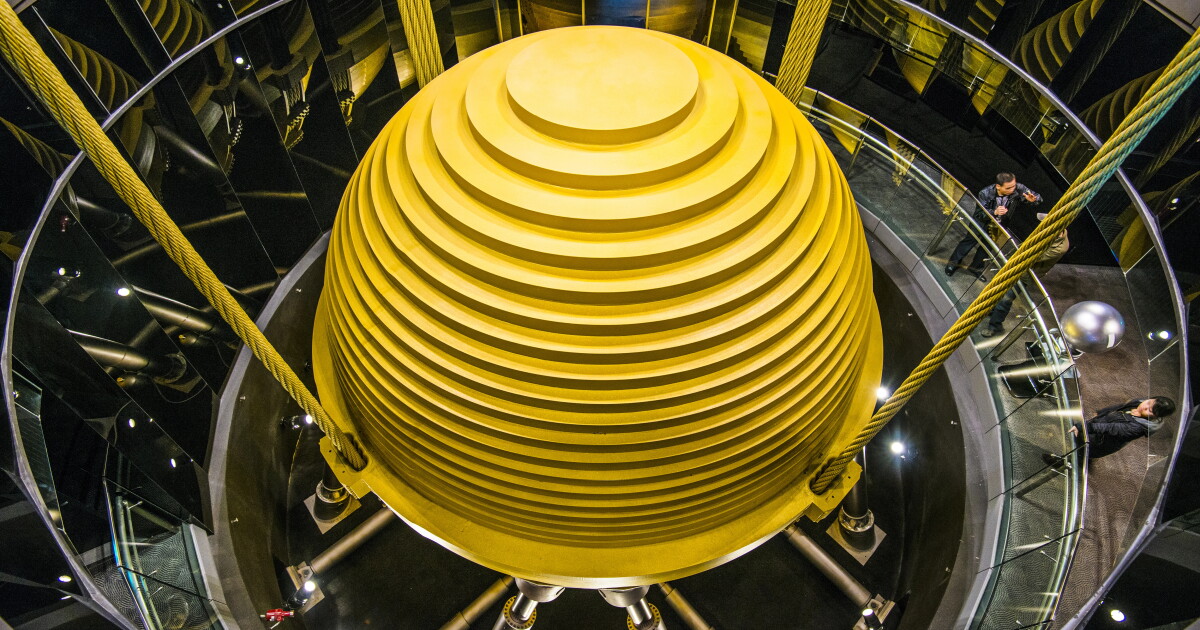
If you simply love trying to work in an office tower or live in a skyrise while constantly fighting the urge to barf or have your brain explode from stress, then you probably hate dampers.
That’s because even ordinary winds – and far worse, storms and earthquakes – cause tall buildings to sway, which ruins people’s concentration, wrecks their mood, and even exhausts them. As Liang Cao, assistant professor of civil engineering at the University of Mississippi says, “In high rise buildings, even if the structure is fine, too much vibration means people may get motion sickness and can no longer work in that building. So even if the building is structurally sound, you have an economic loss.”
But dampers can stop all that.
In cars, dampers are shock absorbers, the hydraulic suspenders attached to springs that keep vehicles rolling relatively smoothly over craters and bumps instead of ricocheting. In buildings, bridges, and other large structures, their job is similar: absorb vibrational energy to reduce motion and thus structural stress, thereby minimizing damage from windstorms, tectonic shifts, and other disasters. The result is increasing structural lifespan and decreasing potentially massive costs during work disruption, repair, and replacement.
But traditional dampers have a problem. Like automobile brakes, they use viscous fluids for hydraulic pressure, and are expensive to purchase and a hassle to replace. But according to a new study in the ASCE Journal of Structural Engineering, the solution to both of these problems is one of the planet’s cheapest, most abundant, and most ecologically sustainable substances of all: humble sand.
“The damper is an energy dissipation device that you use every day,” explains Cao. “Every vehicle you drive has dampers to try to reduce vibrations. As civil engineers, we took that concept and applied it to modern structures, but typical dampers are oil-based or really complex mechanisms, and that makes [them] expensive to build. That’s where the sand damper comes in. Sand is inexpensive, easy to maintain, and environmentally friendly.”
Designed at Southern Methodist University with co-researchers at the University of Mississippi and Pennsylvania’s Leigh University, the new sand dampers outperform hydraulic dampers even under extreme temperatures.
That benefit is crucial, because as Texas State University’s professor Kostas Kalfas explains, heat is the enemy of hydraulic dampers. Continuous pressure on them may heat their fluids, damaging the seals that prevent leaks. Replacing the silicon oil isn’t a simple solution, because as Kalfas says, the complicated design of viscous dampers generally requires complete removal and maintenance or replacement by the manufacturer. Worse, during removal, structures requiring dampers are essentially as defenseless against even normal winds as a car without brakes.
But thanks to the University of Mississippi’s pressurized sand dampers, replacement or repair following damage can be done in mere hours. Even “a lay person or a machinist can repair [these dampers] with human strength alone, so you don’t have to send it back to the manufacturer,” says Kalfas.
To test sand damper performance at extreme temperatures, Cao, Kalfas, Lehigh University engineering professor James Ricles, and SMU professors of civil and environmental engineering Usama El Shamy and Nicos Makris subjected them to a range from 60 °C to 5.6 °C (140 °F to 42 °F).
As Cao explains, the results were impressive. “We have already shown that the damper is stable in different temperatures [and] different conditions,” he says, adding that another benefit of the sand dampers is that even if “humidity causes moisture to form in the damper, it’s still functional.” The next step is “optimization tests for the dampers in dynamic conditions. We want to show the effectiveness and test how it works in a full-scale structural system.”
The use of sand in contemporary engineering isn’t new. As we have previously reported, sand is extremely effective in green energy initiatives such as Finland’s massive sand battery, a replacement for eco-unfriendly concrete, water preservation in farm soil, better batteries, and desert habitations that seem straight out of the novel Dune. Innovators take note.
Source: University of Mississippi

