


The College Football Playoff is expanding from 12 to 24 teams in 2027 in a move that will create myriad ripple effects throughout the sport.
Notably, the Power 4 conferences will no longer stage championship games after this season, rendering these storied leagues as little more than hollow scheduling alliances. Indeed, Missouri coach Eli Drinkwitz recently said as much on the record.
Drinkwitz is correct to question unnecessary cross-country travel in far-flung alignments where conference championships aren’t settled on the field. We need a better system.
With that in mind, we invite you to suspend your disbelief and join us for a sweeping realignment proposal. To be sure, the Big Ten and SEC would never sign off on any plan that would dilute their television revenue. But we can still dream …
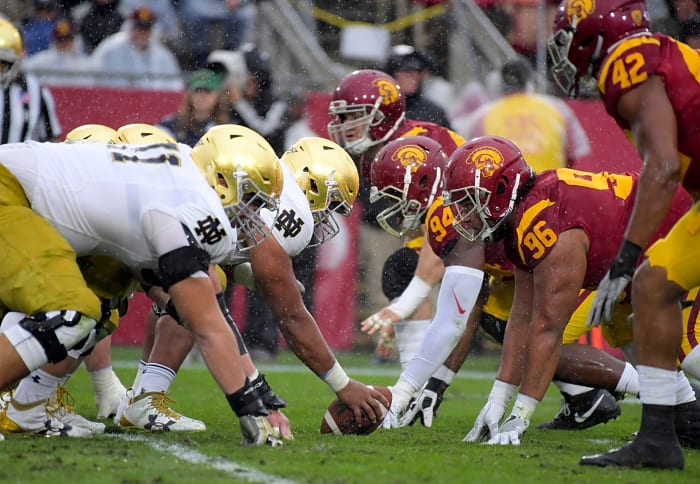
Intersectional rivalries such as Notre Dame-USC will be maintained in our sweeping, 80-team realignment plan.
IMAGN IMAGES via Reuters Connect
How many teams merit ‘power’ status?
Right now, 68 teams compose the “Power 4” class in the NCAA Division I Football Bowl Subdivision, the highest tier of college football. That includes 17 ACC teams, 18 Big Ten teams, 16 Big 12 teams, 16 SEC teams and Notre Dame.
In the new era, we suggest eight groups based primarily on geography for scheduling purposes. That presents a couple logical options.
If four teams were elevated from the Group of 6 to power status, that would allow for eight pods of nine teams each. Each team would play every other program in its group once a year (eight games), plus four nonconference games annually.
That said, we think it’s more compelling to elevate 12 teams to create an overall 80-team format. This would establish eight pods of 10 team each, with every team playing each pod mate once annually (nine games). Three nonconference games would complete a 12-game slate.
Every team will play six home games and six road games. No more stacking the home slate. (Half the teams will play five pod games and one nonconference game at home; the other half play four pod games and two nonconference games at home.)
All nonconference games must be scheduled exclusively against opponents from the 80-team alliance to maintain a balanced ledger and strength of schedule. No more nonconference cupcakes!
Importantly, out-of-pod rivalries such as USC-Notre Dame, remain intact in either format. And we restore disrupted rivalries such as Oklahoma–Oklahoma State, Washington–Washington State and Oregon–Oregon State to permanent annual status.

Boise State and South Florida are two schools standing on the cusp of the Power 4 conferences.
Nathan Ray Seebeck-Imagn Images via Reuters Connect
A conference plan that makes sense
Below, we divide our 80-team amalgamation into eight groups of 10 teams. We’ve named the pods after legendary players of yesteryear, in a nod to tradition: Marcus Allen, Jim Brown, Archie Griffin, Bo Jackson, Nile Kinnick, Davey O’Brien, Gale Sayers and Herschel Walker. In this format, the CFP selection committee could rank the top 24 teams as it sees fit without any regard to division affiliation or standings.
This 80-team plan invites a dozen Group of 6 teams to the power level: Boise State, Connecticut, Hawaii, James Madison, Memphis, New Mexico, Oregon State, San Diego State, South Florida, Tulane, UNLV and Washington State.
We realize any such plan is highly unlikely to gain legitimate traction, as it would require the current power schools to divvy the financial pie in even more directions.
It’s more likely that the current power leagues expand by four to 72 or contract by four to 64. That is, if the Big Ten and SEC don’t simply break away to form a megaconference the likes of which we haven’t seen for nearly a century. And to be sure, ESPN, Fox Sports and other broadcasters will have a voice in shaping future conference affiliations.
If history is any indicator, conference realignment is here to stay … as schools continually navigate to chase the almighty dollar.
