


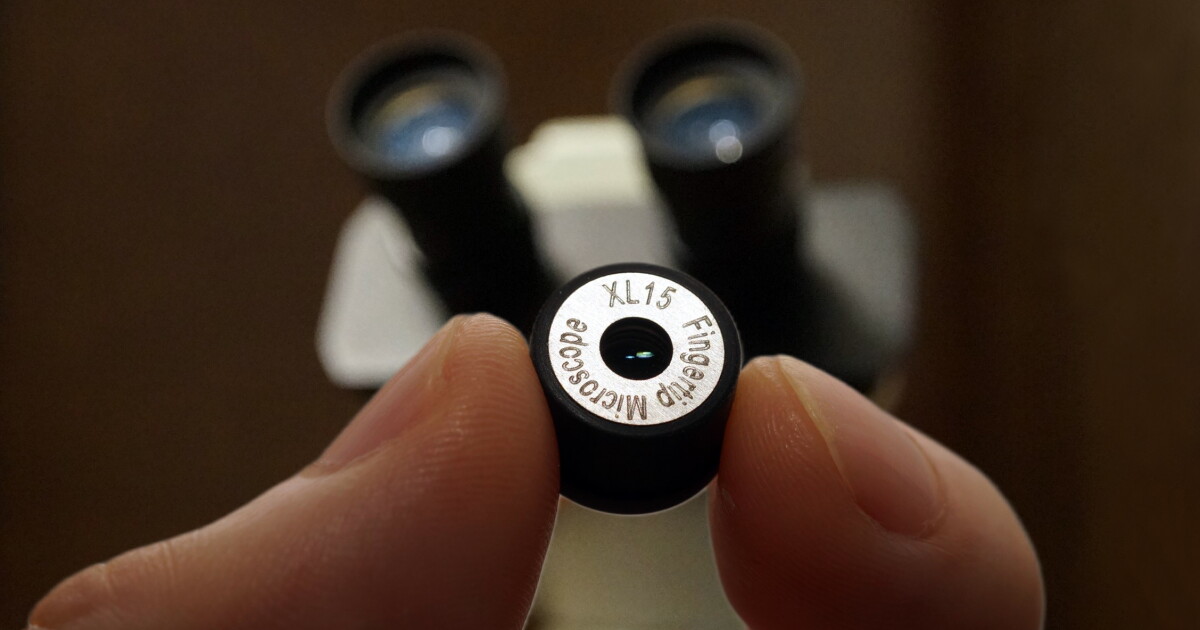
The iMicro XL15 takes a slightly different approach to smartphone microscopy. Built by the team behind the iMicro Q3p we covered in 2024, it weighs just 1.2 g (0.04 oz) but makes a very deliberate move away from that model’s headline-grabbing 1,200x magnification.
Its magnification is much more modest, but what you get instead is a far wider field of view and around 21 mm (0.8 in) of working distance between the lens and subject.
iMicro XL15: A pocket-sized micro exploration studio
The extra breathing room is the key point here. Rather than having to force the optics right up against a flat specimen, the XL15 leaves enough space to inspect more awkward three-dimensional subjects, while still giving you a useful close-up view.
That extra bit of working distance lets you view circuit boards, plant structures, and insects, or manipulate small components while keeping them under the lens. The 10-mm field of view also captures broader context rather than isolating a tiny fragment.
iMicro
iMicro says resolution is around 8 μm when used with a wide camera, which improves to roughly 3 μm with a telephoto camera – though real-world results will also depend heavily on the phone, focus, and lighting setup you’re using.
Lighting is another major part of the XL15’s pitch. Its own lighting module is detachable and has a rechargeable battery. Instead of relying on a fixed light source, you can position it independently for direct white illumination, colored light, low-angle side lighting, or UV. Side lighting is particularly useful, helping reveal surface texture, edges and relief. Meanwhile, UV could expose fluorescence in certain materials. iMicro notes that this feature is purely exploratory, though; it’s not specialized fluorescence microscopy. The slim PP carrying case can also double as a simple lightbox.

iMicro
The XL15 attaches to compatible phones and tablets using a reusable nano-suction pad, so you won’t need a dedicated case or adapter. It works best on smooth, non-porous camera surrounds, and can be used handheld. For finer adjustments and steadier imaging, the bundled FS-5 focusing stand is probably your best bet. A μRuler M stage micrometer provides a scale reference. The XL15 works with a phone’s regular camera app, while the optional i-SEEING app adds calibrated scale bars and measurement tools.
Kickstarter pledge levels start at CAD 84 (around US$60) for the Super Early Bird tier. The kit includes the XL15 lens, detachable light, focusing stand, μRuler M, i-SEEING app, and carrying case.
All crowdfunding campaigns carry an element of risk, but this is not the brand’s first outing – it has a dozen Kickstarters in its trophy cabinet already. This latest campaign runs through December 19, and at the time of writing, has raised over five times its funding target. If all goes to plan, shipping is estimated to start from April 2027.
It isn’t going to replace a proper lab microscope anytime soon. But for roughly US$60 and weighing barely more than a paperclip, the XL15 gives smartphone microscopy something high-magnification predecessors lacked: practical room to work.
Source: Kickstarter
Note: New Atlas may earn commission from purchases made via links

