


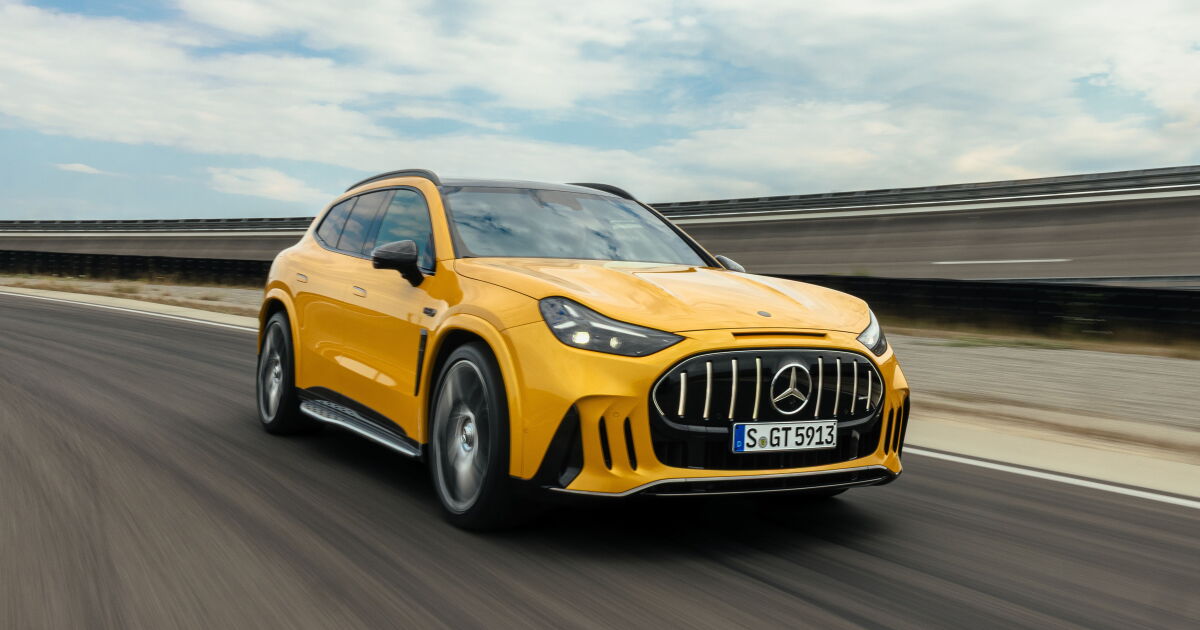
Crowning yourself king of the hyper-SUV world requires more than just a legendary badge. It has taken Mercedes decades to realize it requires cold, hard numbers.
That’s why Mercedes has finally allowed its high-performance AMG department to produce its first ever in-house SUV, which was unleashed on the world this week. At last untethered from merely adapting a standard comfy passenger vehicle, the AMG engineers have created a monster.
Mercedes-AMG
The flagship tri-motor variant of the new Mercedes AMG GT SUV generates a massive 1,153 horsepower (860 kW) – allowing it to rocket from 0 to 60 mph in just 2.4 seconds. This means the GT SUV has jumped to the front of the global rivals.
In Europe it matches the Porsche Cayenne Turbo Electric (2.4s), but outpaces the Lotus Eletre R. In the States it out-sprints Tesla’s Model X Plaid (2.5s), Rivian R1S Quad Max (2.6s), and Lucid Gravity GT-S (3.1s).
It’s significantly quicker than China’s luxury family haulers like the BYD Atto 8 (4.6s), though the BYD charges slightly faster, and it totally outclasses Korea’s high-performance EV flagship, the Hyundai Ioniq 5 N (3.2s).
The AMG marque has instantly inserted itself at the pinnacle of the highly prized sports SUV hierarchy. It’s the most powerful production SUV currently available and matches the fastest acceleration times while offering bespoke suspension engineering that its straight-line rivals cannot replicate.

Mercedes-AMG
But as the market fractures between the traditional European pursuit of mechanical velocity and the rising Asian focus on hyper-efficient battery infrastructure, the definition of the ultimate super-SUV is no longer written solely on the drag strip.
That’s why, beyond its blistering speed, AMG’s race-bred engineering team has introduced some groundbreaking non-performance innovations too.
The aerokinetic bodywork features active motorized bumper slats that close to minimize drag and open only when cooling is necessary. At speeds above 93 mph (150 km/h), a roof spoiler automatically deploys and shifts angles to increase downforce and high-speed stability.
Even more impressively, the center console features three dedicated, tactile rotary dials akin to having an AMG race engineer in the cockpit with you. These give the driver real-time control over accelerator pedal sensitivity, wheel slip thresholds (with nine traction settings) and cornering agility. The digital telemetry monitor logs over 80 driving telemetry points per second including live motor temperatures, side-slip angles and brake pressure curves to offer real-time tutorial graphics to help drivers adjust their driving lines.

Mercedes-AMG
And most theatrically of all, Mercedes has replaced generic electric-vehicle (EV) humming with something much more dramatic. AMG engineers used 16 microphones to record 100 mechanical audio samples from their track-honed Mercedes-AMG GT R. The SUV synchronizes these with simulated gear shifts controlled via steering wheel paddles, while integrated seat-shakers vibrate the driver’s seat during acceleration to physically replicate an internal combustion engine. The V8 roar is even broadcast outside the car, presumably to scare children and small dogs out of the way.
To maneuver its large footprint, there’s rear-axle steering that switches to parallel steering above 50 mph (80 km/h). Other details include digital light projection technology, which Merc says is 50% more efficient and reactive than standard multi-beam setups.
The big SUV uses the same EV platform Mercedes used on the AMG GT Coupe EV. The 800-volt AMG.EA platform supports an immense 710-kilowatt DC fast-charging capacity on the GT 63 flagship’s 128-kWh battery pack. This adds 280 miles (386 km) of WLTP range in 10 minutes and completes a 10-to-80% charge in 12 minutes. The entry-tier dual-motor 536-hp GT 53 utilizes a 106-kWh battery with 600 kW charging, while the tri-motor 804hp GT 55 can max to 710-kW.

Mercedes-AMG
To sustain this superfast input without degrading the cells, the Merc uses a Formula 1-derived central coolant hub that circulates a specialized, electrically non-conductive synthetic oil around the battery cells.
The massive 5,942-lb (2,695 kg) weight is somewhat disguised by a system that swaps traditional mechanical anti-roll bars for triple-stage adjustable air springs linked to a high-capacity central hydraulic pressure reservoir. This can instantly pressurize individual shock absorbers to counteract body roll, front-to-rear acceleration pitch and hard-braking dive.
Power distribution is handled by fully variable all-wheel drive using independent torque vectoring to shuffle 100% of available torque to a single outside wheel within milliseconds in hard cornering.

Mercedes-AMG
There’s luxury too of course, including sports seats with dynamic pneumatic side supports that automatically pump up during cornering to lock passengers in place and an optional panoramic electrochromic glass roof that shifts from completely transparent to opaque at the touch of a button.
The entry-level GT 53 has opened orders at a base price of €113,050 (approximately US$123,000). The track-focused GT 55 and flagship GT 63 are scheduled to follow next April in Europe and US showrooms a few months later as a 2028 model year vehicle. The range topping GT 63 is expected to be priced somewhere up to $260,000.
Source: Mercedes

