


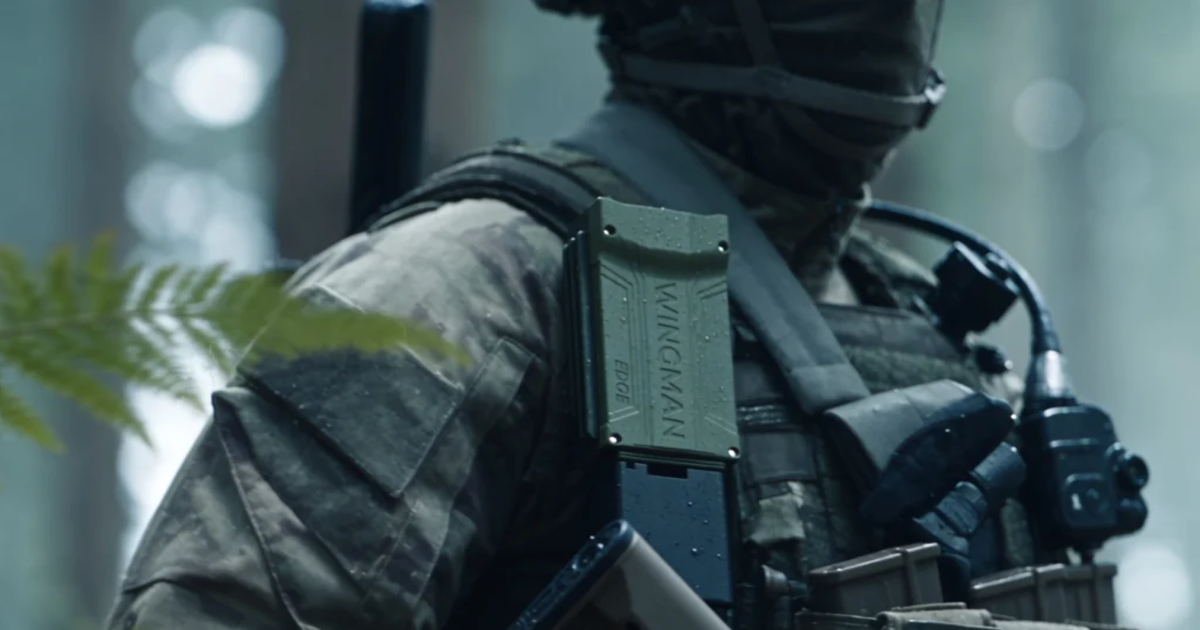
Individual soldiers are getting their own drone protection as Danish defense company MyDefence rolls out Wingman Edge: a wearable that can detect drones by their control radio signals at a distance of up to 3.73 miles (6 km).
Drones have become serious players in military circles, as can be seen by the recent decision by the US Air Force to evacuate its B-1B bombers from RAF Fairford – allegedly because of fear of a suspected drone attack plot. However, drones are seen as a threat on all scales of the combat spectrum, including to individual infantry soldiers targeted by what are basically flying grenades.
To guard against these, MyDefence has come up with an electronics box that can be easily worn. Weighing only 975 g (2.15 lb), it is in theory a convenient tool for the field, though quite a few squadies would argue that nearly a kilo of gear is scarcely “only” when you consider the average infantry field load.
One weakness that many drones, especially the smaller ones, suffer from is that they are dependent on radio signals that they must both send and receive for control, not to mention communications links, Wi-Fi, analog video, and other tasks. By using a passive radio receiver hooked into an AI-enabled classification system, Wingman Edge scans various wave bands from 200 MHz to 6 GHz. If a signal is detected, it’s analyzed and compared to known drone signals.
Because the unit is networked with command and control systems, it can quickly adapt to new threats and unknown signals. Once a signal is confirmed, the wearer is warned of the drone’s presence by sound, light, vibration, or display, depending on the mode selected. In addition, Wingman Edge is backward compatible with other MyDefence systems.
“The evolving drone threat does not wait for a database to be updated,” said Dan D. S. Hermansen, CEO of MyDefence. “For more than a decade, we have put wearable drone detection into the hands of soldiers. Wingman Edge builds on that foundation by giving the individual soldier a much deeper understanding of what is happening in the spectrum around them, including activity that does not match an existing signature.”
Source: MyDefence

