


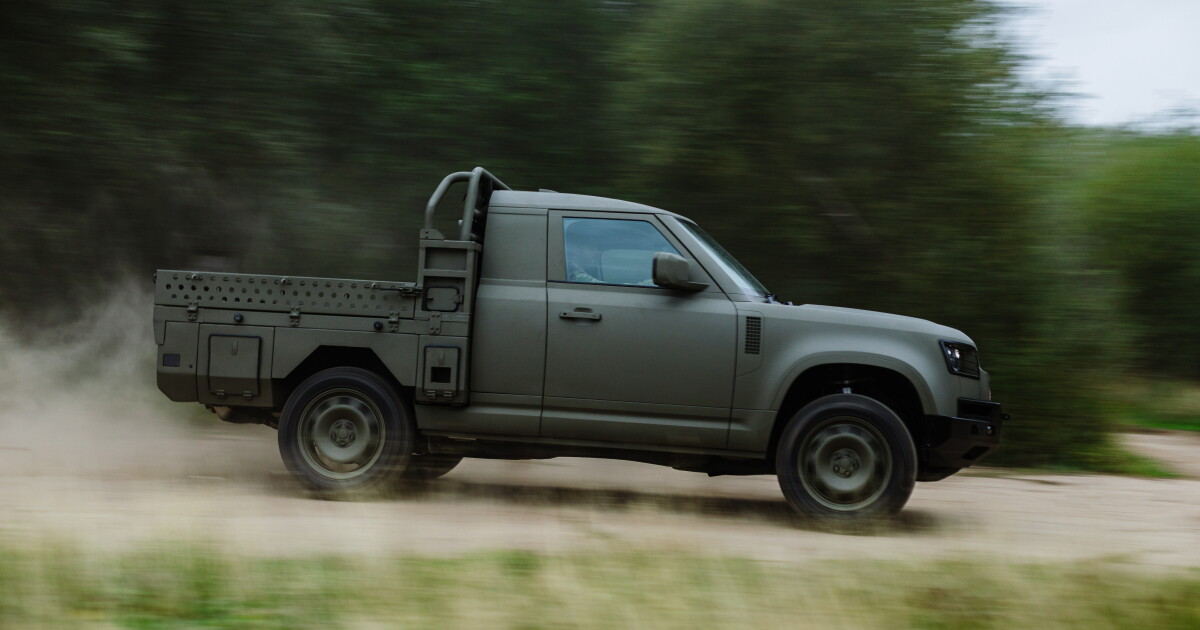
Who doesn’t love a Defender? It’s been more than three decades since the nameplate has been on offer across the globe. And ever since the modern, redesigned L663 model made its debut in 2019, that appeal has only increased. But there was always one thing missing: a proper Defender-based pickup.
Hear me out: the Defender always had everything needed for the job. It’s rugged, boxy, incredibly capable off-road, and built around a body style that practically begs for someone to chop the back off and turn it into a truck. And yet, despite all the Defender variants Land Rover has cooked up over the years, a factory-built pickup has remained stubbornly absent from the lineup.
… until now. Land Rover has just revealed the Defender Wolf Series II. But as is the case is for all good things, there’s a catch to it. And that is that it’s been specifically developed for military use. Which means we might not see it on public roads … at least for now.
Nonetheless, it’s a compelling proof-of-concept for what a Defender pickup could look like for when JLR finally decides to build one for the masses. Not merely a Defender with the roof chopped off, but a genuine pickup with a single-cab body and a dedicated load bed.
JLR
As opposed to a traditional ladder-frame chassis, this one’s engineered on the standard model’s ultra-stiff D7x aluminum monocoque. According to the British company, this move results in a stiffer body structure that should be more resilient to the challenging conditions that these cars typically operate in, as well as more generous when it comes to payload capacity.
Before being approved, the Wolf Series II completed almost 62,000 engineering tests, with the body and chassis going through the company’s Extreme Event Test process. It’s basically a rigorous engineering validation process that tests a car’s chassis and body architecture to repeated impacts well above standard passenger car and SUV limits.
JLR states that the Wolf Series II has been tested with a torsional rigidity of 29,000 Nm/degree as part of this process, which means it’s three times more rigid than traditional body‑on‑frame designs. It’s also tested across millions of miles in testing environments, ranging from the 50‑degree heat of the desert and sub‑40‑degree cold of the Arctic, to altitudes of 10,000 ft in the Rocky Mountains of Colorado.
Now, as far as specs, dimensions, interiors, or any of the official numbers are concerned, we know nothing. Land Rover kept all other cards about the Wolf Series II family close to its chest.

JLR
Judging by the images, we clearly see the single-cab body and dedicated pickup bed, a visibly beefed-up chassis, heavy-duty suspension, and chunky off-road tires. There are substantial recovery points front and rear, a military-style front bumper, exposed tow hardware, and what appears to be a reinforced load area designed to take considerably more punishment than the average lifestyle pickup.
The overall design is refreshingly utilitarian, too. There are no oversized alloy wheels, fake skid plates, or elaborate body cladding trying to make it look tougher than it is. The upright windshield, flat body panels, exposed equipment, and simple steel wheels give the Wolf Series II the sort of honest, industrial appearance that modern pickups increasingly seem to have forgotten.
We saw four variants of the Defender Wolf Series II unveiled at the recently concluded British Army DVD 2026 event in Bedfordshire, UK. These included a tactical mobility vehicle, a general mobility vehicle, an ambulance and a utility vehicle.
This isn’t the first time we’ve seen the Defender in military clothing. In fact, it’s named after the original Defender Wolf, which served the British Armed Forces for more than 70 years. This one, though, has been built to compete for the Ministry of Defence Light Mobility Vehicle tender, with JLR also committing to a new Defender Defence Division to support the requirements of other defense organizations.

JLR
What makes this story interesting, though, is the fact that a modern Defender can be turned into a proper pickup without losing the basic formula that makes it so appealing. Which means if Land Rover ever decides there’s enough demand for a mass-produced Defender pickup, it no longer has to wonder whether the idea works. It has already built one … technically.
All it’s got to do is take away the camouflage, add a warranty, and put one on a showroom floor.
Source: JLR

