


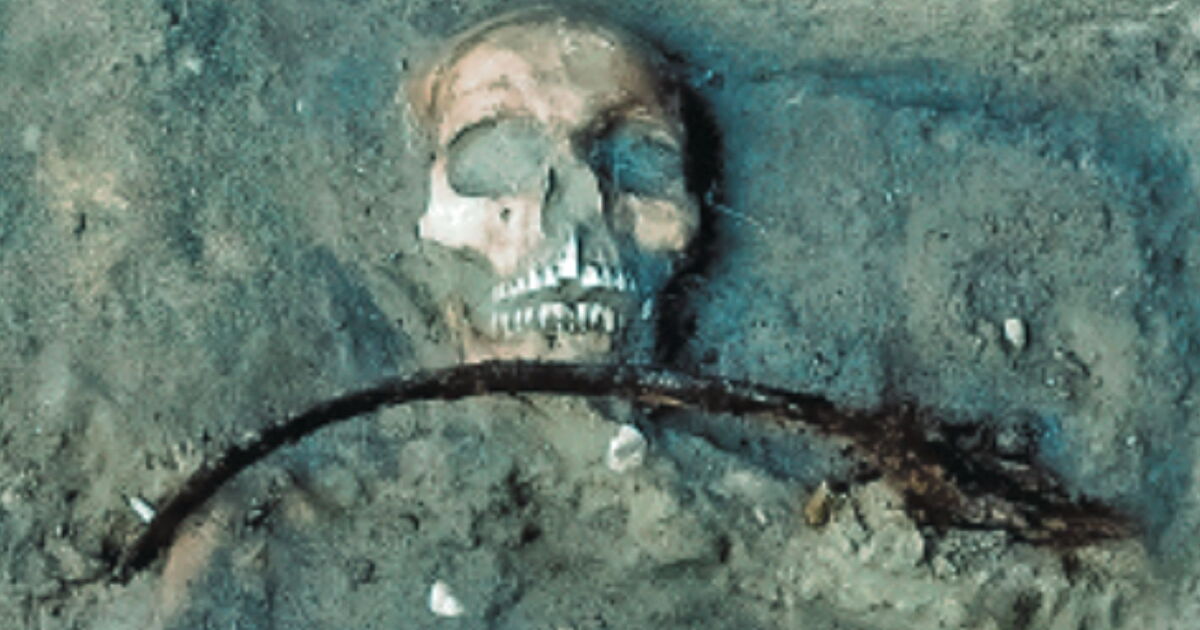
Finding a human body buried with a sickle around their neck and a padlock around their big toe isn’t exactly common fare.
So when a 17th-century woman’s bones were found several years ago with such odd accoutrements as part of her burial in a Polish cemetery, archeologists knew they had stumbled across something a little different.
The results of a recently published study on the remains led by researchers from the Nicolaus Copernicus University may shed some light on this rather odd discovery, suggesting the remains belonged to a young, high-status woman thought to have collaborated with the dark side.
Ever since Bram Stoker popularized Count Dracula as a gothic figure of fantasy, the word vampire has been synonymous with undead bloodsuckers who vanish in a puff of smoke in the morning light (if not dazzle a little in the sunshine).
Yet the term has been historically applied to just about any figure who may have invoked a supernatural fear. Finding bodies with their heads removed, bricks in their mouths, or – as in this case – a sickle pointing at their throat, automatically earns suspicion as a vampire.
“An anti-vampiric grave … can thus be defined as any grave in which actions related to burial rituals were observed that are not typical for a specific human group, cultural unit, or region,” the researchers behind the recent study explain.
The real question is then, “whatever did they do to deserve such protective practices?”
A case in point is the occupant of Grave 75, a young female recovered from a cemetery site in Pien, north-central Poland, by a research team from the Institute of Archaeology at Nicolaus Copernicus University in Torun in 2022.
(Polinski et al., J. Archaeol. Sci. Rep.,2026)
At the time, researchers could only guess her story. Nicknamed the “Vampire of Pień”, locals affectionately called her Zosia. A subsequent television special employed a forensic artist to give her a face. Yet the official results of a scientific investigation had to wait.
The cemetery Zosia was found in no longer exists on any maps, nor is it referenced in historical records. An absence of religious paraphernalia suggests the dead within were Protestant, raising the possibility that within the surrounding social landscape of the 17th century, it may have been a necropolis of outcasts – vagrants, heretics, orphans, unbaptized babies, individuals who took their own lives. And perhaps the occasional collaborator with demonic forces.
Aside from a complete skeleton, a 36-cm (14-inch) sickle, and a triangular padlock, Grave 75 contained remnants of a decorative band made of woven gold and silver threads and silk, known as a galloon or galon.
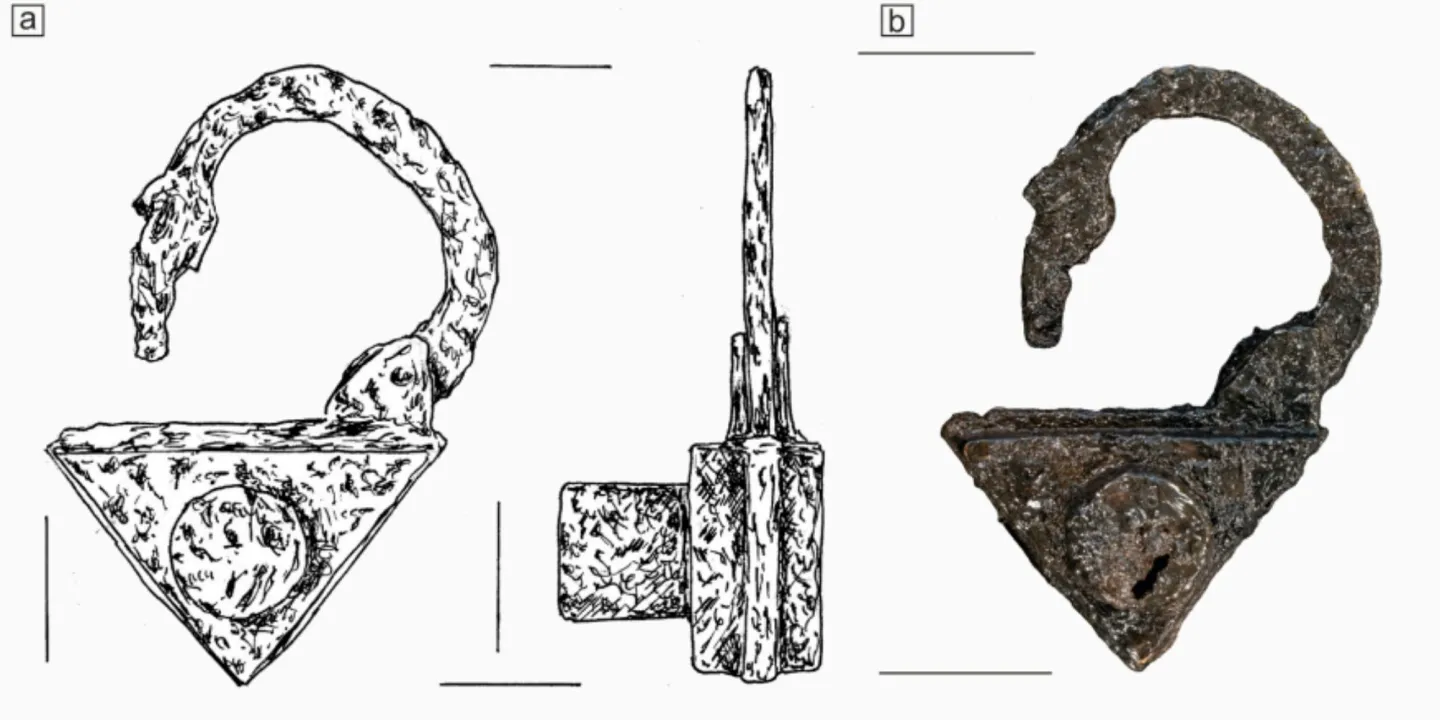
(Polinski, et al., J. Archaeol. Sci. Rep., 2026)
To get a better understanding of who this individual was, researchers have spent the past few years conducting a detailed analysis of the remains’ DNA and isotopes, and the chemical properties of the metallic artefacts and the decorative band.
Their findings suggest the grave was occupied by a young woman of around 17 to 19 years, who, though local to the area, appears to have Scandinavian ancestry.
Her fancy galloon may have once edged a cap or other garments, now serving as the only indication of her elevated social class. As affluent as she may have been, signs of her diet in her bones hint at a slightly above-average consumption of animal proteins.
Given the hardships European faced during this period, one characterized as the Little Ice Age thanks to its harsh winters, it’s easy to assume nobody was having an easy time.
Could this young descendant from outsiders have been blamed for hardship in her community? Perhaps a famine, an outbreak of disease, or social upheaval? One enduring mystery is the cause of her death itself.
Early speculation suggested Zosia may have had a condition that put her at risk of severe headaches and fainting. Yet with no obvious signs of trauma, the researchers couldn’t say what sent the woman to an early grave.
Whatever it was, according to the researchers, the sickle and padlock were clear signs that nobody wanted to see her climb back out of it.
“This practice may be interpreted as an attempt to symbolically limit the deceased’s postmortem agency, symbolically constraining her potential return to the world of the living and interaction between the realms of the living and the dead,” researchers note.
This research was published in the Journal of Archaeological Science: Reports.
Source: Phys.org

