


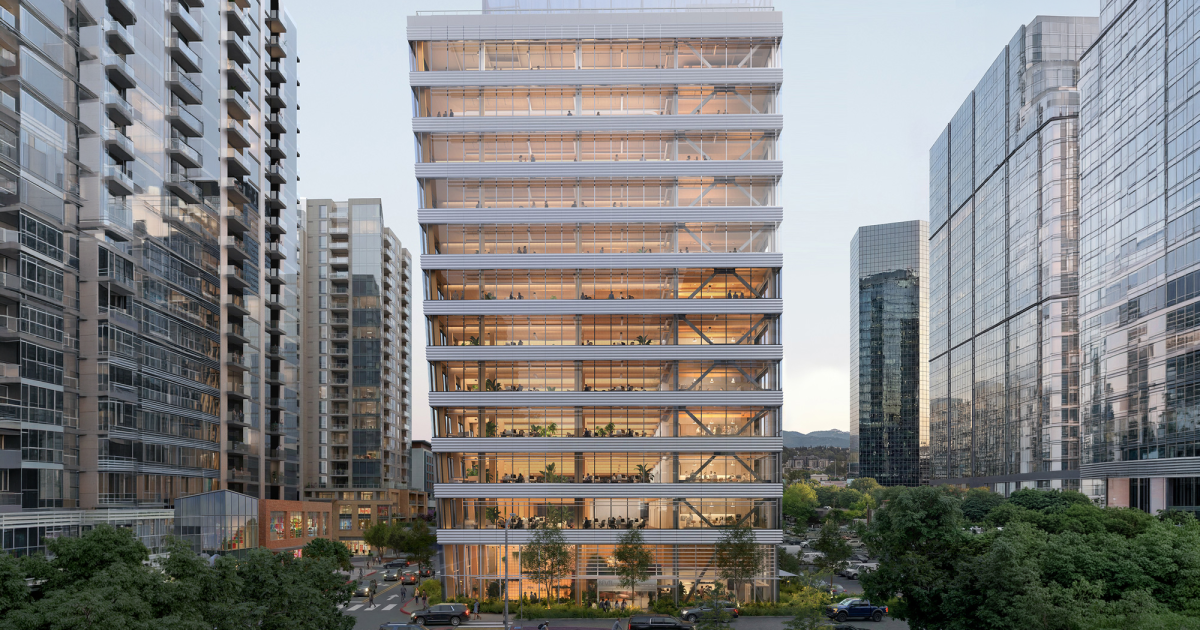
Plans have been revealed for an ambitious wooden high-rise in Bellevue, Washington, that will set a new height record. The timber tower will rise to a height of 180 ft (54.8 m), making it the tallest mass timber office building in the United States once completed.
Developed by Skanska, Bevel is being designed by Waugh Thistleton Architects and Mithun. The building will feature an understated appearance that displays a mass timber frame behind a glazed facade.
Though its designers confirm that its height will make it the tallest mass-timber office building in the USA, it’s worth putting this into perspective. It won’t be anywhere near as tall as the world’s tallest timber skyscraper, the Ascent, in Milwaukee, Wisconsin, which is a residential tower and not an office tower. The Neutral 1005 N Edison St, also planned for Wisconsin, would have been even larger, but that project appears to have stalled.
Skanska
The tower will consist of 12 floors, most of which will be rented out as office space. Like most large timber buildings nowadays, the Bevel tower will actually use a hybrid structure with a concrete parking garage and steel core for structural stability and safety. These will be paired with modern engineered wood columns, beams, and ceilings, which will be exposed throughout the office floors and in ground-floor public areas. Other notable touches include a nature-infused lobby with floor-to-ceiling glazing, and a rooftop garden area.
“Bevel is notable for what will become the tallest mass timber office building in the US, but it’s also expanding the idea of what’s possible with these projects,” says Jennifer Cover, president and CEO of timber-focused nonprofit WoodWorks. “Of the 22 tall timber buildings under construction or built, only three are commercial. A tremendous amount of work also went into gaining approval for the 100% exposed timber ceilings. In both areas, Bevel is setting an example that advances the options available to other building designers.”
Bevel is slated to receive the LEED Platinum certification for its green credentials, which – beyond the use of wood – include integrated stormwater capture and reuse systems, native landscaping, and energy efficient building systems. However, it’s still early in the design phase, and we’ve no word on when it’s expected to be completed.
Sources: Skanska, Mithun, Waugh Thistleton Architects

