


China’s epicenter of robotics and AI innovation, Shenzhen is a sprawling city now home to some of the most ambitious architecture projects anywhere in the world. The latest, four years in the making, is one of its best yet.
Rather than build upwards, as we’ve covered many times over the years, the Shenzhen Natural History Museum has more in common with one of the city’s most impressive new builds, the Shenzhen Bay Cultural Center (affectionally known as the “Airpod building”). Both merge nature and structure in a way that lets people enjoy the free outdoor space as much as what’s held inside. The photos of wandering around and over the cultural center don’t do it justice, but trust me, it’s incredible.
B+H Architects
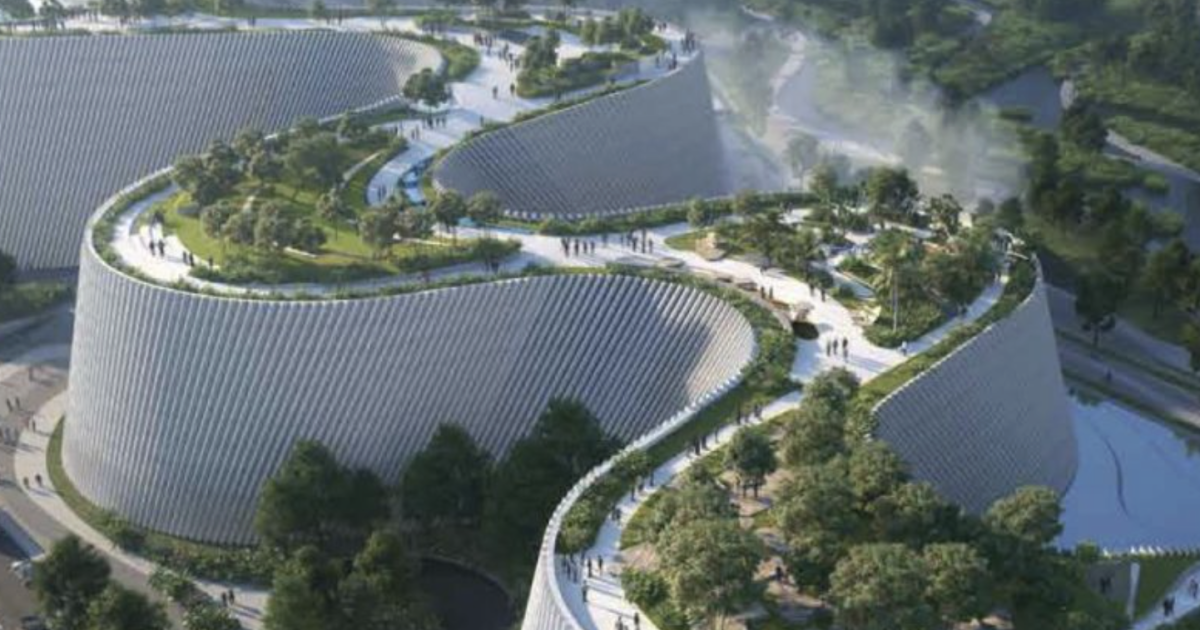
Now, the Natural History Museum in the city’s Pingshan District looks to have even outdone this bayside landmark, stretching more than 105,000 sq m (1.13 million sq ft) adjacent to the Yanzi Lake. It takes its place as one of the world’s largest natural history museums and is also the first institution of its kind in the region that covers a massive area of southern China, including Shenzhen, Hong Kong, Guangzhou and many other large cities.
Designed by Danish architectural company 3XN, with B+H Architects and Zhubo Design, the building resembles a curved sculpture in itself. It’s been designed for community access, with people able to wander across large parts of the roof much like they would walk through a park.
Besides an impressive cantilever, I love a new build that manages to blend a building with the nature its set in, and this massive space does an impressive job of that. During the day, visitors don’t even need to step foot inside the building to enjoy views of the surrounding wetlands and the Yanzi.

B+H Architects
As I’ve written before, Shenzhen is a critical hotspot for China’s rapidly advancing robotics industry. But it’s also a place of immense natural beauty; as a local proudly told me last week, there are more than 1,000 parks there, with more on the way. Even at 8 pm with the atmosphere a soupy 35 °C (95 °F), Luohu Sports and Leisure Park was full of hikers, joggers and people playing basketball.
And it’s this outlook – ambitious builds that also offer public green spaces – that is at the heart of the new museum.
But enough about the outside. The museum, which officially opened on July 28, is more than just a giant space for fossils. It’s also a research center, educational space and is equipped with laboratories, scientific collections and other facilities behind the scenes for everyone from anthropologists to zoologists to make use of.

B+H Architects
Ultimately, the museum’s goal is to be an international center for natural history research, as well as a place for visitors of all ages to learn about the world, past and present. There’s also an astronomical observatory for the space nerds among us.
From what we know so far, inside the huge space are displays that cover 4.6 billion years of Earth’s history. Starting at the beginning – from what we know of Earth’s emergence and the earliest forms of life – through to the age of dinosaurs, and onto mammals, and humans, it’s a journey you’d expect from a natural history museum.
There’s also space dedicated to southern China and its biodiversity, something visitors from outside of the region may not be aware of. (Side note: If you’re a wildlife obsessive like I am, check out this site if you can’t get to the museum anytime soon.)
While the museum has put a lot of effort into dinosaur builds, which are found throughout several gallery spaces, the curators have worked hard to highlight the extant biodiversity of the Guangdong Province and the Pearl River Delta. Here, exhibits take visitors on a journey through species adaption over millions of years – and how present-day conservation efforts are working to safeguard threatened habitats.

B+H Architects
And given Shenzhen’s unprecedented transformation when it comes to cities – from fishing village to futuristic technology hub in a handful of decades – the museum also gives visitors a chance to see this transformation. This in turn connects with the museum’s surroundings, where a city’s growth is still working to strike a balance with the wildlife that has called it home long before the humanoids made it famous.
While the museum’s striking architecture is clearly front and center, perhaps the most impressive aspect is that as well as providing space for the community to enjoy for free, it’s created an entirely new facility for scientific discoveries. This makes it more than a building showcasing the past, but one that has the potential to advance our knowledge of many fields – from geology to animal and environmental science – while taking us on a journey through the world that existed before us.
Source: B+H Architects and 3XN

