


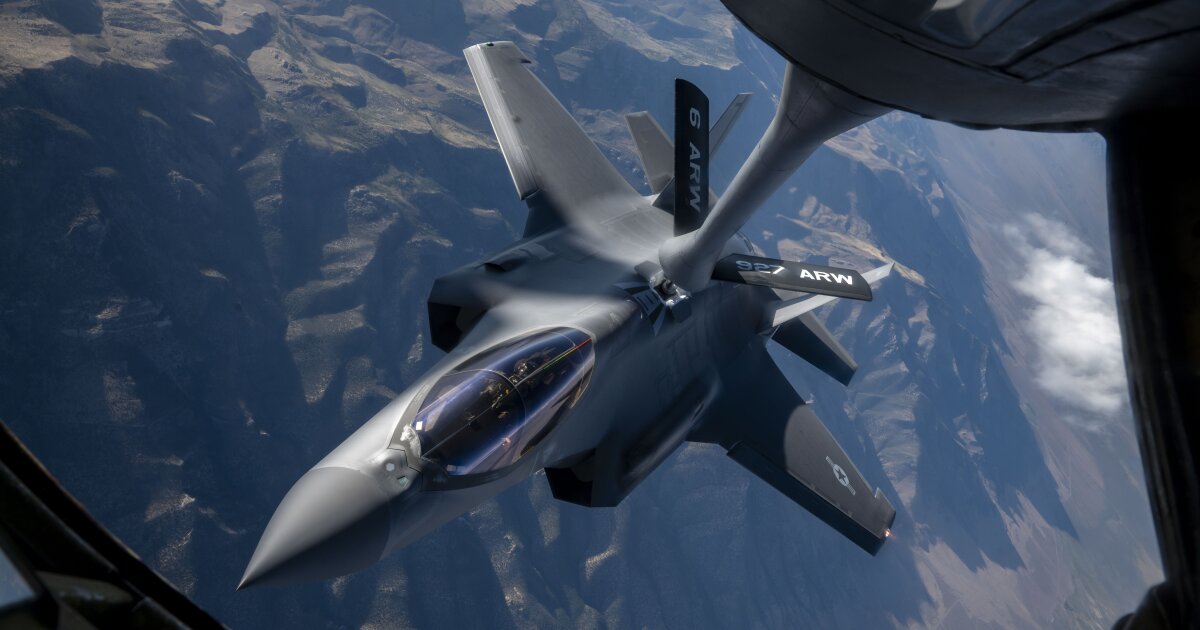
CycloKinetics, a US propellant company, has unveiled a new family of superfuels for aircraft, missiles, and rockets that increase fuel performance by 32%. Aimed at the defense market, the fuels could allow vehicles to fly farther while carrying heavier payloads.
If you’re an aficionado of old matinee serials or pulp thrillers, scientists were forever inventing secret rocket fuels before being kidnapped by dastardly villains in improbable costumes for their troubles. It was all very exciting until you learned a bit about basic rocketry and discovered that secret super rocket fuels were pretty much a non-starter from the get-go.
Well, not quite.
True, the gold standard in terms of energy density for practical fuels will always be hydrogen, with methane a distant second. But leaving out the cryogenic class and concentrating on more day-to-day rocket, missile, and aviation fuels, there’s still a lot of room for improvement.
CycloKinetics’ approach is to create “plug-in” fuels that can replace conventional fuels in various vehicles without requiring modifications to the craft or its engines. There’s nothing particularly wild or exotic about this, and no unobtanium-type elements are involved. It’s more a matter of changing the geometry of the hydrocarbon molecules that make up the fuel itself.
Conventional aviation fuels consist of linear and branched hydrocarbon molecules, which limits how much energy can be packed into a given volume. CycloKinetics instead engineers cycloparaffinic hydrocarbons – that is, ring-shaped molecular structures that pack more carbon and hydrogen atoms into the same space as would be occupied by conventional fuels.
CylcoKinetics
The upshot is 32% more energy in the same volume as standard Jet A fuel. That means, for example, an aircraft capable of flying 1,500 nautical miles (1,726 miles, 2,778 km) on standard fuel could potentially exceed 1,950 nautical miles (2,244 miles, 3,611 km) using the new superfuel, while reconnaissance aircraft could remain on station up to 30% longer.
According to a white paper from the company, the new fuels eliminate the need for aromatics or sulfur, and they don’t “coke” or break down like conventional fuels, which can leave behind abrasive carbon deposits when used as engine coolants. This soot reduction could also make engines stealthier by reducing their infrared signature.
The superfuels also boast much greater thermal stability, meaning they can absorb more heat without degrading and tolerate very low temperatures without becoming viscous. That makes them particularly well suited for high-altitude flight.
CycloKinetics is currently producing three fuel types. These include CycloJP, a replacement for Jet A, JP-5, JP-8, and JPTS used in turbine-powered aircraft and unmanned aircraft systems (UAS); CycloRP, a rocket propellant intended to replace RP-1 and RP-2 refined kerosene used in liquid rocket engines; and CK-10, which replaces JP-10 fuel used in cruise missiles and standoff munitions.
The company’s current production capacity reportedly stands at 60,000 gallons (227,125 L) per year as of 2025, with further scaling planned by 2027. Because the fuels are created using a proprietary fermentation and catalytic process, the product is likely more expensive than conventional fuels. That combination of limited capacity and higher cost probably explains why the primary customer base currently lies in the defense sector, where the demand for increasingly long-range missions can outweigh fuel price concerns.
“Building superior fuels has been our business for 15 years, and that work has earned us the trust of leading airlines and every branch of the U.S. military,” said Mukund Karanjikar, CEO and founder of CycloKinetics. “Creating CycloKinetics as a dedicated defense entity is the logical outcome of that history; we now have the scale and operational depth to warrant the same structure. Across defense and space, propulsion is no longer a background variable but a primary driver of mission capability. From high-altitude ISR and long-range strike systems to next-generation propulsion and space launch, performance increasingly comes down to the energy powering the platform. As operational demands evolve, advanced propellants have become a critical lever for extending range, increasing endurance, and enabling entirely new mission profiles that were previously out of reach.”
Source: CycloKinetics

