


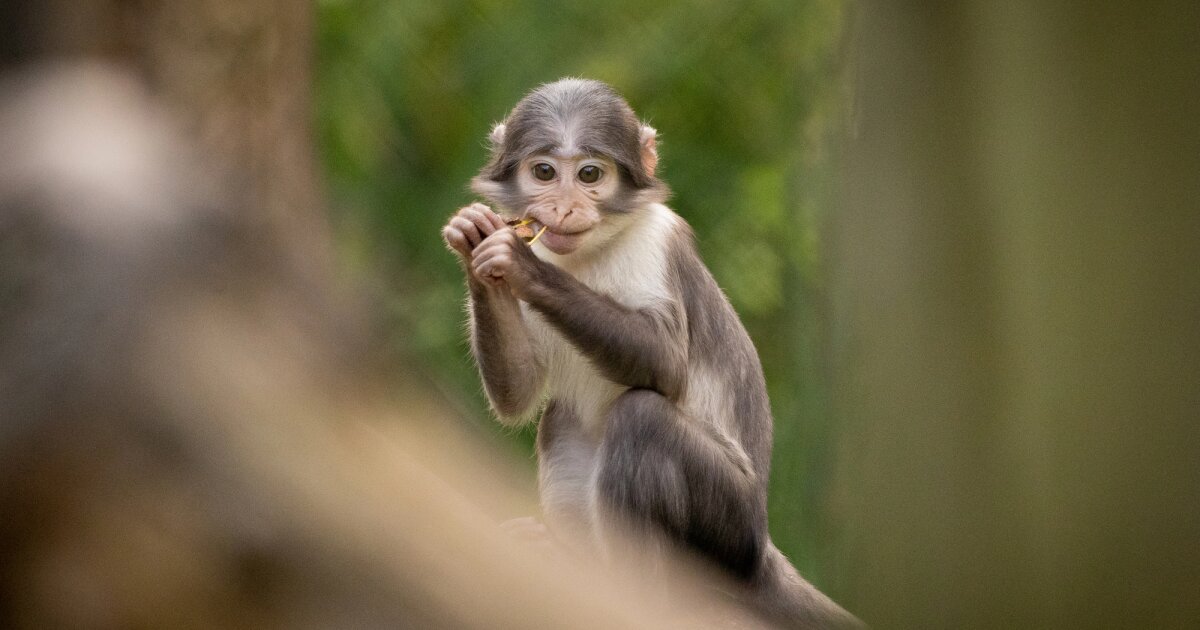
In January 2023, researchers at the Helmholtz Institute for One Health in Germany noticed that an infant monkey known as a sooty mangabey had developed reddish skin lesions across its forehead, chest, and legs. Within 48 hours, the animal was reported dead. Over the following weeks, nearly a third of the group’s 80 members developed similar lesions, and four infants died. The outbreak was caused by the monkeypox virus (MPXV).
Now, a study published in Nature has traced its source to a small African rodent called a fire-footed rope squirrel (Funisciurus pyrropus), providing researchers an “unique opportunity to describe the transmission of the virus from a reservoir to a host in real time,” a disease ecologist, Fabian Leendertz, told Refractor. “We were there when it happened, and this is very rare in history.”
Rope squirrels have long been suspected as a monkeypox reservoir. But evidence of the virus jumping from a squirrel to another animal had never been documented.
Around 12 weeks before the onset of the outbreak in the mangabeys, Leendertz and his colleagues reported, a dead fire-footed rope squirrel was found in Taï National Park in Ivory Coast. “We were surprised because squirrels are normally small-bodied animals in the rainforest, they decompose very quickly, they’re quickly gone,” says Leendertz.
The first author of the study, Carme Riutord-Fe, did a necropsy on the squirrel carcass, and the squirrel tested positive for MPXV. Researchers were even able to isolate viable MPXV from its skin, lung, and liver. When the team sequenced the virus from the squirrel and the dead mangabeys, they found the virus genomes to be identical.
In an interview, Leendertz told us that this dead squirrel didn’t initiate the outbreak, as it was found 3 km (almost 2 mi) away from where the monkeys lived. “It was another squirrel,” says the veterinarian. The virus likely circulated through the woods among the squirrel population, and “the monkey was unlucky to eat the wrong squirrel,” he told us.
Another piece of evidence came from the mangabey’s fecal samples. Using a technique called diet metabarcoding, the team identified the traces of fire-footed rope squirrel DNA in two samples.
Deadly chain
So, to summarize, the team first found MPXV in a fire-footed rope squirrel. Next they found the same DNA from that virus in the virus that infected the dead monkeys. And finally, they confirmed through fecal analysis that the monkeys ate this particular squirrel species.
While not a direct link in the sense that the researchers didn’t see the monkeys eat an infected squirrel, it’s certainly enough evidence to draw the conclusion they reached in their study — and to inform future research.
“The fire-footed rope squirrels are one of the potential reservoirs, but there will be more rodent species,” Leendertz says.
A biologist, Chinmay Sonawane, at Stanford University, who was not involved in the study, says that documenting spillover events between species is incredibly challenging. But this study provides persuasive evidence of monkeypox virus spillover from a rodent to a primate. “This study offers strong support for rope squirrels as long-term reservoirs for monkeypox virus,” Sonawane says.
Researchers also imply the virus’s possible spillover to humans. Fire-footed rope squirrels are hunted and consumed by humans in West and Central Africa. The spillover may also occur through infected mangabey and humans. “If a hunter goes into the forest and kills one of the monkeys with the lesions, they will also take it (virus) home,” Leendertz concludes.

