


For more than 150 years, vertebrate vision has been understood as a two-part system: rods for low-light conditions, and cones for bright light and color. That tidy division is now under the microscope, as researchers from the University of Queensland have discovered a new hybrid cell that breaks the rule: rod-shaped photoreceptors that run cone-specific genetic programs.
In larval deep-sea fish, these cells dominate early development. The result suggests vision can follow a different path, tuned to the dim, in-between light these animals inhabit.
What we know of most vertebrates is that vision develops in a set sequence: cones first, rods later. Deep-sea fish appear to break that pattern, relying instead on hybrid photoreceptors to navigate low, diffuse light conditions.
That alternative pathway may reflect the unusual light environment these fish inhabit early in life. Unlike most marine larvae which begin life in sunlit surface waters, many deep-sea species develop deeper in the water column, within the mesopelagic, or “twilight,” zone. Here, sunlight fades to a faint, filtered glow – just enough to see, but far from the brightness most young fish experience.
In this dim, transitional layer, neither rods nor cones alone are ideal, creating a niche where a hybrid system may offer a clear advantage.
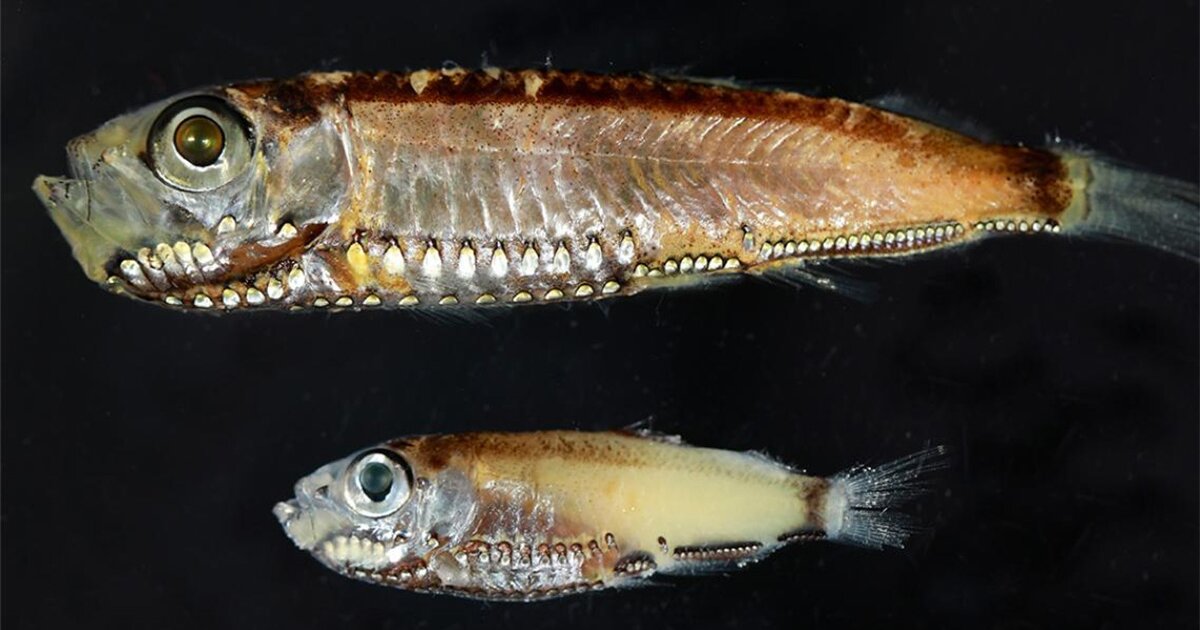
To understand how these hybrid photoreceptors function, the researchers examined the retinas of larval deep-sea fish across three species: Vinciguerria mabahiss, Maurolicus mucronatus, and Benthosema pterotum. These specimens were collected in the Red Sea, between 65 and 650 ft (20 and 200 m) below the surface, during a series of marine expeditions led by researchers including Lily Fogg and Fanny de Busserolles.
Fogg et al / University of Queensland
Upon examination, the team found that the samples were telling a different story at the molecular level: these rod-shaped cells overwhelmingly expressed cone-specific genes. In other words, they had the form of rods, while functioning like cones.
Rod-like structures are optimized to capture as many photons as possible in low-light conditions, while cone-derived molecular machinery supports faster response and recovery. Together, that combination gives these hybrid photoreceptors an edge in dim, shifting light.
As these fish develop, that hybrid setup doesn’t always carry through unchanged. In Maurolicus mucronatus, those rod-shaped, cone-expressing cells remain dominant into adulthood. In the other species, Vinciguerria mabahiss and Benthosema pterotum, the retina eventually settles into a more familiar low-light system, shifting toward true rods.
The findings point to a more flexible visual system, where structure and molecular function don’t always align. Rather than fixed categories, photoreceptors appear capable of shifting in response to their environment.
Similar photoreceptors have been observed in other vertebrates, including reptiles, amphibians, and jawless fish, but their role in early development has remained largely unexplored. Because the species examined here span distant evolutionary lineages, the findings suggest this flexibility in visual systems may be more widespread than previously thought.
What’s less clear is how far this flexibility extends. Whether these hybrid photoreceptors represent a single cell type that shifts identity over time or distinct populations that appear at different stages remains unresolved.
Future work will need to determine how these cells develop and whether they represent a transitional form or a distinct photoreceptor type in their own right.
This study was published in the journal Science Advances.

