


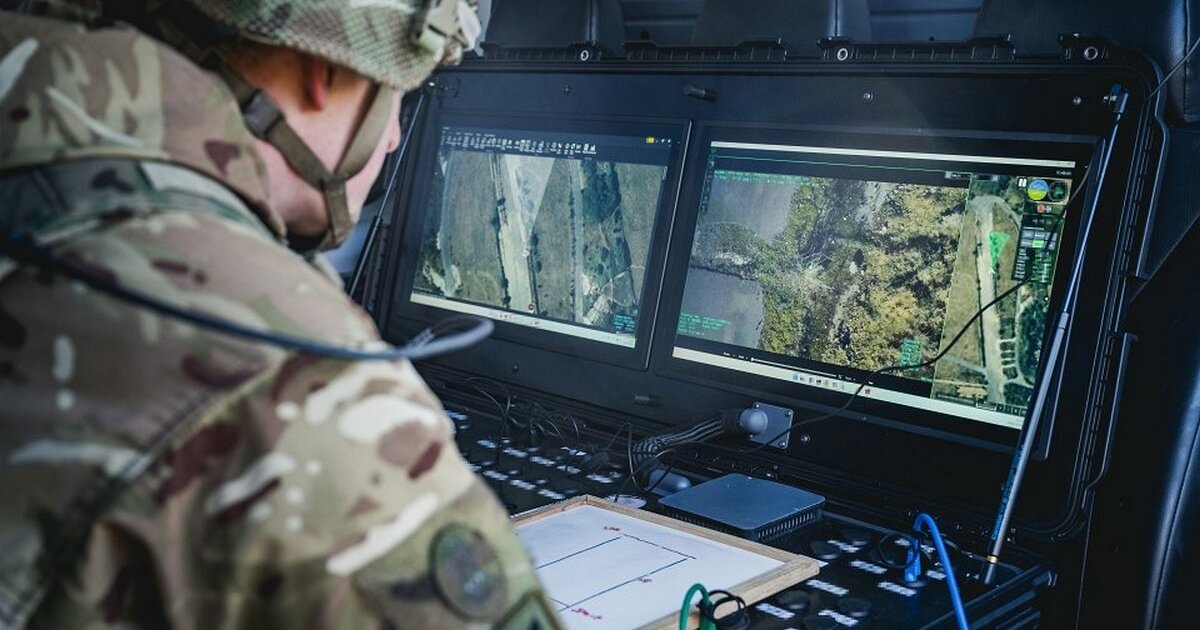
The British Army and the Defence Science and Technology Laboratory (Dstl) have completed a multi-week test in Essex using drones, advanced sensors, and AI to speed up and make safer the hunt for deadly mines and munitions scattered on battlefields.
If you look at the inventory of any major military power, you’ll find that a surprisingly large percentage of its forces are dedicated to finding, removing or detonating mines and ordnance. But that isn’t, after all, so surprising when you understand the extent of the problem and the hazards presented by such nasty little traps.
Since the Russian invasion, for example, Ukraine has become the most heavily contaminated country in the world – even surpassing Syria and Afghanistan – when it comes to landmines and ordnance. It’s estimated up to 67,000 square miles (174,000 km²) or up to 30% of the area is strewn with anti-personnel mines, butterfly mines, and similar scattered munitions, plus anti-vehicle mines along with up to five million failed artillery shells, cluster submunitions, and duds.
Project GARA
Along with other conflicts, terrorist attacks, and the detritus of previous wars, bomb detection and disposal units are gaining far too much experience in dealing with such threats to life and limb as well as learning from the painful examples of others.
It’s with this in mind that Britain is pursuing Project Ground Area Reconnaissance and Assurance (GARA), which focuses on developing the British Army’s Future Counter-Explosive Ordnance Capability (FCEOC). Working with Dstl and the Army’s 33 Engineer Regiment (Explosive Ordnance Disposal and Search), the objective is to explore new technologies to find ways to speed up and make safe the arduous task of dealing with high explosives.
As part of this, the partners conducted several weeks of tests earlier this year dealing with minefields where there are a bewildering variety of mixed munitions made of metallic, minimum-metal, and plastic-bodied devices that are too slow and hazardous to handle using conventional methods – especially when many may be obscured or buried.
For the latest exercise, the teams used quadcopter drones with a suite of highly advanced optical, thermal, long-wave infrared, magnetometers, and computer vision algorithms to relay data to remote Army personnel. AI tools designed for rapid retraining as new information becomes available were then utilized to locate and identify munitions in the field. This introduces a “reconnaissance layer” between the human operator and the digital system that is capable of seeking out, identifying, and geolocating threats before the human soldiers even show up. Even better, if the operator sees a new threat on their screen, they can upload the image and data into the AI models to update the system.
Crown copyright
The technical details of the new systems and how they operate are classified for obvious reasons, but it is essentially part of a three-tiered approach of dealing with mines and munitions by first detecting and classifying, then marking and prioritizing the thread, and finally neutralizing these threats by means of robots, drones laying explosive charges, or (as a last resort) sending in a human to cut the red wire. Or is it the green one?
“The modern battlefield is littered with explosive ordnance,” said Major Mark Fetters, British Army Future Counter-Explosive Ordnance Capability lead. “The equipment being developed by Dstl will allow EOD operators to conduct their mission faster and will remove people from the explosive hazard.
“We are also looking to understand how the capability will grow as other technologies mature. As different types of sensors become lighter, more power-efficient, and smaller, they will be able to fit on to smaller uncrewed aerial systems – constantly improving the capability available to our EOD and Search personnel.”
Source: Ministry of Defence

