


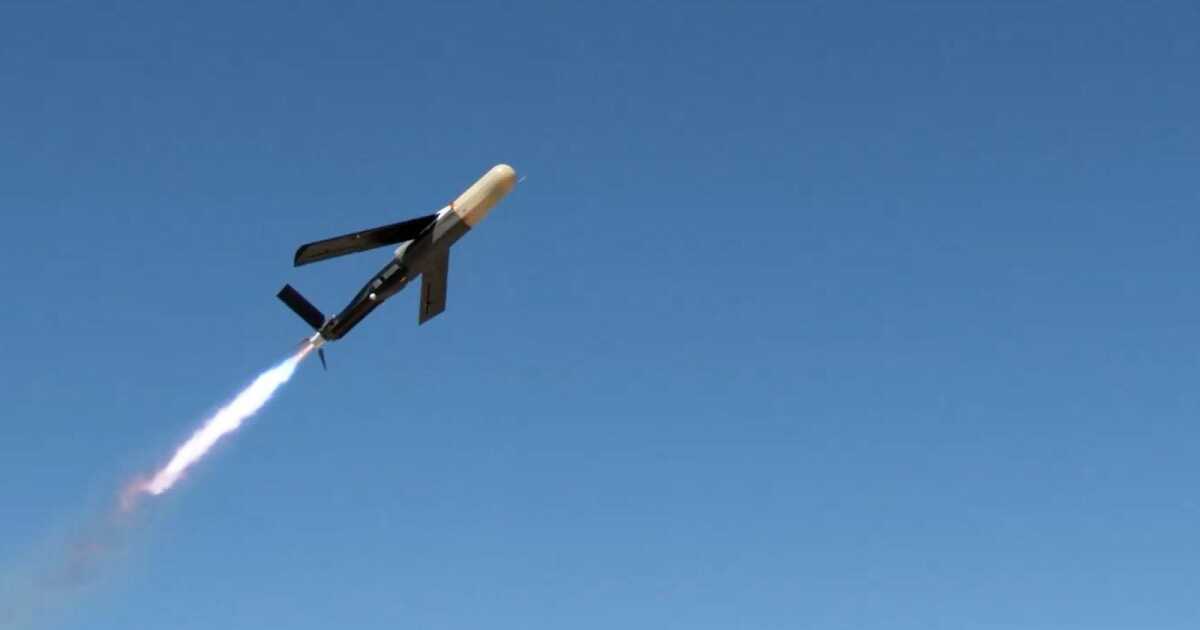
With a single invisible shot, Raytheon’s Coyote Block 3 UAV zapped swarms of drones out of the sky in a US Army demonstration showing that a reusable drone with electromagnetic weapons is an economical alternative to explosive interceptors.
One very unpleasant fact about drones is that they are inexpensive and can be deployed in swarms, while conventional explosive or impact countermeasures are expensive, limited in number, and can be overwhelmed by a large enough attack.
The problem is that conventional weapons operate on the doctrine of one-shot-one-kill. Unfortunately, those shots can cost hundreds of thousands of dollars per round. This is not only hard on the public purse, it also means that interceptor batteries suffer from “magazine depth” problems. That translates as reaching into the box for the next round and grasping thin air, which can ruin your whole day.
The recent tests by the US Army at the Yuma Proving Grounds in Arizona of what is called the Low, slow, small-unmanned aircraft Integrated Defeat System (LIDS) were intended to validate the latest Coyote variant under stress-level drone saturation attacks. The scenario involved about 10 drones approaching from different directions to test the supporting radar’s Ku-band radio frequency sensor and its ability to track them, as well as the Coyote’s ability to lock on, make decisions, and engage.
Coyote
As the name suggests, the Coyote Block 3 is the third variant of Raytheon’s Coyote platform, which has undergone considerable evolution. The first version was an electric-powered, propeller-driven craft with pop-out wings that was made for reconnaissance. Block 2 upgraded to a jet turbine engine with four control fins, turning the drone into an interceptor missile for destroying hostile drones by impact and explosion. Meanwhile, Block 3 keeps the turbine-powered airframe and performance of the Block 2, yet swaps out the warhead for an energy weapon. In addition, Block 3 is designed to be recovered and rescued at the end of its mission by catching it in a net.
Exactly what kind of weapon the Coyote carries remains unknown, but it’s likely to be either a High-Power Microwave (HPM) system or an advanced Electronic Warfare (EW) suite.
The former works by firing a directed burst of electromagnetic energy that fires a jolt of high-voltage electricity through the target’s circuits, frying them so fast that the drone drops out of the sky. The latter, to put it simply, is more subtle. Instead of burning out the drone’s components, it scrambles the signals in a manner akin to a taser.
Such systems have already been tested on both ground-based and airborne platforms, but miniaturizing one to fit in a small drone allows them to be used at close range to the attacker for greater effectiveness. The specifications of the Coyote are classified, but it has enough range, speed, and altitude to engage Group 2 and Group 3 drones. It can also act as a node in the Forward Area Air Defense Command and Control network. In addition, it has the ability to network with other Coyotes, which can then autonomously divide up targets and decide how to engage them most efficiently without the need for a human operator. It can even configure the attack field to take on several hostiles simultaneously.
What all this adds up to is that the Coyote can loiter and attack at the cost of its fuel and battery refurbishment without sacrificing a valuable airframe and sensor suite after each engagement.
“Coyote provides warfighters a cost-effective defense for individual drones and swarms,” said Tom Laliberty, president of Land & Air Defense Systems at Raytheon. “We continue to invest in Coyote’s combat-proven capabilities, ensuring that allies around the globe gain an affordable operational advantage over sophisticated and evolving drone threats.”
Source: Raytheon

