


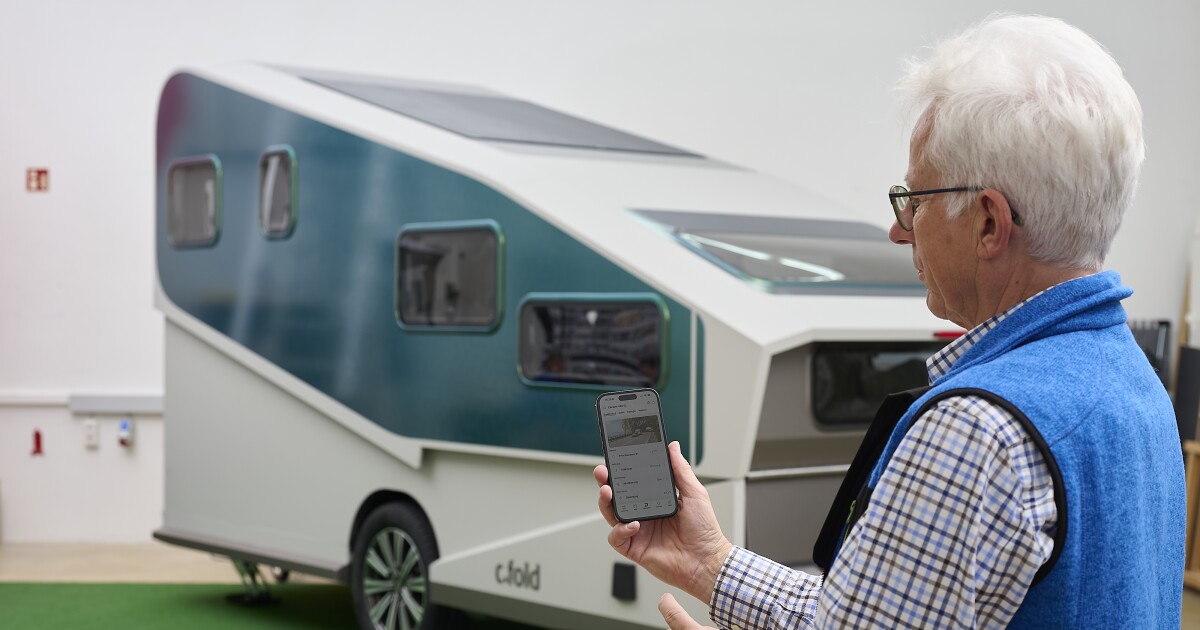
Never one to shy away from exploring potential avenues for the future of RVing, Dethleffs has hit this year’s CMT show with a new camper concept. The C.Fold concept caravan was developed specifically for the latest vehicles, particularly electric cars and smaller autos. It tucks down low during driving before lifting at camp with the push of a button to essentially double its interior volume.
The C.Fold Caravan is the latest in Dethleffs’ “Destination Future” concept and prototype series, which kicked off nearly a decade ago with the solar-slathered E.Home concept that still looks futuristic today. Dethleffs previously left off with last summer’s sustainably built E.Home Eco.
The inspiration for the new C.Fold came from Dethleffs customers Monika and Peter Marchart, lifelong camping enthusiasts who have spent decades touring Europe with a variety of campers. The couple switched to an electric vehicle several years ago but found that pulling a caravan equated to cutting range in half. Specifically, they found their 400-km (249-mile) car could only drive 200 km (124 miles) per charge with a trailer on the hitch.
The Marcharts brought the idea of a more EV-friendly caravan to Dethleffs, undoubtedly one of the more receptive longtime caravan builders thanks to the keen eco focus of its aforementioned Destination Future program.
In 2018, that Destination Future program resulted in the debut of the world’s first self-driven caravan concept, a product category that finally entered the production stage in 2025, albeit under a completely different brand. But long before Silicon Valley had any interest at all in RVing, Dethleffs was experimenting with a self-powered camping trailer of its own in the 2018 E.Home Coco. It went on to test the prototype on a 240-mile (386-km) EV towing trip through the Alps, reporting it a success.
With the C.Fold, Dethleffs goes back to basics, eliminating heavy, expensive EV-size battery packs and drive systems and instead focusing on creating a lighter, sleeker trailer in order to cut drag on the tow vehicle and boost range. To keep weight of the trailer down, it relies on an Alucore aluminum-honeycomb composite body construction and insulation made from recycled PET plastic bottles. The result is a 549-cm-long (216-in) travel trailer that weighs in at 1,709 lb (775 kg), light enough to be towed by a wide variety of EVs and small ICE vehicles.
Dethleffs
Dethleffs’ alu-composite body construction isn’t your usual trailer box at all, splitting the C.Fold body into an upper over-shell that collapses down over the lower body to drop total height to 165 cm (65 in) during travel. Dethleffs finds a comfortable medium between a full-body telescopic over-shell, as we’ve seen on such RVs as the Lightship F1 and Kimberley Karavan, and a wedge-style pop-up body more similar to a hard-sided version of the Easy Caravanning TakeOff. It’s ultimately a long, trailered version of a hard-sided wedge-shaped pickup camper like the XPCamper V2 or Innovan.
This clamshell-like mechanism keeps the C.Fold low and aerodynamic while towing before offering plenty of space in which to live and lounge at the campsite. Instead of an electric actuator at each front corner, Dethleffs has gone with a central cable pulley system that lifts and lowers both corners from the center.

Dethleffs
The compacted C.Fold parks and stores comfortably in a home or public garage, complemented by a body that measures 1.9 m at its widest. The trailer also features an independent air suspension that allows drivers to lower it even further, and the over-shell covers the wheels partially for improved airflow.
All in, Dethleffs says that its computational fluid dynamics (CFD) analysis surmises that the trailer could add up to 100 km (62 miles) of range versus a traditional travel trailer, meaning the Marcharts’ 400-km electric vehicle would be able to tow it for up to 300 km (186 miles) before requiring recharge.
The C.Fold’s upper body shell rises into camp form at the push of a button or command on the accompanying mobile app, lifting upward via a rear hinge to open up the interior. Once fully set up, the C.Fold offers 1.9 m (6.2 feet) of headroom at the front end.

Dethleffs
Stepping inside the half/half door, Dethleffs job was simplified by the fact that this trailer was designed with a couple (the Marcharts) in mind, not an entire family. So it’s able to shorten up the common four-person convertible dinette into a two-seater, saving floor space and weight.
Instead of lowering on a pedestal, the tabletop folds out of the way against the wall. The two bench tops also fold out of the way, and the bases fold in via accordion-style panels, allowing the front-end of the trailer to stow cargo while driving. The space is sized to carry two electric mountain bikes.

Dethleffs
Moving back from the front dinette, the C.Fold features a traditional layout that’s been strategically compacted for better space utilization. Dethleffs had to be particularly creative with the toilet room, walling off a private space separate from the remainder of the open floor plan that fits in below the lowered roof. It’s developed a half-height compartment that works as a side console, complete with a flat shelf top. The top lifts up to the ceiling, pulling a wraparound fabric wall along with it to complete the room. The space includes a Clesana dry toilet and sink but no shower.

Dethleffs
Across from this transforming toilet room, the kitchen remains more straightforward and traditional. It includes a sink below a flush lid, a refrigerator placed inside the doorway for easier outdoor access and a worktop. It also stores a portable induction cooktop that can be used on the galley worktop or outside, powered via an onboard electrical system with dual 150-Ah lithium batteries, a 2,000-W inverter and 350 watts of rooftop solar.
The rear of the trailer is filled out by a fixed double bed, a U-shaped design that’s split on the frontmost end. While the bed pushes up to the lowest point inside the trailer, campers have space to sit upright so long as they’re situated with their heads at the center of the trailer.

Dethleffs
Other features of note include openable windows and shades integrated into the walls to maintain a flush shell that can slide over the lower body, hidden ambient lighting that illuminates the trailers curvature and a skylight over the bed. The overhead cabinets feature a self-leveling design to keep contents from sliding or rolling around, allowing campers to keep all their dishes and provisions stored while driving.
None of Dethleffs previous Destination Future concept vehicles has made it to production, though the features, design methods and styling have undoubtedly influenced production models, particularly eco-friendly ones like the Globevan e.Hybrid. Perhaps it will do some on-road testing of the C.Fold and even allow the Marcharts to try towing the creation they helped inspire.
We’ll look to get more information at the CMT show in Stuttgart later this week, as we’ll be on our way to Germany this evening.
Source: Dethleffs

