


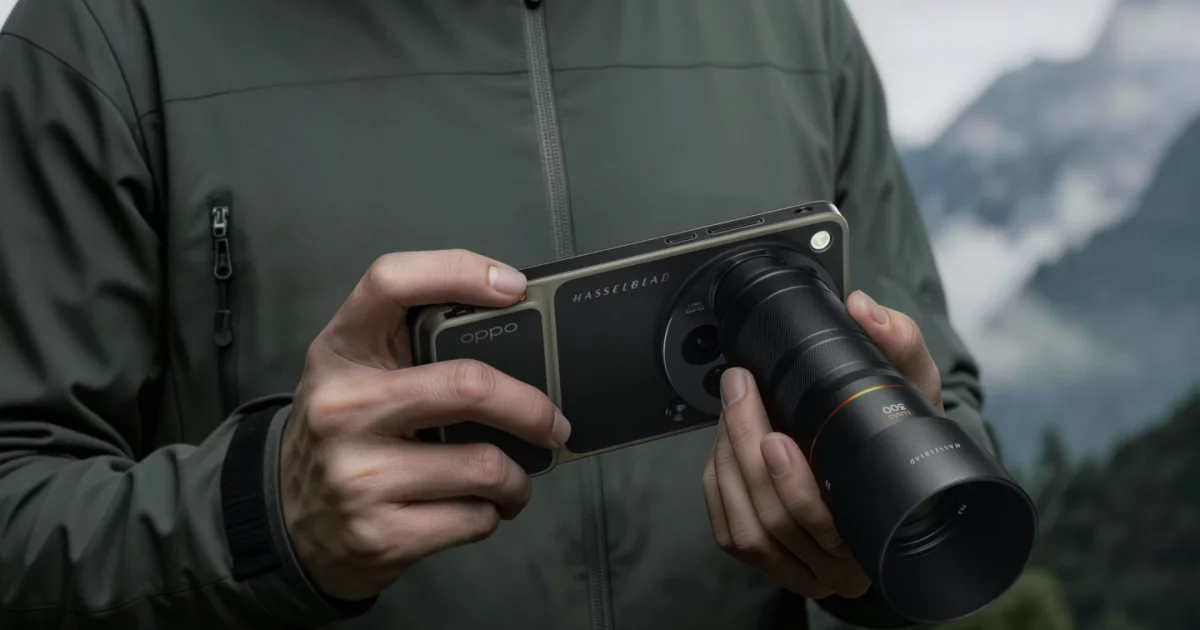
Oppo’s Find X9 Ultra takes smartphone photography to the next level with a 10x optical zoom telephoto and dual 200MP cameras built around a Hasselblad-tuned system, plus an externally mounted teleconverter lens option to reach even farther.
Smartphone makers have spent years trying to close the gap with dedicated standalone cameras. In many cases, they’ve succeeded, particularly against mid-range gear. But when it comes to long-range zoom and low-light performance, high-end cameras still tend to have the edge.
The Find X9 Ultra is Chinese consumer electronics manufacturer Oppo’s latest attempt to redefine mobile photography. Building on earlier Find X-series devices, it prioritizes high-resolution optics, anchoring its Hasselblad-tuned system with a suite of 50-MP and 200-MP sensors.
Oppo
Rather than incremental upgrades, Oppo seems to be targeting the areas where smartphone cameras have struggled: reach, control, and consistency across the focal range.
The standout feature is the Find X9 Ultra’s 50-MP 10x optical telephoto lens, enabled by a “quintuple prism” periscope system that essentially “folds” light multiple times to fit inside a smartphone body. The company says this reduces module size by around 30%, solving one of mobile zoom’s biggest constraints: space.
With sensor-shift stabilization and a relatively fast f/3.5 aperture, the system is designed to deliver sharp long-range shots, with up to 20x “optical-quality” zoom. This opens up use cases like wildlife or concert photography without needing heavy cropping or editing.
For anyone who needs even greater reach, OPPO is also introducing an optional Hasselblad 300-mm Explorer Teleconverter. This external lens mounts to the 3x telephoto camera module and uses a 16-element optical design for the equivalent of 300-mm reach, enabling up to 13x optical zoom and improved results at 30x and beyond. This is a unique move from a smartphone maker, blurring the lines between mobile device and a professional lens system.

Oppo
Supporting this is a multi-camera array designed to work across various focal lengths. A 200-MP main camera (Sony LYTIA 901) is paired with a 200-MP 3x telephoto with macro capability, plus a 50-MP ultra-wide and a multispectral color sensor.
Together, the system spans roughly 14 mm to 460 mm of hybrid zoom, with improved low-light performance and more accurate color via Hasselblad tuning. This sits very much in line with the broader smartphone trend of coordinated multi-lens systems.
On the video side, the Find X9 Ultra moves deeper into professional territory. It supports 4K/60fps Dolby Vision recording, alongside 4K/120fps slow motion and 8K at 30 frames per second.
For content creators, Oppo is adding tools we typically see in dedicated cameras: an O-Log2 profile for grading, ACES workflow support, and the ability to import or burn in LUTs directly. Hasselblad Master Mode and RAW capture across multiple focal lengths expand creative control, and film simulations offer quicker stylistic options. The approach here is clear: this isn’t just a point-and-shoot phone, but something closer to a hybrid production tool.
Beyond the camera showstopper, the phone’s hardware is firmly flagship-level. A Snapdragon 8 Elite Gen 5 chip powers a 6.82-inch 144-Hz AMOLED display, backed by a large 7,050-mAh battery with 100-W wired and 50-W wireless charging.
Overall, the design mirrors its photographic ambitions, featuring Hasselblad-inspired detailing and a rugged IP66/68/69 rating.
Pricing starts at around £1,449 (roughly US$1,940) in the UK from next month, placing it at the premium end of the market. That converts to around US$1,940, though an official US release is not on the cards.
Positioned between a smartphone, compact camera, and creator gear, the Find X9 Ultra reflects a broader shift toward camera-centric devices – though, as ever, how close it gets to replacing dedicated cameras will depend on its real-world performance.
Source: Oppo

