


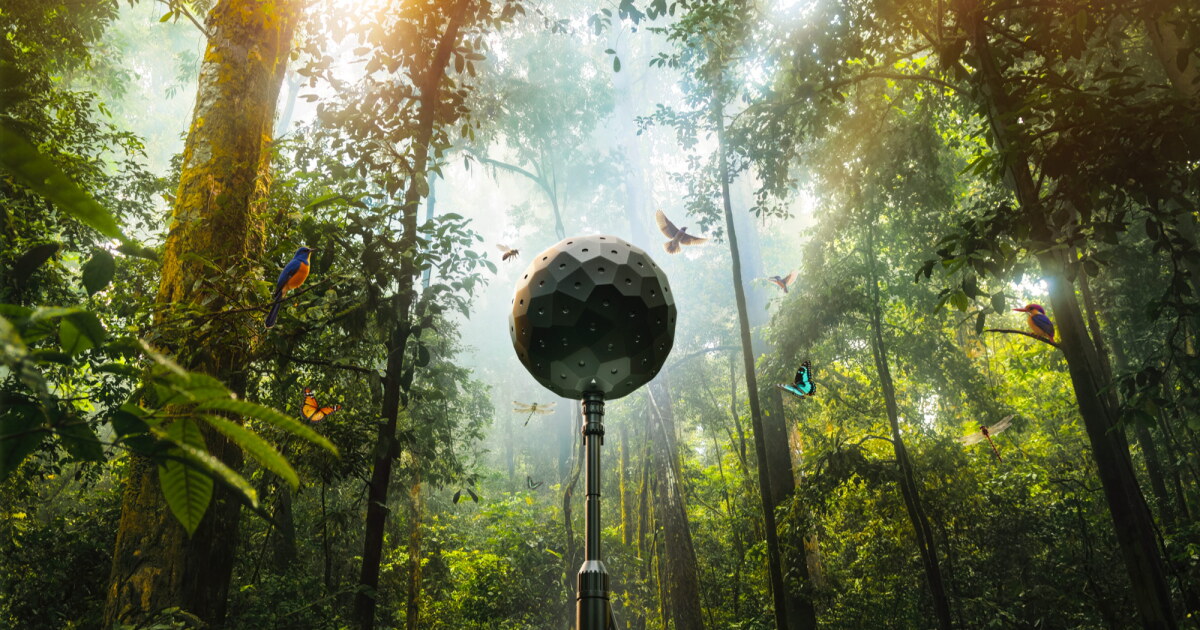
Blackmagic Design has crammed 108 microphones into a faceted metal sphere small enough to sit on top of a camera. The company’s new Ambisonic Microphone is built to give 360-degree cameras and the immersive video they shoot a soundtrack that’s similarly all-encompassing.
These digital MEMS capsules capture sound from every direction at the same time; Blackmagic describes the device as the world’s first 7th-order ambisonic microphone.
Developed alongside Apple during work on the URSA Cine Immersive camera, it aims to make professional spatial-audio capture a lot less cumbersome than it historically has been.
Blackmagic Design
Ambisonics works differently from conventional stereo. Instead of recording fixed left and right channels, it captures a 360-degree spherical sound field that can later be rendered based on the direction the listener is facing. The higher the “order,” the greater the spatial resolution: first-order ambisonics uses four channels, third-order uses 16, while seventh-order jumps up to 64.
The array processes those 64 channels in real time at 32-bit resolution. By comparison, Zylia’s 19-capsule ZM-1 tops out at third-order ambisonics, which highlights the magnitude of the spatial resolution jump Blackmagic is making here.
Arguably, what sets it apart is everything you don’t need. An internal processor handles the entire microphone array and uses Apple-licensed geometry and encoding filters to convert its signals into seventh-order ambisonics while you’re recording. There’s no external breakout box or separate encoding computer required, and a single USB-C cable delivers both audio and power.
The system is class-compliant, too, so you won’t need to install any drivers or plug-ins. Mounted on the Blackmagic URSA Cine Immersive, it can record spatial audio directly into the camera’s files, already synchronized with the footage.

Blackmagic Design
On the software side, the microphone feeds directly into Apple Immersive Video and Vision Pro workflows, where Higher Order Ambisonics serves as the environmental sound bed alongside conventional channels and positioned audio objects.
Blackmagic hasn’t locked the mic to a single camera, though: you can also connect it to a computer for Fairlight Live, record directly to an iPhone through the Blackmagic Camera app, and eventually feed broadcast systems through an optional USB-to-SMPTE-2110 converter.
The Ambisonic Microphone is due to ship in December for US$1,695 before local duties and taxes, via resellers worldwide. The company’s US store currently lists it at US$1,909, reflecting import duties. Mounting hardware comes included, while an optional kit adds a windshield and a locking USB-C cable.
It costs far more than consumer 360-audio recorders, but brings rare seventh-order fidelity to a portable camera-top rig – this may be a sign that immersive audio is finally catching up to immersive video.
Source: Blackmagic Design

