


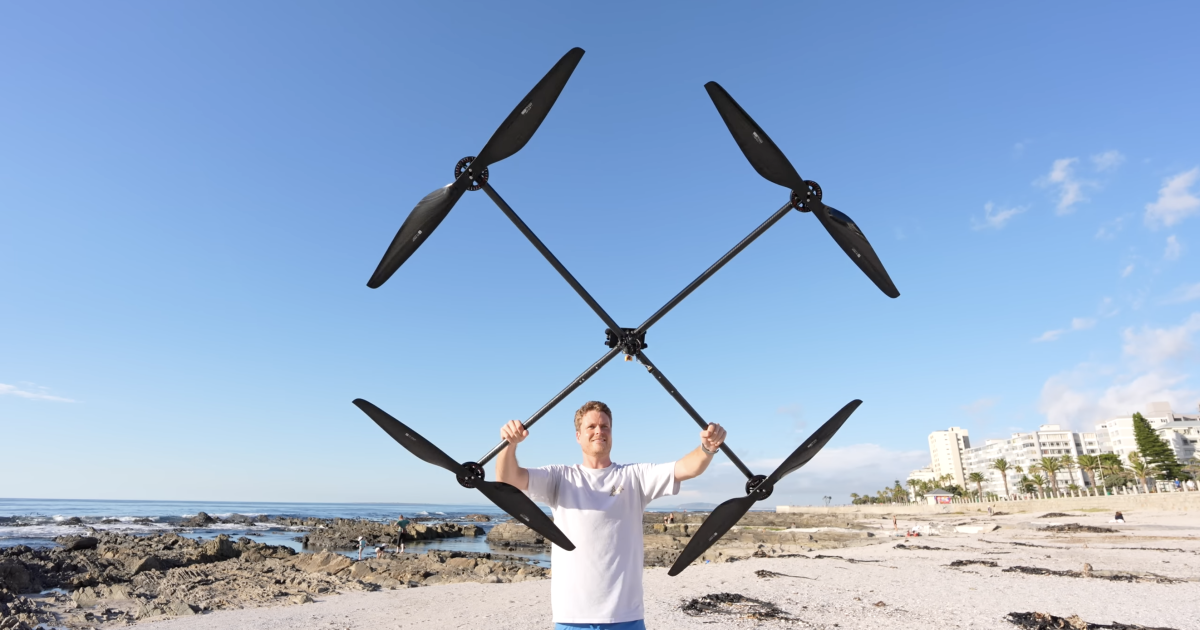
Most drone engineers pick a lane. You build for speed, or you build for range. Luke and Mike Bell, the father-and-son team from South Africa already famous for pushing electric quadcopters to velocities that seemed positively absurd, appear to be building for both.
A couple of weeks ago, Luke Bell quietly set an unofficial world record for multirotor hover endurance: 3 hours, 31 minutes, 6 seconds of continuous stationary flight, beating the previous mark of 3 hours and 12 minutes held by SiFly’s Q12 model. What made the result even more striking was the margin of comfort. “At 2 hours and 14 minutes, I still had 33% battery left,” Luke Bell noted in the video documenting the flight. He hadn’t expected to fly that long – which is precisely why the record is still unofficial. “I hadn’t flown it for anything close to that duration before,” he explained, “so I didn’t want to make people wait four hours for something that might not happen.”
Creating the World’s Most Efficient Drone
The engineering logic behind the drone is a single principle pushed to every last component: minimize energy consumption everywhere, without exception.
It starts with the propellers. Luke Bell chose T-Motor’s G40 carbon-fiber blades, 40 inches (101 cm) in diameter. A bigger propeller generates the same amount of lift at far lower RPM, which means far less energy used per second. “The bigger the prop, the more efficient it is, because it can generate a lot of thrust spinning at very low revolutions,” he explained. The motor – a T-Motor MN105 V2 Anti-Gravity at 90 KV – was chosen as the smallest and lightest unit still capable of turning those blades at the required speed.
Arm length (800 mm, or about 31.5 in) was determined through five rounds of computational fluid dynamics (CFD) simulation in AirShaper – essentially using software to model how the airflow from each propeller might disturb the others, and finding the geometry that minimizes that interference. The motor wiring, totaling 11 meters (36 ft), was optimized in a separate analysis. AWG 18 gauge wire turned out to be the sweet spot between electrical resistance and the added weight the drone would have to carry. The central hub was redesigned twice to shed 40 g (1.4 oz) and every small saving was multiplied across four motors.
Luke Bell/YouTube
The decisive component, though, was the battery. Luke Bell used Tattu semi-solid NMC cells with an energy density of approximately 320 Wh/kg, roughly double that of a conventional LiPo battery (around 160 Wh/kg). A semi-solid battery sits between traditional liquid-electrolyte LiPo chemistry and true solid-state cells. The electrolyte is a gel, which improves energy density without the chemical instability risks of fully solid designs. The trade-off – lower peak discharge current – is irrelevant when motors are spinning slowly and drawing minimal power. The creator even stripped part of the original protective packaging from each pack: 180 g (6.3 oz) per battery, 360 g (12.7 oz) total, roughly equal to the weight of the entire carbon-fiber chassis.
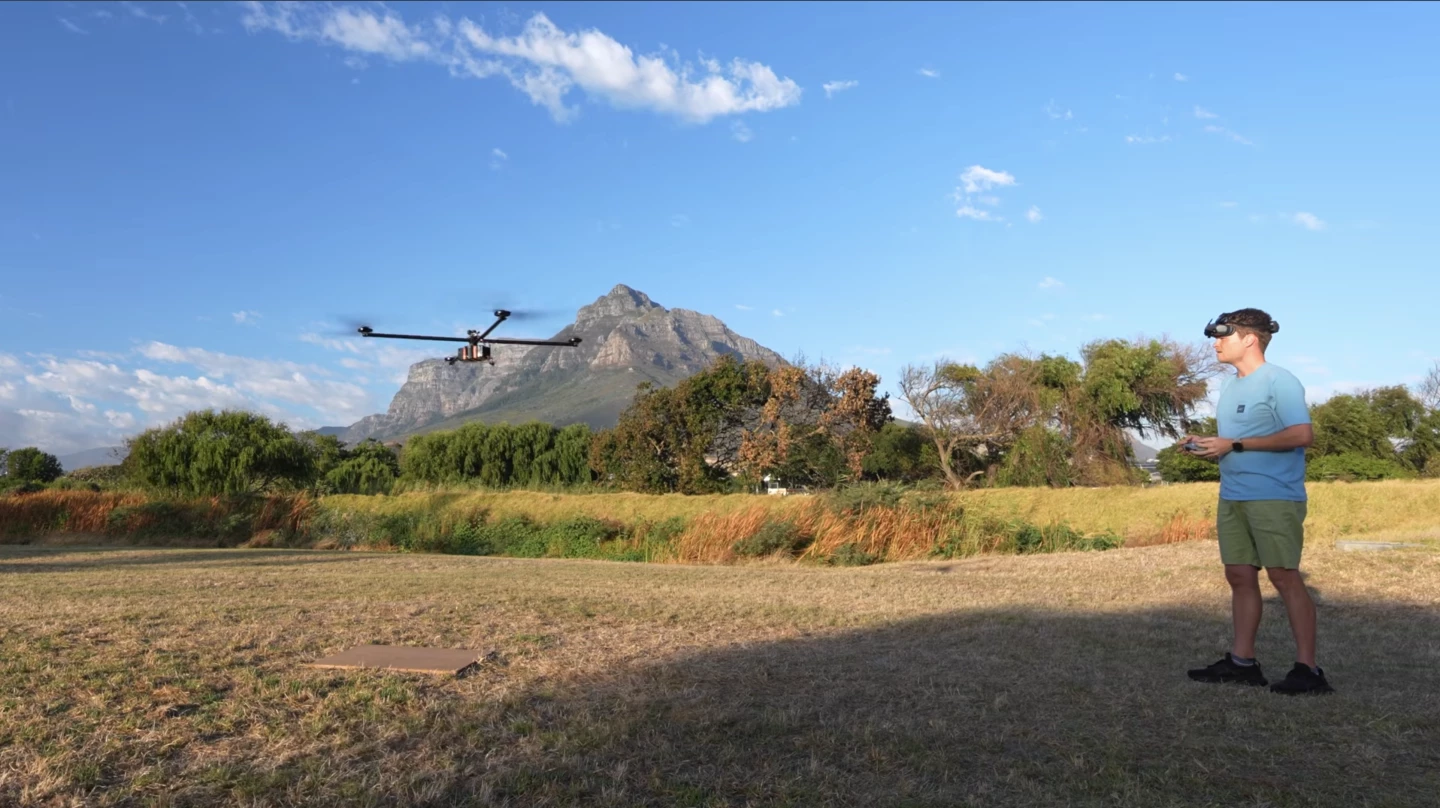
In-hover power consumption averaged around 400 watts. Slow forward flight dropped that to approximately 250 watts – a 37.5% reduction that points directly at the next challenge.
Despite these advances, Mike Bell is unsentimental about the ceiling. “Aviation kerosene carries about 50 times more energy than the best batteries available today,” he tells me via email. “The best commercial aircraft can fly for 20 hours on a tank. The battery equivalent is 24 minutes. It’s enough to make any environmentalist cry. Doubling energy density would extend that flight to 48 minutes. Tripling it gets you to 1 hour 12 minutes, which is still pretty terrible. Long-range electric flight is an impossible dream. My bet is that future zero-carbon commercial aviation will be driven by entirely different innovations.”
Luke Bell/YouTube
On the speed side, the race remains wide open. Australian aerospace engineer Benjamin Biggs recently posted an unofficial 411-mph (661-km/h) run, edging past the Bells’ current Guinness record of 408 mph (656 km/h), set in January 2026. The progression has been steep: 300 mph (483 km/h) in May 2024, 363 mph (584 km/h) in October 2025, 389 mph (626 km/h) in December, and the current record just weeks later. A Peregreen V5 is in development.
“We are focusing on other exciting projects for the moment but will get back to speed again with V5,” Mike Bell says. “Hoping to reach 450 465. There is upside from there but that is for V 6 and 7. Interestingly the main hurdle to more speed right now is the props, but as we improve the prop technology the limits of battery power will be there.”
Source: Luke Bell

